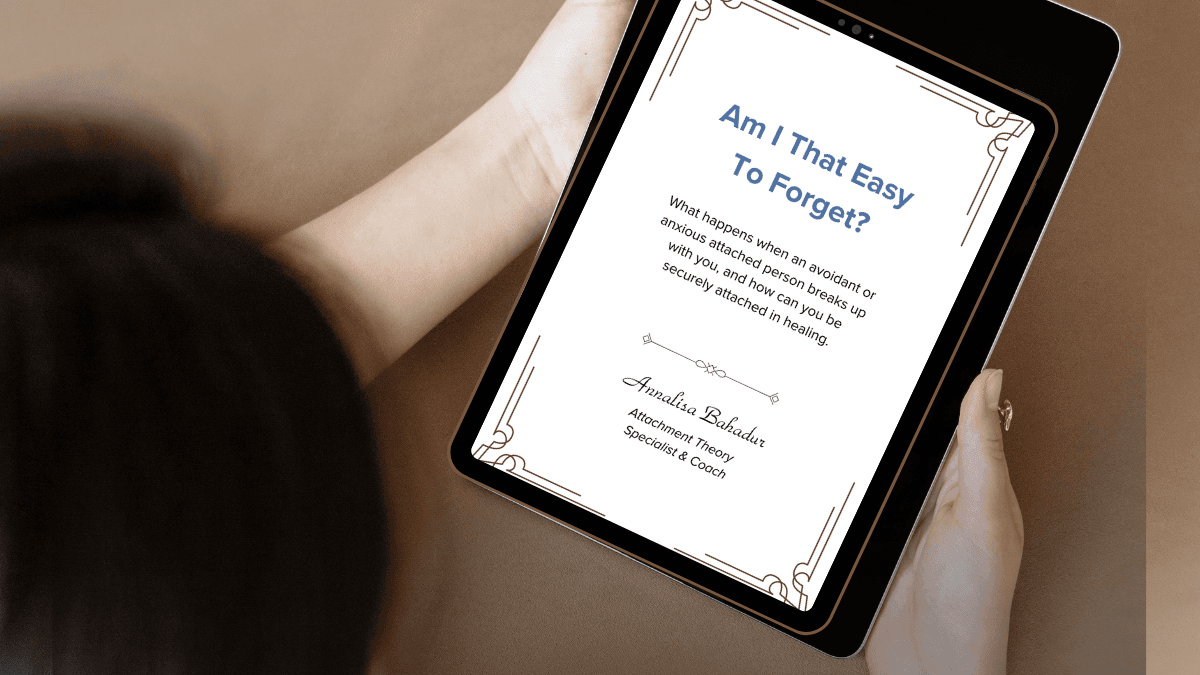
How your Avoidant/ Anxious Manage Breakup
$11.11
They seem completely fine after the breakup and you can’t understand how that’s possible.
You’re checking your phone, replaying conversations and wondering whether they miss you while they appear to be getting on with their life.
Maybe they’re going out, posting on social media, keeping busy or acting like the relationship never happened.
And you start thinking, “Did I really mean that little to them?”
But people don’t all experience breakups the same way, and they definitely don’t all show their pain the same way.
Anxious, avoidant, fearful-avoidant and secure attachment patterns can respond very differently to separation and loss.
So what looks like “they’ve moved on” from the outside doesn’t necessarily tell you everything about what they’re experiencing inside.
HOW WE’RE GOING TO WORK ON IT
We’re going to look at how each attachment style can experience the different stages after a breakup.
You’ll learn why one person may feel devastated immediately while another initially feels relief.
We’ll explore why someone can miss you and still not contact you.
You’ll understand why some people distract themselves, stay incredibly busy, date quickly or appear unaffected after a relationship ends.
We’ll look at why an ex may suddenly reach out weeks or months later after seeming completely done.
You’ll learn what may be happening when they watch your stories, like a post, send a random message or find another small reason to reconnect.
We’ll also talk about what those behaviors don’t necessarily mean, so you don’t turn every tiny interaction into proof that they want the relationship back.
You’ll understand how your own attachment style may be influencing the way you’re experiencing the breakup too.
We’ll look at when reaching out may make sense and when continuing to pursue someone could create more distance.
If communication starts again, you’ll learn how to approach it without immediately trying to force a reconciliation.
We’ll explore what would actually need to change for rebuilding the relationship to make sense.
And we’ll separate missing each other from being capable of creating a healthier relationship together.
THE PAYOFF
You’ll have a better understanding of what may be happening instead of filling every silence with the worst possible explanation.
You’ll stop using how okay they look as the measurement of how much the relationship meant.
You’ll be better equipped to decide when to communicate, when to give space and when to stop searching for signs.
If there is an opportunity to rebuild, you’ll understand how to approach it differently.
And if rebuilding isn’t in the cards, you’ll have tools to help you begin moving forward without needing their behavior to give you closure.
Someone can miss you, love you and struggle after losing you and that still doesn’t automatically mean they’re ready or able to rebuild the relationship.
If you’re trying to understand what happens after a breakup and whether there’s a healthy path back to each other this will help you understand what attachment may be telling you about them, you and what happens next.