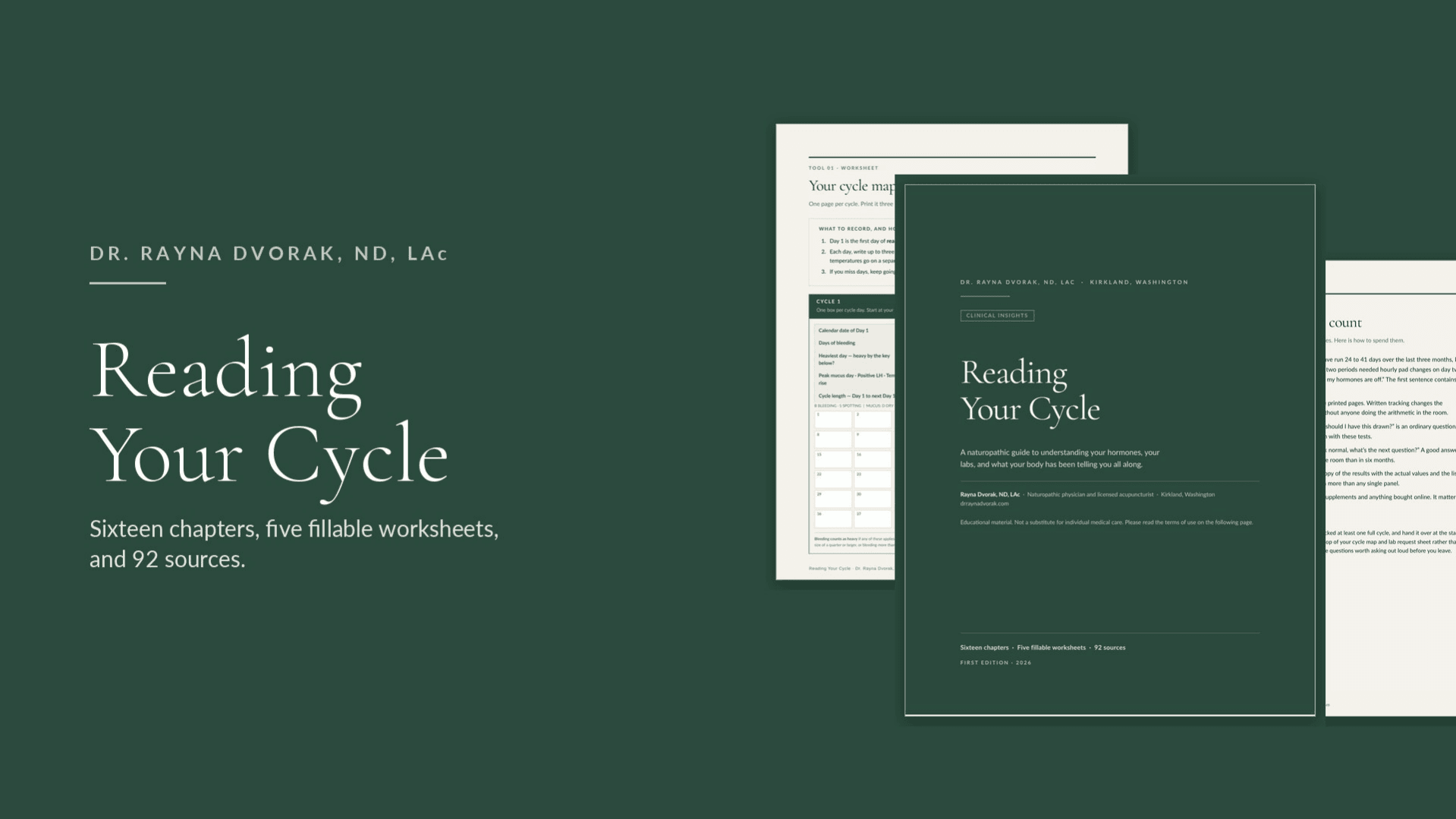
Reading Your Cycle
$59
Your cycle produces information every month. This is how to read it.
Most women arrive at an appointment with a folder of results and a set of symptoms that are real and patterned, and nobody has connected the two. They know the words — progesterone, AMH, ferritin, insulin resistance. What they have not been given is the shape of the thing: how the pieces relate to one another, and to them.
Reading Your Cycle is that explanation, written out. Sixty-four pages, sixteen chapters and five fillable worksheets, built around one idea: when a cycle changes, the useful question is rarely what are my hormones doing. It is what is my body responding to.
This guide will help you
Identify which of the five things clinicians actually measure has changed in your own cycle — and what each one points to
Read cervical mucus and basal temperature well enough to know whether, and roughly when, you are ovulating
Understand what each hormone test measures, what it can and cannot tell you alone, and the cycle day it has to be drawn on to mean anything
See how your thyroid, iron stores, insulin and available energy each reach the ovary, so a change in your cycle stops looking random
Recognize the small number of symptoms that deserve prompt medical assessment rather than tracking
Walk into an appointment with written records, a correctly timed list of tests to discuss, and three specific questions to askWhat is included
What is included
Sixty-four pages, in four parts.
Part One — How your cycle works. The four-hormone sequence in plain language. How much room there actually is inside “normal.” Your fertile window, and the signs you can read in real time, in the cycle you are in right now.
Part Two — Your labs, and what each one can tell you. Progesterone, and why timing decides the answer. FSH, estradiol and AMH. Androgens, SHBG and insulin. Prolactin and a full thyroid panel. Ferritin, and reading an iron reserve before it becomes anemia.
Part Three — Patterns worth recognizing. PMOS, the condition still widely called PCOS. When ovulation is not happening reliably. Bleeding that is heavier than it should be. Perimenopause, and how it actually begins.
Part Four — The foundations, and taking it into the room. Eating for hormonal health. Nutrients and botanicals, with the evidence stated plainly. Movement, rest, and the load you are carrying. What deserves attention promptly. And how to spend the ten to twenty minutes you get with a clinician.
Five worksheets, and every field is fillable — type into them on a laptop, tablet or phone, or print them and use a pen.
Tool 01 · Your cycle map — one page per cycle, designed so that three of them make a pattern visible
Tool 02 · Your cycle notes — what else was happening that month: illness, travel, disrupted sleep, a new medication or supplement, a change in training or in what you were eating. It is usually what explains the odd cycle
Tool 03 · Your symptom pattern — records when a symptom happens rather than how severe it feels, because timing is the more informative of the two
Tool 04 · Your lab request sheet — each test, the cycle day it should be drawn on, and one line on why you are asking
Tool 05 · Your one-page summary — built to be read by a clinician in ninety seconds and handed over at the start of the appointment
Ninety-two referenced sources. Every substantive claim traces to a named study or clinical guideline, listed at the back. The research supports the guide from underneath; what you read is the translation.Who it is written for
Who it is written for
Women who have been told their labs are normal and still do not feel like themselves. Women tracking a cycle to conceive, or to avoid conceiving, who would rather understand the physiology than trust an app’s prediction. Women whose periods have changed and who want to describe that change precisely enough to be taken seriously.
It assumes no medical background, and it does not talk down. It is written for adults, for their own use.
What you will walk away understanding
What your cycle is doing, in physiology you can actually hold. Which measurement has changed for you, and what that specifically raises. Which tests are worth asking for, and when they have to be drawn. And how to sit in an appointment, ask a precise question, and follow the answer.
Please note
This guide is general health education. It is not medical advice, diagnosis or treatment, and it is not individualized to your circumstances — it cannot account for your history, your examination findings, your medications or your other conditions. Purchasing, downloading or reading it does not establish a clinician–patient relationship with Dr. Dvorak, who is licensed as a naturopathic physician and acupuncturist in Washington State and works with people outside Washington as a health coach. No specific outcome is promised or guaranteed. Please consult a qualified healthcare professional who knows your case before making any change to your care, and before starting or stopping any supplement, botanical or medication. If you are pregnant, breastfeeding or actively trying to conceive, speak with the clinician managing your care first. Statements about dietary supplements have not been evaluated by the US Food and Drug Administration; nothing here is intended to diagnose, treat, cure or prevent any disease. If you believe you may have a medical emergency, contact your local emergency services immediately.
Delivery and refunds
A digital PDF, delivered by email immediately after purchase and downloadable on any device. There is nothing to ship and no login to create. Because the file is delivered instantly and in full, all sales are final and no refunds are offered — please read the description above before purchasing. If your download does not arrive or will not open, email hello@drraynadvorak.com and it will be resent.
The guide is licensed for your own personal, non-commercial use. Please do not share, copy, resell or redistribute it.