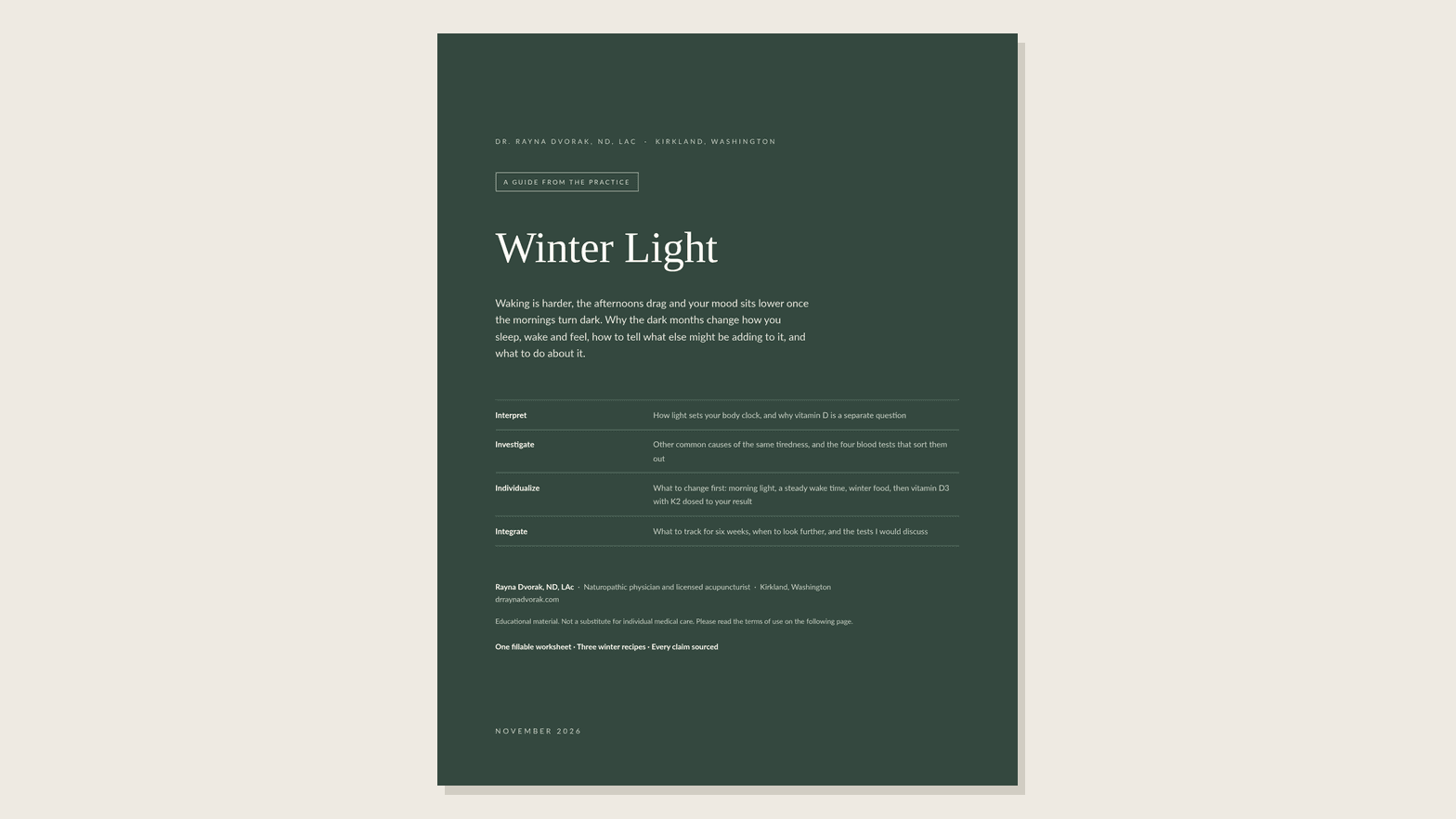
Winter Light
$29
Waking is harder, the afternoons drag and your mood sits lower once the mornings turn dark.
I wrote this for the woman who finds that the dark months change her, and who has been told that is just winter. Waking gets harder, even when she has slept enough. By mid-afternoon she wants bread or something sweet, and by eight in the evening she wants the couch. Her mood sits a little lower than it did in September — nothing she would call a problem, just less of her. What she has rarely been asked is whether these things share a cause, and whether anything else is sitting underneath them.
Most of the time two separate things are going on. Less light reaches your eyes in the morning, and morning light is what keeps your body clock on time. Less ultraviolet light reaches your skin, and your skin needs it to make vitamin D. Winter Light explains both in plain language, how to tell whether anything else is adding to them, and where to start.
This guide will help you
Understand how light sets your body clock, and why vitamin D is a separate question
Rule out the other common causes of the same tiredness, such as low iron, the thyroid, sleep apnea and perimenopause
Know which four blood tests sort them out, and how to read a vitamin D result against its month, its laboratory and its cut point
Make a clear plan: morning light and a steady wake time first, then food for the dark months, then vitamin D3 with K2 dosed to your result
Track what changes over six weeks, and know when to look further
What is included
Thirty-one pages, in five chapters.
One — What the dark months do to you. How light sets your body clock, why going to bed earlier often fails, why appetite, energy and mood move with it, and why vitamin D runs on a different track.
Two — Before you call it winter. Low iron, the thyroid, sleep apnea, perimenopause and the other common causes of the same picture, and how to tell them apart.
Three — Testing you. The question I ask first, the four blood tests, and how to read your vitamin D result.
Four — What to change first. Morning light and a steady wake time, then add, stop doing, what to eat through the dark months with three winter recipes, the optional clinical support I use, the two light boxes I recommend, and a cautions page for everything named.
Five — What to observe, and when to look further. A six-week tracking table, the tests worth discussing with your clinician, and the red flags that need a physician.
The winter light and mood log: fourteen mornings, then your pattern and your results, fillable on screen or printed.
Twenty-five referenced sources. Every substantive claim traces to a named study or guideline, listed at the back.
Who it is written for
Anyone who finds that waking, energy, appetite or mood change once the clocks fall back, or who has a vitamin D result nobody explained. It assumes no medical background, and it does not talk down. It is written for adults, for their own use. Wherever you live, you are welcome to bring this guide to your own clinician. That is what it was written for.
Please note
A low winter and a depressive illness are not the same thing. If your mood is severe, getting worse quickly, or includes thoughts of harming yourself, please seek care now, before reading further. In the United States you can call or text 988 at any hour.
This guide is general health education. It is not medical advice, diagnosis or treatment, and it is not individualized to your circumstances. It cannot account for your history, your examination findings, your medications or your other conditions. Purchasing, downloading or reading it does not establish a clinician–patient relationship with Dr. Dvorak, who is licensed as a naturopathic physician and acupuncturist in Washington State and works with people outside Washington as a health coach. No specific outcome is promised or guaranteed. Please consult a qualified healthcare professional who knows your case before making any change to your care, and before starting or stopping any supplement, botanical or medication. If you are pregnant, breastfeeding or actively trying to conceive, or if you are immunocompromised, speak with the clinician managing your care first. Statements about dietary supplements have not been evaluated by the US Food and Drug Administration; nothing here is intended to diagnose, treat, cure or prevent any disease. If you believe you may have a medical emergency, contact your local emergency services immediately.
Delivery and refunds
A digital PDF, delivered by email immediately after purchase and downloadable on any device. There is nothing to ship and no login to create. Because the file is delivered instantly and in full, all sales are final and no refunds are offered. Please read the description above before purchasing. If your download does not arrive or will not open, email hello@drraynadvorak.com and it will be resent.
The guide is licensed for your own personal, non-commercial use. Please do not share, copy, resell or redistribute it.