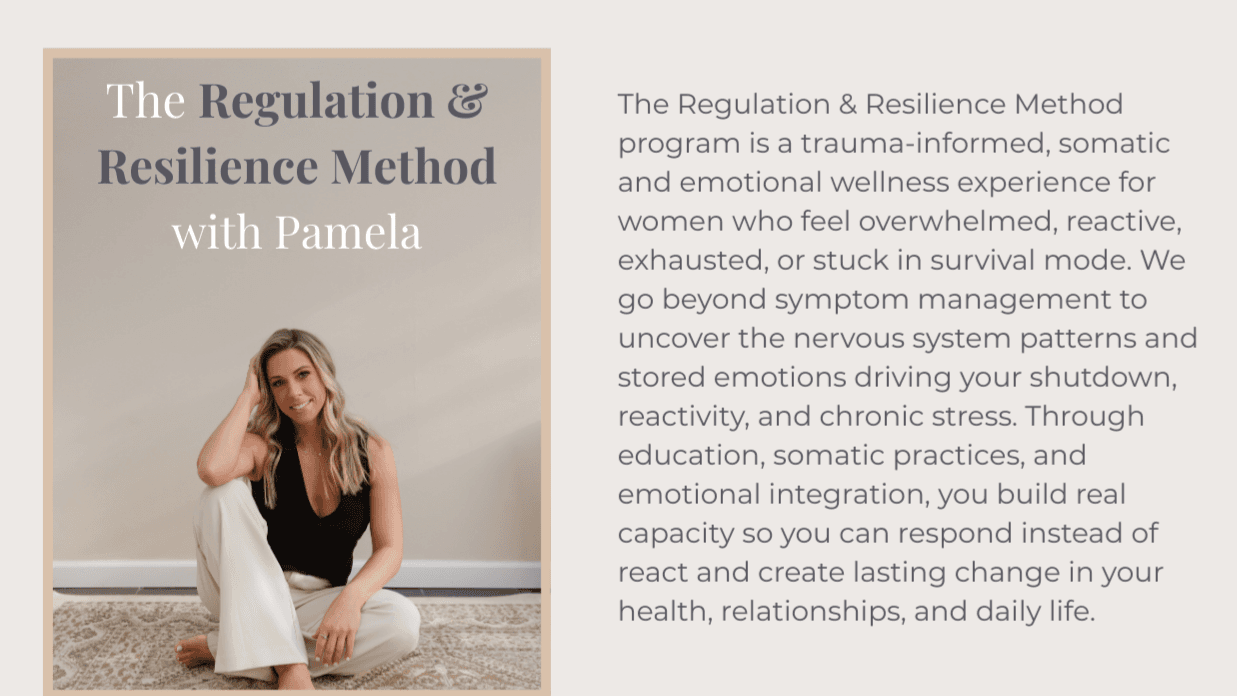
Regulation & Resilience Group Coaching for Parents
$547
The Regulation & Resilience Method for Parents
8-Week Live Group Coaching Experience | Starts August 2026
Build a steadier nervous system, respond instead of react, and feel more like yourself again.
Parenting can bring more love than you ever imagined and more stress than you were prepared to carry.
Maybe you love your children deeply, but lately you feel like you're running on empty.
You wake up already thinking about everything that needs to be done. You're managing appointments, schedules, behaviors, emotions, work, the house, relationships, and everyone else's needs. Your child may need more support than other children. You may be navigating parenting alone, co-parenting, divorce, health challenges, developmental or behavioral concerns, or simply a season of life that feels like too much for too long.
You may notice yourself:
Snapping or yelling more quickly than you want to
Feeling overstimulated by noise, mess, questions, or constant demands
Shutting down when everything becomes too much
Feeling anxious or on edge even when nothing is technically wrong
Overthinking every parenting decision
Struggling to slow down or rest
People-pleasing and putting everyone else's needs before your own
Feeling guilty after you react
Experiencing physical tension, exhaustion, anxiety, or other stress-related symptoms
Wondering why you know how you want to respond but can't seem to do it in the moment
You are not a bad parent. And you are not failing.
Your body may simply be carrying more stress than it has the capacity to manage right now.
The Regulation & Resilience Method for Parents is designed to help you understand what's happening beneath your stress and reactions and give you practical tools to begin changing it.
This Is Not Another Parenting Class
I'm not going to give you another list of strategies for managing your child's behavior.
This program focuses on you.
Because when you're overwhelmed, overstimulated, exhausted, or activated, it becomes much harder to access the patience, clarity, and connection you want to bring to your family.
Over eight weeks, you'll learn how stress affects your brain and body, how to recognize when you're becoming overwhelmed before you reach your breaking point, and what to actually do in those moments.
You'll learn how to:
Calm your body when stress is building
Recognize your triggers before they become automatic reactions
Understand the emotions underneath anger, anxiety, shutdown, or overwhelm
Recover more quickly after difficult moments
Repair with yourself and your children when you don't respond the way you wanted
Set boundaries and stop carrying everything alone
Understand old patterns that may be affecting how you parent today
Build greater capacity for the realities of your life
The goal is not to become a perfectly calm parent.
The goal is to become a parent who knows how to come back to yourself when life gets hard.
Why Do I Keep Reacting This Way?
Many parents come into this work thinking:
“I just need to be more patient.”
“I need to stop yelling.”
“I should be able to handle this better.”
“Why do I get so overwhelmed by things that shouldn't bother me this much?”
But when your body has been under stress for a long time, your reactions can begin happening before you've even had time to think.
Your child's meltdown may trigger your own stress response.
A difficult text from your co-parent may send you spiraling.
Noise and constant demands may suddenly feel unbearable.
A behavioral challenge may leave you feeling angry, helpless, or completely shut down.
A physical symptom may immediately send you into fear and anxiety.
This isn't simply a lack of discipline or willpower.
Your brain and body have learned patterns for responding to stress—and those patterns can change.
That's what we're going to work on together.
What You'll Learn Over 8 Weeks
We will move through this work slowly and step by step. Each week builds on the one before it so you're not simply collecting more information, you're learning how to apply these tools to your actual life.
You'll learn how to:
Understand Your Stress Response
Learn what happens in your brain and body when you're stressed, overwhelmed, reactive, anxious, or shut down and begin recognizing your own patterns earlier.
Create Safety and Calm in Your Body
Learn simple tools you can use when your body feels activated, including grounding, breathing, orienting, movement, and other body-based practices.
Understand and Process Your Emotions
Learn why emotions don't simply disappear when we ignore or suppress them and how to begin safely acknowledging and processing what you've been carrying.
Recognize Your Triggers
Understand why certain behaviors, situations, relationships, or experiences affect you so strongly and learn how to interrupt the automatic reaction.
Understand the Patterns You Carry
Explore how past experiences, unmet needs, attachment patterns, and protective behaviors may still be influencing how you respond to stress, relationships, and parenting today.
Respond Instead of React
Learn what to do in real-life moments when you feel yourself becoming overwhelmed, angry, anxious, overstimulated, or shut down.
Repair Without Shame
You will still have hard moments. We all do. You'll learn how to repair with yourself and with the people you love instead of getting stuck in guilt and self-criticism.
Build Resilience for Real Life
The goal isn't to eliminate stress. It's to increase your capacity to move through stress, recover more quickly, and trust yourself to handle the hard moments.
My 7-Step Regulation & Resilience Flow™
Throughout the program, you'll learn a simple framework you can return to whenever life feels overwhelming:
1. NOTICE
Recognize what's happening in your body before automatically reacting.
2. REGULATE
Use simple tools to help your body settle and reconnect with the present moment.
3. LISTEN
Get curious about the emotion, need, trigger, or protective pattern underneath your reaction.
4. RESPOND
Ask yourself what you actually need and choose your next step with greater intention.
5. RELEASE
Give stress and emotion a healthy place to move through journaling, movement, somatic practices, and emotional processing.
6. REPAIR
Reconnect with yourself and others after difficult moments instead of staying stuck in guilt or shame.
7. RETURN
Come back to yourself and move forward.
This is the process you'll practice again and again until it becomes something you know how to use in real life, not just something you learned in a course.
What This Can Look Like in Real Life
Instead of...
Your child has a meltdown, you immediately become overwhelmed, yell, and spend the rest of the day feeling guilty.
You begin to...
Notice the activation building in your body, regulate yourself before responding, and handle the moment with greater intention. And if you do react? You know how to repair without spiraling into shame.
Instead of...
Saying yes to everything, taking care of everyone, and eventually becoming resentful and exhausted.
You begin to...
Recognize your people-pleasing patterns, understand the fear underneath them, and set healthier boundaries without feeling responsible for everyone's emotions.
Instead of...
Feeling anxiety or a physical symptom and immediately panicking, Googling, catastrophizing, or rushing to fix it.
You begin to...
Pause, listen to your body, regulate the fear response, and make thoughtful decisions from a calmer place.
Instead of...
Feeling like one stressful moment ruins your entire day.
You begin to...
Recover more quickly and return to yourself.
That is resilience.
What's Included
Weekly Live Group Coaching Sessions
Each week, we'll meet live for approximately 60–75 minutes.
Our sessions will include:
Easy-to-understand education
Practical tools and exercises
Real-life examples
Group discussion and reflection
Opportunities to ask questions
Support applying the work to your own life
This isn't a course where you watch videos and then try to figure everything out alone.
You will be supported as you learn and practice.
Recordings will also be available if you cannot attend live.
A Step-by-Step 8-Week Framework
Each week builds on the last so you can understand not only what to do, but why you react the way you do.
We'll explore:
Stress and the nervous system
Creating safety in the body
Body awareness and recognizing early signs of overwhelm
Emotions and emotional processing
Triggers and automatic reactions
Attachment, relationships, and unmet needs
Protective patterns and parts work
Somatic practices and daily integration
Building resilience and self-trust
Weekly Resources, Workbooks & Exercises
You'll receive practical resources to help you take what we discuss in class and apply it to your own life.
These may include:
Reflection questions
Stress and trigger tracking
Emotional awareness tools
Nervous system exercises
Guided journaling practices
Relationship and pattern reflections
Somatic practices
A personal regulation plan
You don't have to do everything perfectly.
The goal is to begin noticing yourself differently and practicing small changes consistently.
Simple Daily Practices
You do not need another complicated routine.
The practices in this program are designed to fit into a busy parent's life.
Many can be used in just a few minutes:
Before your children wake up
In the car
After a difficult interaction
Before bed
In the middle of an overwhelming day
You'll learn tools you can actually use while real life is happening.
A Supportive Community of Parents Who Understand
One of the hardest parts of parenting through challenging seasons is feeling like no one truly understands what you're carrying.
In this group, you don't have to explain why you're tired.
You don't have to pretend everything is fine.
You don't have to be the strong one all the time.
You'll be surrounded by other parents who may also be navigating overwhelm, behavioral challenges, additional needs, single parenting, co-parenting, caregiving, health concerns, or simply the weight of trying to care for everyone without losing themselves.
This is a space to:
Ask questions
Share what you're learning
Celebrate small wins
Receive encouragement
Feel less alone
Learn alongside people who understand
Sometimes healing happens through the tools we practice.
And sometimes it happens when we realize:
“I'm not the only one.”
Who This Program Is For
This program may be especially supportive if you are:
A parent who feels overwhelmed, reactive, or emotionally exhausted
A single parent carrying much of the mental and emotional load
Parenting a child with behavioral, emotional, developmental, medical, or additional needs
Navigating divorce, separation, or co-parenting
Caring for everyone else while struggling to care for yourself
Experiencing chronic stress, anxiety, or burnout
Easily overstimulated by noise, demands, conflict, or chaos
Struggling with guilt after yelling, shutting down, or reacting
Aware that your own childhood or relationship patterns may be affecting you today
Ready to understand yourself more deeply and learn practical tools for change
You do not need any previous experience with nervous system work, somatics, or emotional processing.
I will teach you from the beginning.
The Transformation
By the end of our eight weeks together, my goal is not for you to become a parent who never feels stressed.
My goal is for you to understand yourself in a completely different way.
You begin recognizing stress before you reach your breaking point.
You have tools to use when you're overwhelmed.
You understand your triggers instead of feeling controlled by them.
You become less afraid of your emotions.
You begin responding to your needs instead of constantly ignoring them.
You repair after hard moments instead of drowning in guilt.
You recover more quickly.
You trust yourself more.
And little by little, you begin to feel like yourself again.
Not because parenting suddenly became easy.
But because you are no longer navigating every hard moment from survival mode.
Why This Work Is Different
This isn't just about learning breathing exercises.
And it isn't another parenting program focused only on changing your child's behavior.
We look at the whole picture:
Your body.
Your emotions.
Your triggers.
Your relationships.
Your past experiences.
Your protective patterns.
Your needs.
Your daily life.
Because lasting change doesn't come from simply telling yourself to “calm down” or “try harder.”
It comes from understanding what is happening inside you and learning how to respond differently.
The goal isn't to fix you.
The goal is to help you stop fighting yourself and begin working with your body, your emotions, and your nervous system.
Program Details
Start Date: August 2026
Length: 8 Weeks
Format: Live Group Coaching + Weekly Resources + Practical Tools + Community Support
Recordings: Available if you cannot attend live
You Don't Have to Keep Doing This the Hard Way
If you've been holding everything together on the outside while feeling overwhelmed, exhausted, anxious, reactive, or disconnected from yourself on the inside, this space is for you.
You do not need to become a perfect parent.
You do not need to have all the answers.
And you do not need to wait until life calms down to begin caring for yourself.
You can learn how to meet yourself differently in the middle of the life you're already living.
To pause before reacting.
To listen to your body.
To care for yourself without guilt.
To repair after the hard moments.
To recover more quickly.
To trust yourself again.
This is not about becoming someone new.
It's about learning how to come back to yourself again and again. 🌿