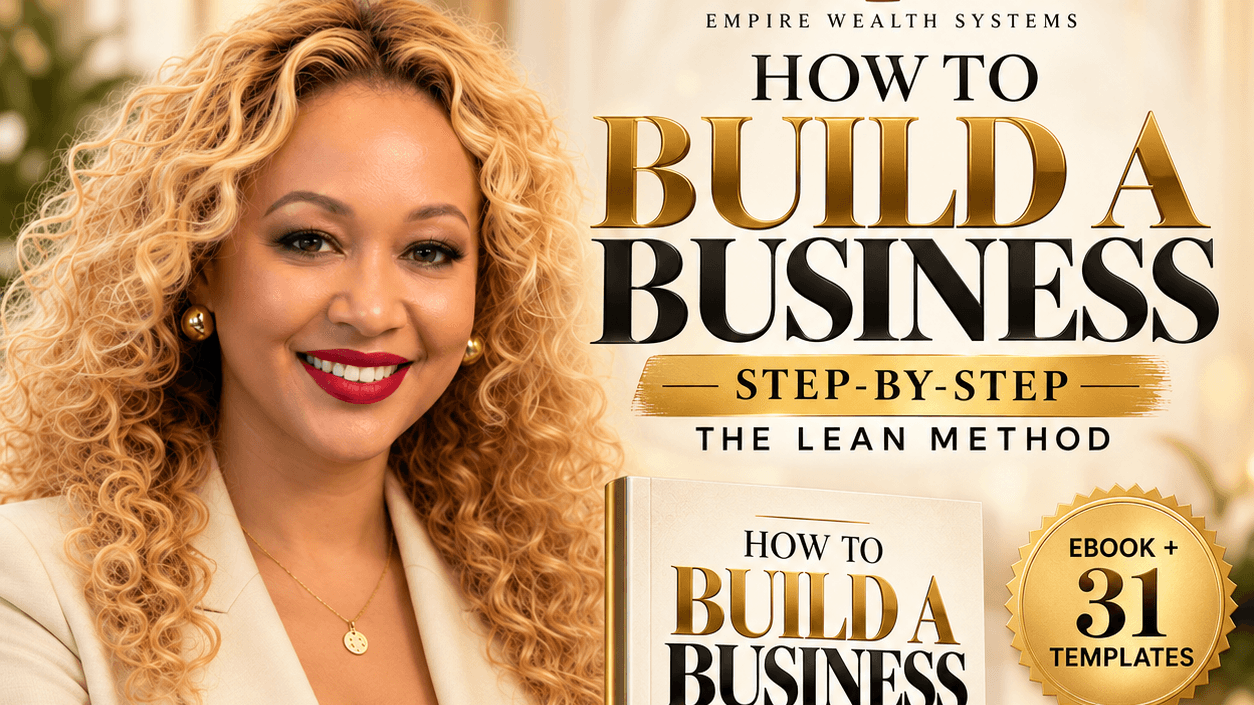
How to Build a Business: Step by Step(Lean Method)
£47
Most people do not fail in business because they are lazy, unintelligent or unwilling to work. They fail because they build in the wrong order.
They spend money before proving demand. They create websites, branding, products, services and systems before knowing whether the right customer actually wants what they are selling. They choose a price without understanding their costs. They chase revenue without knowing whether the business is profitable. They grow before the model is repeatable. They hire too early. They depend on one customer, one channel or themselves for everything. And by the time the problems become obvious, the money, time and energy have already been spent.
How to Build a Business: Step by Step — The Lean Method was created for exactly these problems.
This is not another book that tells you to “believe in yourself”, “just start” or “work harder”. It is a practical business operating system designed to help you make better decisions at every stage of building and growing a business.
If you are struggling to know whether your idea is worth pursuing, this system helps you identify the problem, test whether people genuinely care about it and separate polite interest from real demand.
If you have an idea but no customers, it helps you find the right buyer, understand what they are already trying to solve, build an offer they can understand and ask for commitment before you spend heavily building the full business.
If you have customers but are still not making enough money, it helps you look beneath revenue and understand pricing, contribution, margins, acquisition costs, cash flow and whether each sale is actually making the business stronger.
If you are working constantly but everything still depends on you, it shows you how to build processes, controls, reporting, decision rights and operating systems so the business can become less dependent on the founder.
If you are trying to scale, it helps you answer a much more important question first:
Have you earned the right to scale?
Because more customers do not automatically create a better business.
More sales can increase cash pressure. More staff can increase complexity. More marketing can accelerate losses. A larger business built on weak economics simply creates a larger problem.
The Lean Method helps you test whether the business is repeatable, commercially viable and operationally ready before you commit more money.
And if you are already running a growing business, the system goes far beyond startup advice. It takes you through the areas founders often discover too late: financial controls, cash forecasting, customer retention, sales pipelines, hiring, supplier risk, technology, AI, cybersecurity, management reporting, funding, larger clients, international growth, succession and exit.
The principle behind the entire system is simple:
Commit progressively as the evidence gets stronger.
Do not spend heavily because you are excited about an idea. Do not hire because you feel busy. Do not scale because revenue increased for a few months. Do not invest in automation before you understand the process. Do not enter a new market because the opportunity looks large.
Move forward because the evidence supporting the next decision is becoming stronger.
Across 42 chapters and 11 structured parts, the book takes you from the first idea through validation, launch, management, growth and long-term ownership.
Inside The Lean Method, you will work through:
START Framework — what every new business needs to prove before committing heavily.
Validation Ladder — how to separate attention, interest and compliments from real commercial evidence.
Seven Decision Gates — evidence checks that determine whether you should move forward, go back or stop.
Three Commitment Checkpoints — readiness tests before launch, hiring and significant fixed-cost or market commitments.
Founder Dashboard — the numbers that should influence your decisions.
Unit Economics Check — whether each sale is actually worth repeating.
Scale Readiness Index — whether the business has earned the right to grow.
Pivot Decision Matrix — when to persist, improve, change direction or stop.
These are not frameworks for the sake of frameworks. They are designed to help you understand what has actually been proven, where the business is still exposed and what decision should come next.
What’s Included in the Digital Business Bundle
1. Full Digital Book — How to Build a Business: Step by Step — The Lean Method
The full digital book gives you the complete business operating system, taking you through idea validation, customer research, buyer identification, offer design, pricing, validation, sales, cash flow, financial performance, operations, hiring, technology, AI, risk, management systems, growth, funding, larger clients, international expansion, succession and exit.
The value of the system is not simply that it covers all of these areas. It shows you how they connect. Pricing affects margin. Margin affects cash. Cash affects hiring. Hiring affects delivery. Delivery affects customer experience. Customer experience affects retention. Retention affects growth.
The business becomes stronger when those decisions work together.
2. The Lean Method Digital Toolkit — 31 Fill-In Templates
The book explains the method. The toolkit helps you apply it.
You receive 31 fill-in templates, numbered T1A to T29, covering:
Opportunity assessment
Founder fit
Customer discovery
Buyer fit
Offer design
Validation
First-customer tracking
Unit economics
Founder reporting
Cash flow forecasting
Financial controls
Hiring
Risk
Marketing channels
Sales pipelines
Customer journeys
Retention
Strategy
Management reporting
Decision rights
Decision Gates
Commitment Checkpoints
The purpose of the toolkit is to move you from reading to application. Instead of simply understanding the concept, you work through what it means for your own business.
3. Start Here — The Lean Method Quick-Start Guide
A comprehensive business system is only useful if you know where to begin.
The Quick-Start Guide gives you a clear starting sequence so you can identify what has actually been proven, assess the opportunity, begin customer discovery and move into the 90-day execution process.
It removes the confusion of opening a large business system and wondering what to do first.
4. The Lean Method Founder’s Diagnostic
The Founder’s Diagnostic helps you identify the earliest weak or unproven point in your business.
It uses 20 evidence-based statements covering the journey from problem and customer through pricing, sales, cash, hiring, systems and strategy.
Your first “No” shows you where the weakness starts and directs you to the relevant chapter and tool.
There is no meaningless score. The goal is not to tell you that your business is “70% healthy”. The goal is to show you exactly where you need to start.
5. The Lean Method 90-Day Business Execution Plan
The 90-Day Business Execution Plan turns the method into action.
The first ninety days are divided into six structured phases:
Days 1–15: Problem and market discovery
Days 16–30: Customer research and opportunity assessment
Days 31–45: Offer and pricing development
Days 46–60: Validation and commercial commitment
Days 61–75: Delivery, measurement and proof
Days 76–90: Economics, systemisation and the next decision
Each phase has a clear objective, key actions, evidence requirements and a decision point.
The purpose is not to keep you busy for ninety days. It is to help you determine what has been proven, what is still weak and what should happen next.
This bundle is designed to help you avoid some of the most expensive mistakes in business: building before validating, targeting the wrong customer, confusing interest with demand, underpricing, growing revenue without understanding profit, hiring too early, running out of cash, depending on one customer or one channel, scaling a model that is not repeatable, and continuing to invest simply because you have already spent too much to stop.
It is also designed to help you build something stronger: a business where you understand the problem you solve, know who the buyer is, have evidence that customers will commit, understand what each sale contributes, monitor cash before it becomes a crisis, build systems that reduce founder dependency and make major decisions with greater control.
So this is not a book you simply read and put on a shelf.
You use it to interrogate your idea. You use it to test demand. You use it to challenge your pricing. You use it to understand your numbers. You use it to decide whether to launch. You use it to decide whether to hire. You use it to decide whether to grow.
And sometimes, you use it to recognise that the smartest decision is to stop spending on something the market has not proved.
If you have ever asked, “Is this actually a good business idea?”, “Why am I struggling to get customers?”, “Am I charging the right price?”, “Why do I have revenue but still have cash problems?”, “Should I hire now?”, “Why does everything still depend on me?”, “Is this business really ready to scale?” or “What should I fix before I invest more money?”, this system was built to help you answer those questions with evidence rather than guesswork.
Build on evidence. Grow with control.
Start with the problem. Prove the demand. Understand the numbers. Build the systems. Then earn the right to grow.
Get the Lean Method Digital Business Bundle and stop building your business on assumptions.