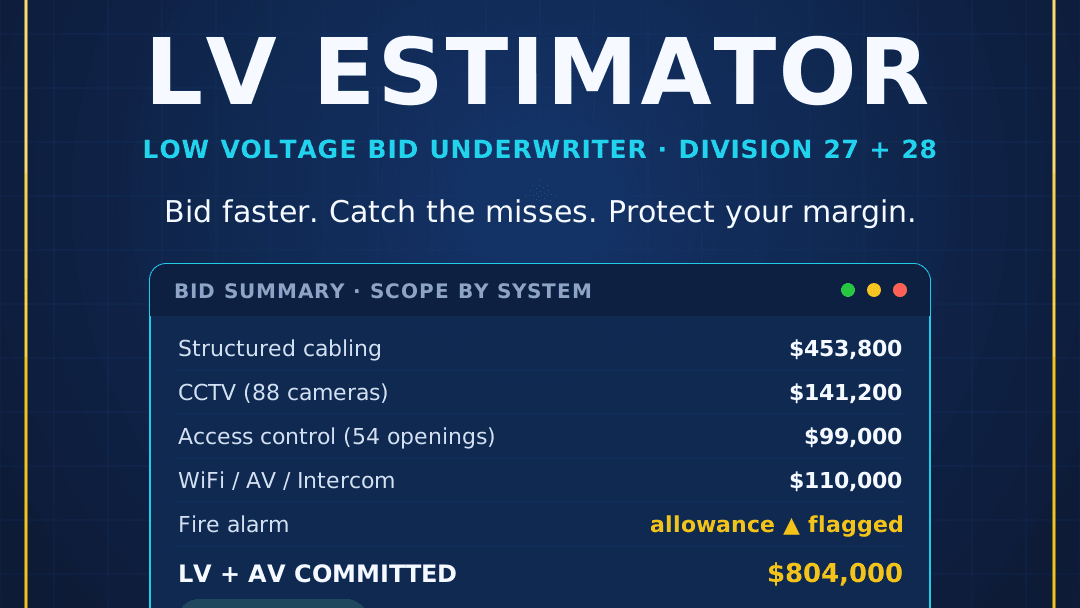
Low Voltage Estimator
$3,970
Bid low voltage faster, and stop leaving money on the table.
An AI bid underwriter that turns your device and drop counts into a production-based, defensible bid, and catches the scope gaps and copy-paste errors that quietly kill your margin. Runs inside Claude. You upload the plans or the takeoff, it does the rest.
What It Does
Give it a device or drop takeoff plus the job context, and it builds the bid the way a seasoned estimator would, then audits itself before you ever see a number:
Converts drop and device counts into cable footage, by system
Calculates labor hours by system and ceiling type (open T-bar, hard lid, plenum)
Builds the equipment and head-end list (racks, panels, switches, NVR, UPS, patch panels)
Applies the furnish and install split so you never price labor you do not own
Adds the line items estimators forget: programming, test and certify, firestop, labeling, as-builts, permits
Applies your overhead and profit and returns a bid range with the drivers behind it
Flags scope gaps, vendor-governed counts, and AHJ-governed systems
Ends with a clear verdict: bid, revise, or no-bid
Covered systems: structured cabling, data, telecom (Div 27), plus access control, CCTV, intrusion, fire alarm, ERRCS, AV, WiFi, and two-way emergency communication (Div 28).
Why Pros Use It.
Low voltage is one of the easiest trades to bid wrong, and the mistakes do not show up until the job is losing money.
The furnish and install trap. Pricing a device the tenant's vendor actually owns, or cabling that belongs in another scope, is the single biggest source of over and under-bidding. The tool splits it every time.
Copy-paste scars. "Provide and install thirty (5) cameras." Reused proposals carry numeral-versus-word errors everywhere. The built-in audit catches them in seconds.
Fire alarm and ERRCS. These are design and AHJ-governed. Bid them as a firm number and you own a problem. The tool holds them as flagged allowances, not false precision.
Cable footage. The highest-variance input on a cabling-heavy job, and the one most often guessed. Here it is a priced line with the formula shown.
Scope gaps. A system that is expected, uncounted, and undeferred is a missed-scope landmine. It gets flagged before you send.
You get a bid you can defend line by line, in a fraction of the time, with the misses caught before they reach the customer.
How It Works
Open it inside Claude.
Upload your LV or electrical plans, or paste a device and drop count.
Answer a few job questions (region, prevailing wage, ceiling type, your rate card if you have one).
It produces a scope-by-system bid with clarifications, a bid range, and a verdict.
You review, adjust, and send.
It drafts and audits. You ratify. That is the whole point: speed without flying blind.
Who It Is For
Low voltage and structured cabling contractors
Security and access control integrators
Fire alarm and life-safety contractors
AV integrators
Estimators who want a second set of eyes before a bid goes out
Owners who want their bids to stop depending on one person's memory
Best fit for shops bidding commercial, multifamily, and mid-rise work.
What You Get
The full LV Estimator, delivered as a skill that runs inside Claude
Scope-by-system bid output in the format estimators already use
A built-in audit layer that challenges every number before you see it
Calibration to your own rate card, unit prices, and labor productivity
Setup guidance so your first real bid is dialed in
FAQ
Do I need my own numbers?
It works out of the box with public cost bands as a sanity check, but it is far more accurate once you load your rate card, per-drop and per-device prices, labor productivity, and overhead. Setup walks you through it.
Does it read plans, or do I count first?
Both. You can hand it a device or drop count, or upload the plans and let it build the takeoff for you to verify.
Does it replace my estimator?
No. It drafts the bid and catches the misses so your estimator moves faster and sends cleaner numbers. A human still ratifies before it goes out.
What about fire alarm?
It never prices fire alarm as a firm number. It carries it as a flagged allowance pending stamped plans and AHJ approval, the way it should be bid.
Do I need special software?
No. It runs inside Claude. If you can upload a PDF and answer a few questions, you can run it.
Is the bid final?
It is a defensible draft with a bid range and the assumptions shown. You review and set your final number. It informs the decision, it does not make it for you.
Ready to bid cleaner and faster?
Get LV Estimator and run your next takeoff today.