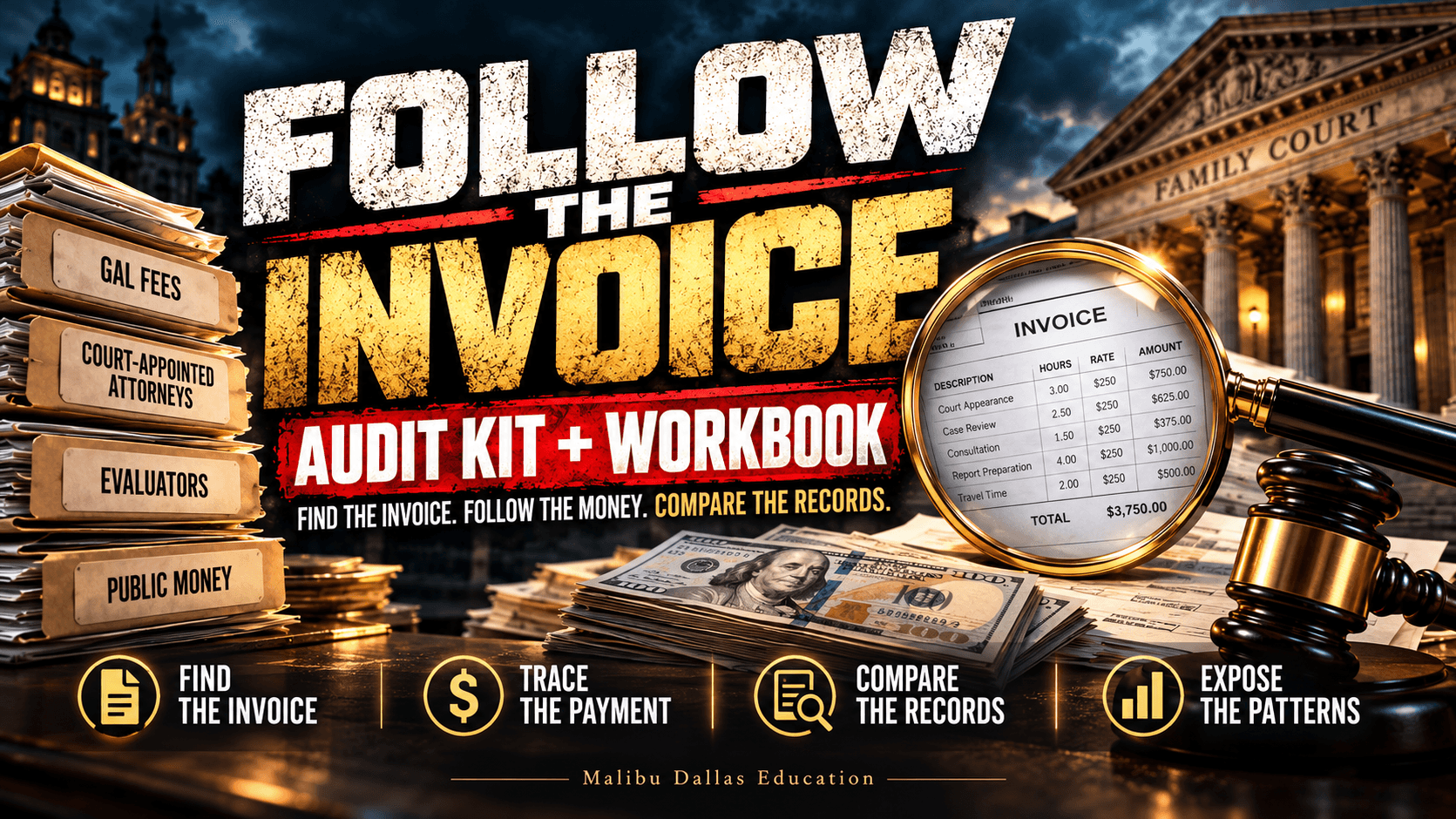
AUDIT KIT & WORKBOOK
$27$200
What if the paper trail tells a different story?
Parents involved in CPS and family-court cases are often required to explain almost every part of their lives.
Their homes are examined. Their finances are examined. Their relationships are examined. Their medical history is examined. Their parenting is examined. Their choices, conversations, appointments, and entire family structure can be reduced to reports, evaluations, court orders, case notes, and professional opinions.
But there is one part of the system that almost nobody teaches parents how to examine: the money.
Who got appointed? Who got paid? What did they bill for? How much did they claim? What work did they say they performed? Who approved the payment? Who actually issued the money? And most importantly, does the paperwork match what really happened?
That is why Follow the Invoice was created.
This is not another generic “Know Your Rights” PDF. It is a nationwide educational audit system designed to help parents, advocates, journalists, and accountability researchers learn how to trace appointments, invoices, vouchers, payments, public spending, and supporting records in an organized, evidence-based way.
One of the biggest questions parents ask is simple: “How do I actually find the invoice?”
This kit answers that directly.
You do not need to already know where the invoice is. You do not need to know what office has it. You do not even need to know what the document is called in your state. The kit teaches you how to figure that out.
In many cases, the court itself may not be the office that actually pays the professional. A judge may approve compensation while a county finance office processes the payment. A state program may administer the voucher. A public defender or appointed-counsel system may issue the payment. A contractor may submit a service claim to an entirely different government office.
That means the document you are looking for may not even be called an “invoice.”
It may be called a voucher, fee claim, compensation request, fee application, billing statement, payment authorization, attorney claim, GAL claim, remittance record, disbursement request, service invoice, claim form, or fee petition.
The name changes. The money trail does not.
Inside the Follow the Invoice Audit Kit, you will learn how to identify the professional you are researching, determine who appointed or retained them, identify who approves compensation, trace who actually pays them, locate the likely records custodian, search for the records online, and follow the payment trail when the first office tells you, “We don’t have it.”
That is one of the most important principles in the entire program: follow the payer.
If a court approved a payment but did not actually issue the money, then another office did. That office may maintain payment records, voucher numbers, vendor records, remittance information, fee approvals, or other documents that help reconstruct the financial paper trail.
The Audit Kit also teaches you how to research court-appointed professionals and service providers such as guardians ad litem, court-appointed attorneys, evaluators, psychologists, drug-testing providers, supervised-visitation companies, residential providers, experts, contractors, and other court-connected professionals.
You will learn how to compare invoices to dockets, compare billed time to hearing records, compare reports to billing entries, compare service dates to payment records, compare contracts to billed rates, and examine public spending records to see how money is actually moving through the system.
The goal is not to make accusations. The goal is to learn how to document.
That distinction matters.
Saying “my GAL did nothing” is an allegation. Asking what the GAL billed for, what the invoice says, what the docket shows, what reports were filed, and what payment records exist is an investigation.
Saying “my attorney was paid for work they did not do” is an allegation. Comparing the voucher, payment record, court appearances, filings, and other available records creates a documented question.
Saying “the same people are always being appointed” is an allegation. Tracking appointment frequency, payment concentration, referral patterns, and public expenditures creates measurable data.
The Follow the Invoice system is designed to help you move from emotion to evidence.
That does not mean your frustration is invalid. It means the strongest way to investigate a serious problem is to organize the records so that the documents themselves begin answering the questions.
The companion workbook is where that research becomes an actual audit.
Instead of hundreds of screenshots, loose papers, downloads, and notes scattered across different folders, the workbook gives you a structured system for organizing what you find.
You can track invoice searches, payment records, appointment orders, record requests, court events, billed hours, claimed services, professional fees, supporting documents, possible explanations, discrepancies, appointment patterns, public spending, federal funding, and the strength of the evidence behind each finding.
The workbook also includes dedicated Invoice Hunt tools so you can document where you searched, who you contacted, what the record was called, which office held it, what response you received, and where the payment trail led next.
This system is designed to help you stop saying, “I know something is wrong,” and start asking, “What do the records actually show?”
That shift is powerful.
$200 Value! Get the complete Follow the Invoice Audit Kit + Workbook for only $27.
Frustration can be dismissed. Suspicion can be ignored. Emotion can be minimized. But a documented file containing appointment records, vouchers, payment records, dockets, reports, contracts, dates, public spending data, and independent supporting documents creates a completely different conversation.
If the records support the billing, the records should show that.
If there is a legitimate explanation, that matters.
If the records do not match, that creates a question.
If the same professional receives repeated appointments, that alone does not prove misconduct.
If a payment appears unusual, that alone does not prove fraud.
Follow the Invoice teaches you how to investigate without jumping ahead of the evidence.
A real investigation does not begin with “they’re corrupt.”
It begins with:
Where is the invoice?
Who paid it?
What does the voucher say?
What does the docket show?
What does the transcript show?
What does the contract require?
What does the service record show?
What explanation exists?
Then you let the records begin answering those questions.
This bundle is for parents who are tired of wondering where the money goes, advocates who want a structured research system, journalists looking for financial patterns, and anyone who wants to understand how court-appointed professionals and service providers are compensated.
It is for people who want evidence instead of rumors, organization instead of chaos, and documentation instead of guesswork.
ONLY $27. GET IT NOW
Important educational notice: Follow the Invoice is an educational research system. It does not provide legal advice, determine whether fraud or misconduct occurred, recommend legal filings, or provide individualized litigation strategy. Records access, court procedures, compensation systems, confidentiality rules, public-record laws, and available remedies vary by jurisdiction.
This product teaches research, organization, records acquisition, documentation, comparison, and evidence-based questioning.
Because if you want to expose a real problem, suspicion is not enough.
You need the paper trail.
Legal Disclaimer: Malibu Dallas and the seller of this kit are not attorneys and do not claim to provide legal advice or legal representation. This material is provided for educational and informational purposes only and is not a substitute for advice from a licensed attorney.
no refunds