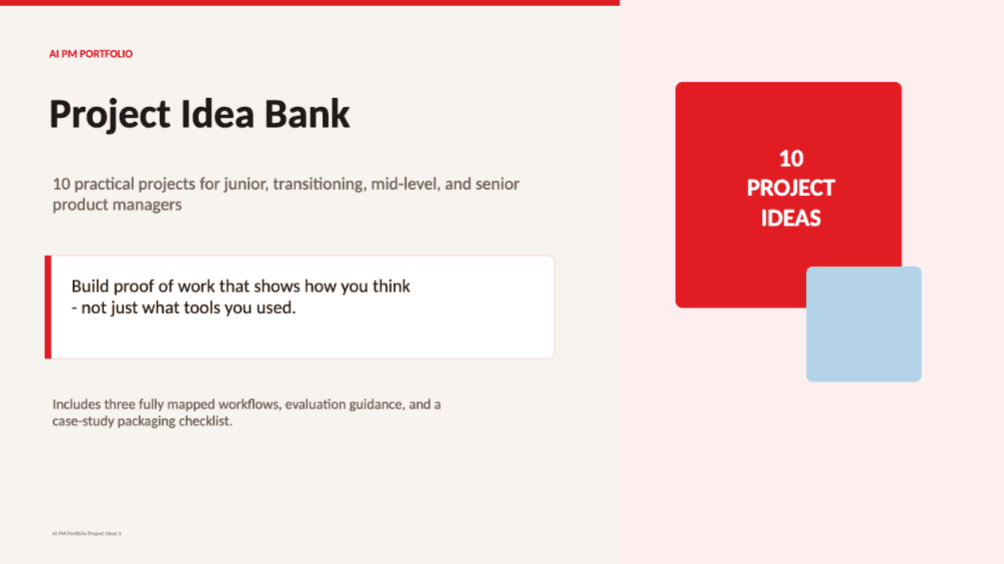
How to Build your Portfolio Mini Course
$47$97
Build a Portfolio That Gets You Taken Seriously
Stop staring at a blank screen. Choose the right project, build it with real product depth, and turn it into proof of work you can confidently share.
It is designed for fresh graduates, career changers (whatever field you are in), junior PMs, mid-level PMs, and senior product leaders who want to stand out in the AI job market and build AI-powered workflows, and THAT is what is included in your resume.
A Resume Tells Employers Where You Worked
A strong portfolio shows them how you think.
It demonstrates how you identify customer problems, make product decisions, evaluate trade-offs, work with data, use AI, and turn an idea into a credible product solution.
But most people never get that far.
They get stuck wondering:
What project should I build?
Is this idea strong enough?
How much research do I need?
What should the final portfolio look like?
How do I demonstrate AI product thinking?
What can I create if my professional work is confidential?
This course gives you the frameworks, examples, prompts, and visual inspiration you need to move past the blank screen and start building.
Generic Case Studies Are No Longer Enough
Most PM portfolios contain the same things:
A long problem statement
A few polished screens
A generic product framework
Very little evidence of product judgment
Hiring managers want to understand:
Can you identify a meaningful problem?
Do you understand the user and business context?
Can you explain your decisions?
Can you prioritize and evaluate trade-offs?
Do you understand where AI adds value?
Can you identify risks, failure modes, and guardrails?
Can you explain how your solution would be tested and measured?
This course will help you answer those questions through your portfolio.
What You’ll Learn
1. What Hiring Managers Expect at Your Level
Understand what a strong portfolio should demonstrate for a fresh graduate, career changer, junior PM, mid-level PM, or senior product leader.
You will be able to build for the role you actually want instead of following generic portfolio advice.
2. How to Choose a Strong Portfolio Project
Stop building random projects that have nothing to do with your target role.
You’ll learn how to choose a relevant problem, connect it to your experience, and select a project that strengthens your career story.
3. How to Build a Complete PM Case Study
Follow a practical structure that covers:
Problem and opportunity
Target users
Research and assumptions
Product strategy
Solution options
Prioritization
Trade-offs
User experience and workflows
Success metrics
Risks and failure modes
Testing and iteration
4. How to Build an AI Product Project with Real Depth
Learn how to go beyond a basic chatbot or AI-generated prototype.
You’ll learn how to explain:
Why AI is necessary
What the AI workflow looks like
Where human judgment is required
What could go wrong
How the product should be evaluated
Which metrics and guardrails matter
You’ll also see several examples of AI workflows and portfolio projects you can adapt for your own experience and target roles.
5. How to Package and Present Your Work
You do not need to be a designer or developer to create a credible portfolio.
You’ll see visual examples of portfolio layouts and learn how to organize your homepage, case studies, project summaries, and calls to action so hiring managers can quickly understand your value.
What Students Say About Learning with Nazuk
"I had been putting off my portfolio because I didn’t know what project to choose or what hiring managers expected to see. The examples and step-by-step framework helped me move past the blank screen and create a clear plan for my first portfolio project." - Richa Sharma, Paypal.
“I already had Product Management experience, but most of my professional work was confidential. This course helped me turn what I knew into a credible portfolio project while showing my decisions, trade-offs, metrics, and AI product thinking in much greater depth." Bharath, Lyft
“What I appreciated most was that the guidance wasn’t limited to junior PMs. It showed me how to present my experience at a senior level, focus on strategic judgment, and build an AI portfolio project that felt thoughtful rather than like another generic chatbot case study." Onya, Airtable
What’s Included
When you enroll, you’ll receive:
A step-by-step, self-paced portfolio course
Portfolio guidance for every PM experience level
A framework for selecting strong portfolio projects
AI product and workflow examples
Guidance for presenting research and assumptions, trade-offs, risk, metrics, and evaluation frameworks
Sample portfolio projects and layouts
Practical AI prompts to help you develop your ideas
A repeatable system for building future projects
Access to the private community group chat
Monthly office hours where you can ask questions
Coming Soon: Build Your First AI Agent
I am also adding a new module showing you how to build your first AI agent, including autonomous and human-in-the-loop processes.
Enroll now and you will receive this module when it is added without paying the higher future price.
This Course Is for You If…
You are a fresh graduate trying to break into Product Management
You are transitioning from engineering, design, operations, consulting, marketing, analytics, project management, or another field
You are a junior PM who needs stronger proof of work
You are an experienced PM who cannot share confidential company projects
You want to move into AI Product Management
You have started a portfolio but do not know what to include
Your existing projects do not clearly demonstrate your product thinking
You want examples and visual inspiration before you start building
You Do Not Need
A previous Product Manager title
A design background
Coding experience
Confidential company information
A fully launched product
Months of free time
You need one relevant project, a clear process, and the ability to explain your decisions.
This course will help you develop exactly that.
Frequently Asked Questions
Is this only for aspiring PMs?
No. The course includes guidance for fresh graduates, career changers, junior PMs, mid-level PMs, and senior product leaders.
Is this only for AI Product Manager roles?
No. The portfolio system can support broader Product Management roles. However, the course includes dedicated guidance for demonstrating AI product thinking and building AI-focused projects.
Do I need a real company project?
No. You can build a credible portfolio project using a workflow you understand, a problem you have observed, or a thoughtfully developed concept.
Do I need to know how to code?
No. The focus is on product thinking, decision-making, workflows, evaluation, and communication.
Will I receive support?
Yes. You can join the community group chat and attend monthly office hours to ask questions.
Your Experience Deserves More Than a Resume
You may already have valuable product skills. You may simply not be presenting them in a way hiring managers can recognize.
This course will help you turn your experience, ideas, and product thinking into visible proof of work.
Instead of only telling employers that you can do the job, you will be able to show them.
Enroll Now and Start Building
Get immediate access to the self-paced lessons, resources, examples, prompts, community group chat, and monthly office hours.
The price will increase as new projects, templates, and modules are added.
Enroll now to lock in your current price and receive the upcoming AI-agent module without paying more.

Jenn
I love how detailed this is. I was able to create a detailed portfolio in about 2 weeks, and it helped start conversations with a handful of recruiters. it couldnt be happier.
Rohit
I am a fresh grad, and with APM hiring around the corner, I needed to make sure my portfolio stood out! With all the resources shared by Nazuk i was able to do exactly that.