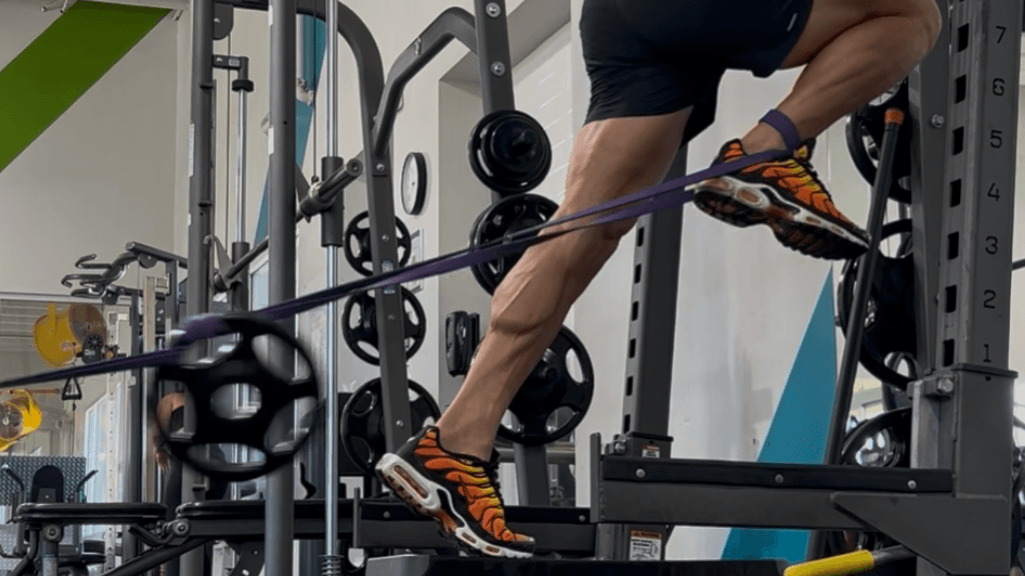
Oscillatory Isometric Manual
$59
Most training programs have never asked this question: what happens to an athlete's nervous system when the load stops being predictable?
Every rep in a conventional program is a solved problem. The barbell weighs the same. The machine moves the same arc. The nervous system generates a fixed motor program, executes it, and repeats. This develops strength. It does not develop what competition actually demands — the ability to produce force, maintain position, and make rapid decisions under conditions the body has never fully seen before.
This manual introduces a training modality that operates in that gap. It is not a standard isometric. It is not a standard oscillatory drill. It sits in a category that most of the training industry has not yet named, let alone understood — and the science behind why it works reaches into some of the most cutting-edge research in connective tissue biology, computational neuroscience, and dynamical systems theory.
Inside, you'll find a complete scientific framework for understanding what this training is actually doing at every level of the biological hierarchy — from a newly identified mechanosensitive ion channel in tendon cells, to the predictive coding architecture through which the brain manages uncertainty in competition, to the attractor stability principles that determine whether an athlete's technique holds under pressure or collapses. You'll also find a clear, principled programming framework — how to use this work as a pre-training activation tool, how to structure dedicated sessions around it, and how to progress it intelligently over time.
This is not a cueing manual. It is not a collection of exercises. It is a framework for understanding a category of training stimulus that the industry has largely overlooked — and a blueprint for integrating it into athletic preparation in a way that is grounded in the best available science.