Familiar Isn't Always Safe
$19
You’re Not Fighting. You’re Just Not Close Anymore.
Why sometimes the calmest, safest relationship you’ve ever had can still feel lonely — and what to do about it before “fine” becomes permanent.
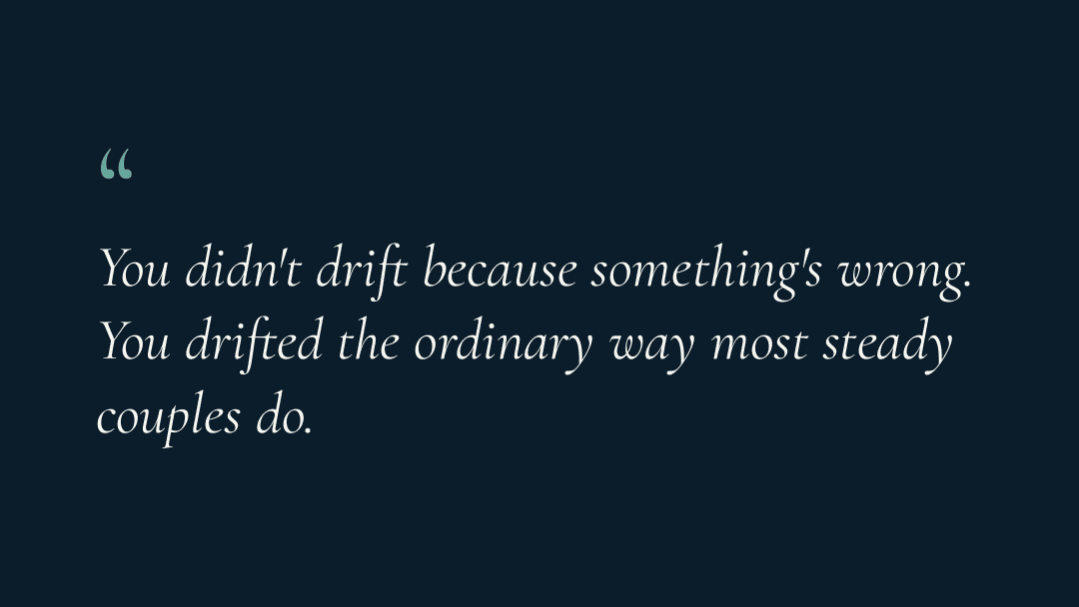
No affair. No blowup. Just two good people who somehow started living like roommates.
If that’s you, this isn’t a relationship book. It’s a nervous system reset.
The Problem No One Warns You About
Nobody writes books about couples like you.
There are shelves of books for couples in crisis — books about affairs, addiction, screaming matches. There’s almost nothing for couples who are fine. Safe. Stable. Still together. Still quietly drifting apart, year after year, with no single moment to point to and say “that’s when it broke.”
That’s the trap. Nothing is dramatic enough to force a conversation. So the distance just sits there. You get good at logistics. You get quiet about how you actually feel. You start to wonder if this is just what long relationships turn into.
Here’s what usually goes untreated: your nervous system, not your relationship, may be the thing steering you toward distance. If calm wasn’t common in your early life, calm can quietly register as wrong — even when it’s exactly what you asked for.
That’s fixable. Not through another 300-page relationship book. Through understanding what your body is actually doing, and a handful of practices that take minutes, not months.
Why This Is Worth 10 Minutes of Your Attention
Built on real, established research — attachment theory (Bowlby, Ainsworth) and polyvagal theory (Porges), not opinion or vibes.
Grounded in the Gottman Institute’s landmark relationship data — including the finding that couples who stayed together turned toward each other’s small bids for connection 86% of the time, versus 33% for couples who split.
Written for a problem almost nothing else addresses — stable, safe couples who’ve drifted, not couples in crisis.
The Part Everyone Else Misses
Most relationship advice targets your behavior: communicate better, schedule date nights, say “I appreciate you” more. Useful, sometimes. Often ignored, because it doesn’t touch the actual reason closeness feels hard.
Familiar Isn’t Always Safe starts one level lower — at your nervous system. It walks you through why calm can feel foreign if it wasn’t familiar growing up, why distance quietly becomes “normal” in a peaceful relationship, and how to use breath and body-based practices (borrowed from yoga and used by nervous system researchers) to physically shift back toward connection — with or without your partner in the room.
You don’t need a weekend retreat. You need 15 pages, 10 minutes a day, and a willingness to notice what your body’s actually doing.
What’s Inside
The Core Workbook (15 pages, printable/fillable PDF) — $27 value
Nervous System Self-Assessment — spot exactly where your body may be working against your relationship — $15 value
Breathwork & Body-Based Practice Guide — 4 breathing techniques plus 3 partner reconnection practices — $19 value
7-Day Nervous System Check-In Tracker — build the habit of noticing instead of assuming — $12 value
Quick Reference Card — every practice on one printable page, for the moments you need it fast — $9 value
Total value: $82
Today: $19
[ Start Now → ]
Why $19, and Why That Might Change
This is priced as an introductory offer while we gather feedback from early readers and keep refining it. Once that round of feedback is in, the price moves up to reflect the fuller version. Right now, you’re getting the current edition at the lowest it will be.
[ Start Now → ]
Get Familiar Isn’t Always Safe Today
$19. One PDF. Yours to keep.
No login. No app. No subscription. Just a workbook you can open tonight.
[ Start Now → ]
Questions Before You Start
We don’t really fight. Is this actually for us? Yes — this was written specifically for you. Most relationship resources assume conflict. This one assumes the opposite: two people who are fine on paper and still feel far apart.
Is this a substitute for therapy? No. This is education and reflection, not clinical treatment. If you’re navigating something more serious, a licensed therapist is the right next step — this guide says so plainly, and means it.
What if my partner won’t do the exercises with me? Most of the reflection and breathwork pages work solo. A few are designed for two people, but even doing your half changes what you bring into the relationship.
I’ve read relationship books before and nothing changed. Why would this be different? Most books ask you to change your behavior first. This one starts with your nervous system — the part that’s often quietly overriding your best intentions before you even get to behavior.
How much time does this actually take? Most pages take 5–10 minutes. The breathing practices take 30 seconds to 5 minutes. There’s no course to finish, no streak to keep. But - building healthy habits that stick starts with small steps, over time.
Is this only useful if my relationship has a real problem? It’s built for the opposite case — relationships with no obvious problem that still feel distant. If that’s not you, this probably isn’t either.
What format do I get? A single PDF, formatted to print or fill in digitally, delivered immediately after purchase.
P.S. Six months from now, you’ll either still be quietly coexisting, or you’ll have spent 10 minutes a day, a few times a week, actually turning back toward each other. The second one starts with a $12 workbook and about as much effort as reading this page took.
P.P.S. The price goes up once this round of early feedback closes. If you’ve read this far, you already know whether this is worth $19 to you.