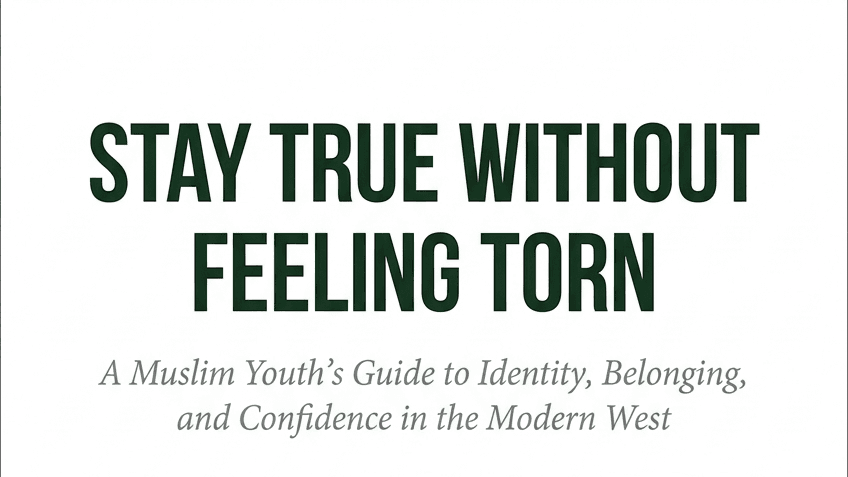
Get STAY TRUE WITHOUT FEELING TORN Now!
$27$49.99
STAY TRUE WITHOUT FEELING TORN
It's Friday. And You're Three Different People Before Lunch.
Jummah prayer this morning — calm, certain, exactly who you're supposed to be. A group project straight after — laughing at jokes that would feel out of place at the masjid, quietly hoping nobody asks where you disappeared to at lunch. A family gathering tonight — an aunt asking pointed questions about your future, and you softening every answer to avoid the lecture.
Three settings. Three slightly different scripts. Nobody ever handed you a manual for switching between them smoothly. You just learned to do it — and the learning cost something.
If you're a Muslim teen or young adult living in the West, this exhausting daily translation between worlds probably isn't new to you. What might be new is the idea that it's not a personal failure, it's not weak iman, and it's not something you have to keep white-knuckling your way through alone.
Does any of this sound familiar?
✗ You edit yourself constantly — softer at school, different at the masjid, different again online — and you're not always sure which version is actually you.
✗ You've frozen when a teacher or classmate suddenly put you on the spot to “explain” something about Islam or Muslims.
✗ You feel pressure to prove you're not “too religious,” and guilt for feeling that pressure at all.
✗ You compare your practice to your parents', to your friends', to strangers online — and always feel like you're falling short.
✗ You've quietly missed prayers not because you stopped believing, but because explaining yourself got tiring.
✗ You scroll for hours and come away feeling worse about your body, your life, or your faith than when you started.
✗ You've wondered if you're “not Muslim enough,” even while trying harder than almost anyone around you.
✗ You want to belong — to friends, to your family, to your deen — without constantly feeling like belonging to one means betraying another.
Here's the reframe this entire book is built on: you are not broken, and you are not a weak Muslim. You've likely just never been handed a clear, practical framework for understanding what you're carrying — and for building through it, on purpose.
You Are Not Broken. You Are Unclear.
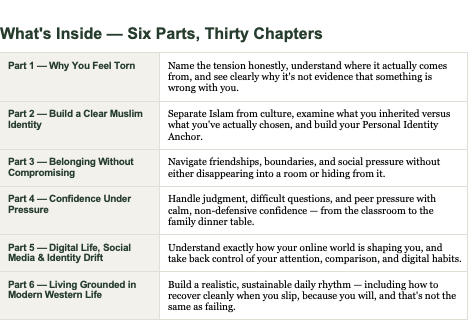
Stay True Without Feeling Torn is a complete, faith-grounded guide — 6 parts, 30 chapters — built specifically for Muslim youth navigating identity, belonging, and confidence in Western countries. It doesn't ask you to withdraw from the world, and it doesn't ask you to quietly dilute your faith to fit into it.
Every single chapter follows the same structure: a real struggle named honestly, a verse from the Quran and an authentic hadith that speaks directly to it, an explanation of what's actually happening psychologically, and a short, concrete practice called Try This — so none of it stays theoretical.
Why Willpower Alone Was Never Going to Work
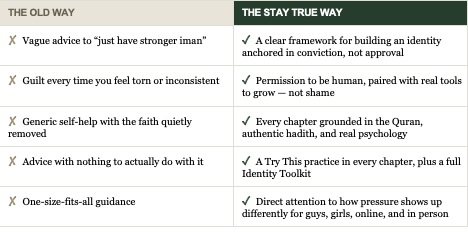
Most advice aimed at Muslim youth is either pure guilt (“try harder, pray more”) or pure secular self-help with the faith stripped out. Neither one actually addresses what's happening. Here's the difference in approach:
Plus: A Full Identity Toolkit You'll Actually Use
The back of the book gathers every worksheet and template into one practical toolkit — designed to turn insight into an actual, lived plan, not just something you nod along to and forget by next week.
→ Identity Clarity Worksheet — get honest about what you actually believe, separate from what you were simply told.
→ Values Alignment Checklist — audit whether your daily life actually reflects your stated priorities.
→ Friendship and Boundaries Guide — evaluate your closest relationships and set boundaries without losing them.
→ Digital Pressure Reset Plan — a step-by-step way to reset an unhealthy scrolling habit for good.
→ Personal Identity Statement Template — write the one-page anchor you return to whenever pressure tries to blur the picture.
→ 3 Bonus Guides — how to answer hard faith questions without freezing, what to do when you feel “not Muslim enough,” and navigating parent and family expectations.
“But What If...” — Let's Address the Doubts
“What if I'm not struggling that badly? Is this really for me?”
If you've ever felt even slightly different at home than you are with friends, or slightly out of place in more than one room you belong in, this book will still sharpen and strengthen something real — not just rescue something broken.
“Will this feel like another lecture?”
No. There's no shaming here. The book is written to sound like an honest older friend who has spent years actually listening to Muslim youth, not a scholar delivering a sermon from above.
“I've read faith books before and never finished them.”
This one is built to be used in pieces. Every chapter stands on its own, every chapter ends with one small, doable action, and the appendix toolkit is designed to be returned to for years — not read once and shelved.
Who This Book Is For
This book is for you if:
• You're a Muslim teen or young adult growing up in a Western country, navigating faith, family, friendships, and identity all at once.
• You want a clearer sense of who you are — not a version performed for whichever room you're standing in.
• You want practical tools grounded in the Quran and authentic Sunnah, explained in language that actually makes sense.
• You're tired of choosing between feeling like you belong and feeling like yourself.
This book is not for you if:
• You're looking for detailed fiqh rulings on specific worship, marriage, or legal questions. For those, this book will point you to a qualified scholar rather than attempt to replace one.
Why I Wrote This Book
This book didn't start as a plan. It started as a pattern I couldn't ignore — the same questions, the same quiet exhaustion, the same feeling of living as a slightly different person in every room, showing up again and again across years of conversations with young Muslims trying to hold onto their faith while building a real life in the West.
I'm not a scholar, and this isn't a book of formal religious rulings. I'm someone who has spent years talking with, listening to, and creating content for Muslim youth navigating exactly this tension — in comment sections, in messages, in long conversations after events, in the quiet admissions people only make once they trust you won't judge them for having doubts.
Stay True Without Feeling Torn was written to gather what actually seemed to help — grounded in the Quran and authentic hadith rather than personal opinion alone, and built to be used, not just read. If it helps even one reader feel a little less torn and a little more whole, it will have done what it set out to do.
— Dr Daud Guushaa