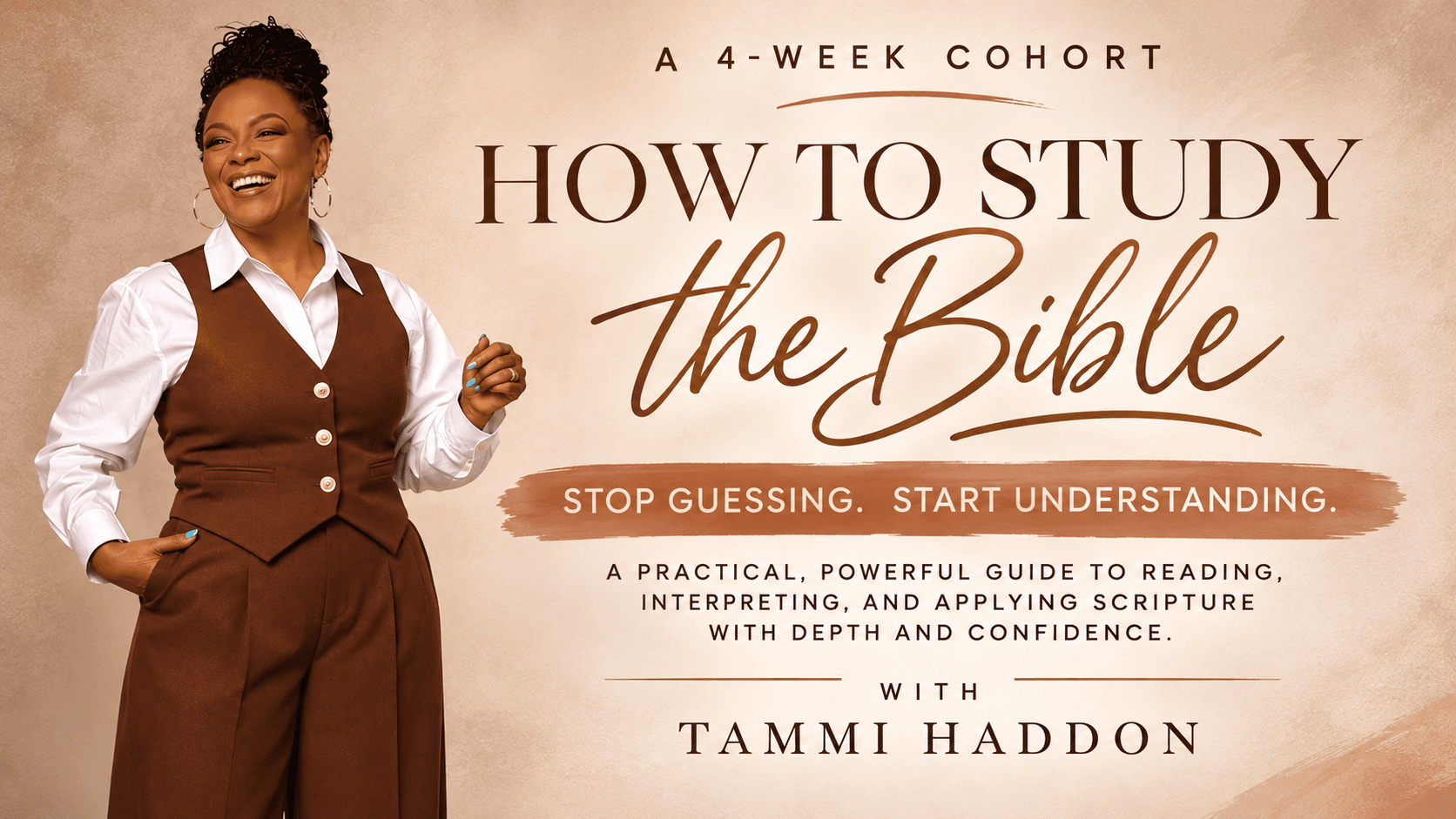
How To Study The Bible
$97
HOW TO STUDY THE BIBLE
READY TO GO DEEPER?
Join me for HOW TO STUDY THE BIBLE!
Four weeks of interactive, hands-on biblical study designed to equip you with the tools to handle Scripture exegetically, historically, culturally, and theologically.
We're going beyond simply knowing Bible verses.
We're learning how to understand the Bible!
STOP GUESSING. START UNDERSTANDING.
Enroll today!
A 4-Week Interactive Bible Study Intensive with Tammi Haddon
You've been quoting Scripture. But do you actually know how to study it?
What if I told you that some of the Scriptures you've heard preached your entire life don't actually mean what you've been taught they mean?
What if the verse you've been claiming was never a promise made to you? What if the passage you've heard used to establish an entire doctrine has been taken completely out of context?
And here's the bigger question: Would you know how to recognize it for yourself?
Welcome to HOW TO STUDY THE BIBLE!
And trust me, this is NOT your typical Bible study.
We're going behind the sermons, beyond the Sunday school answers, and deeper than the inspirational quotes.
For four weeks, I'm taking you into the world of biblical interpretation and giving you the tools to stop simply reading Scripture and start studying, investigating, interpreting, and understanding it for yourself.
We're talking hermeneutics, exegesis, historical and cultural context, biblical theology, systematic theology, Greek and Hebrew word studies, and so much more!
Don't let those big theological words intimidate you. You already know how we do at Itty Bitty Bible Study.
We make big theology understandable without sacrificing biblical depth.
And here's what makes this cohort different:
WE'RE NOT JUST TALKING ABOUT HOW TO STUDY THE BIBLE. WE'RE ACTUALLY GOING TO STUDY IT!
This is a hands-on, interactive learning experience.
You'll learn how to approach biblical passages, investigate their backgrounds, examine the original languages, identify the author's intended meaning, and understand how individual passages fit into the larger story of Scripture.
You'll practice what you're learning through guided Bible labs, interactive exercises, and real-life examples.
You won't just leave knowing what exegesis means. You'll know how to actually do it!
You don't need a seminary degree. You don't need to speak Greek or Hebrew. And you certainly don't need to be a preacher or theologian.
You just need your Bible, your curiosity, and a willingness to question what you thought you knew.
And trust me, we're going to question some things!
WHAT WE'RE GETTING INTO
WEEK ONE: READ WHAT'S THERE, NOT WHAT'S IN YOUR HEAD
Is that what the Bible says, or is that what somebody told you it says?
We're starting by challenging the way we've been taught to read Scripture.
Have you ever heard a Scripture preached a certain way your entire life, only to discover that when you read the surrounding verses, the passage was talking about something completely different?
That's why understanding how to interpret Scripture matters!
This week, you'll learn:
Hermeneutics: The principles and methods that guide responsible biblical interpretation.
Exegesis vs. eisegesis: The difference between drawing meaning out of Scripture and reading your own meaning into it.
How personal experiences, church traditions, denominational teachings, and theological assumptions can influence interpretation.
Why context matters and how to recognize when a verse has been taken out of its context.
How to slow down, observe the text, and ask the right questions before arriving at a conclusion.
The difference between what a passage says, what it means, and how it applies.
HANDS-ON BIBLE LAB: We'll examine familiar passages and practice distinguishing what the text actually communicates from what we've traditionally heard taught about it.
By the end of Week One, you'll understand the foundational principles of biblical interpretation and how to begin approaching Scripture exegetically rather than simply devotionally.
WEEK TWO: THE TEXT HAS A CONTEXT
Before you make the Bible about you, find out what it meant to them!
Who wrote it? Who were they writing to? What was happening historically, politically, socially, and culturally?
And why does one Bible translation say something different from another?
This week, we're going deeper into the world behind the biblical text.
You'll learn:
Historical context: How to investigate the time, place, circumstances, and original audience of a passage.
Cultural context: Why understanding ancient customs, traditions, social systems, and worldviews matters.
Literary context: How to identify different biblical genres and why poetry, prophecy, narrative, parables, and epistles cannot all be interpreted the same way.
Original-language study: How to investigate Hebrew and Greek words using accessible Bible study tools.
Translation comparison: Why translations differ and how to compare them responsibly.
Descriptive vs. prescriptive Scripture: How to distinguish what the Bible records from what it commands.
How to avoid imposing modern assumptions onto ancient biblical texts.
HANDS-ON BIBLE LAB: We'll investigate biblical passages using historical research, cultural background, translation comparisons, and original-language study tools.
By the end of Week Two, you'll understand how to examine Scripture historically, culturally, linguistically, and literarily instead of interpreting it through a modern lens alone.
WEEK THREE: ONE BIBLE, ONE BIG STORY
Just because you found a verse doesn't mean you've established a doctrine!
Now we're getting into theology!
Have you ever wondered how different churches and denominations can read the same Bible but arrive at different theological conclusions?
Or how certain beliefs become widely accepted even when the biblical evidence supporting them is questionable?
This week, we're learning how theology is developed and why studying individual Scriptures is only part of understanding the Bible.
You'll learn:
Biblical theology: How to trace themes, teachings, promises, and concepts throughout the biblical narrative.
Systematic theology: How biblical teachings are organized into doctrines concerning God, Jesus Christ, the Holy Spirit, salvation, humanity, the Church, and more.
Christology: How the person and work of Jesus Christ relate to the larger biblical story.
Progressive revelation: How God's revelation unfolds throughout Scripture.
How to examine multiple biblical passages when studying a theological subject.
How to distinguish biblical evidence from assumptions, traditions, and theological opinions.
How doctrines are developed and why a single isolated verse may not be sufficient to support a theological claim.
How to recognize the difference between what Scripture explicitly teaches and what we infer from Scripture.
HANDS-ON BIBLE LAB: We'll investigate theological claims, examine supporting passages, and practice building biblical conclusions through careful study rather than isolated proof texts.
By the end of Week Three, you'll understand the relationship between exegesis, biblical theology, and systematic theology—and how to examine theological teachings more critically and responsibly.
WEEK FOUR: CAN YOU HANDLE THE TEXT?
You've heard everybody else's interpretation. Now it's your turn!
This is where EVERYTHING comes together!
For three weeks, you've been learning the principles, understanding the terminology, and discovering the tools.
Now it's time to put them to work.
I'm going to walk you through the process of approaching a biblical passage, researching it, interpreting it, and explaining what you've discovered.
No guessing. No grabbing random Scriptures to prove a point. No repeating something simply because your favorite preacher said it.
We're learning how to do the work!
You'll learn:
How to conduct a step-by-step exegetical study of a biblical passage.
How to use Bible dictionaries, commentaries, lexicons, concordances, and other study resources.
How to identify the main idea and intended message of a passage.
How to examine historical, cultural, literary, and theological context together.
How to use cross-references responsibly.
How to evaluate different interpretations and identify common interpretive errors.
How to move from interpretation to faithful, practical application.
How to communicate your findings clearly and confidently.
You'll also learn how to use my C.O.N.T.E.X.T. Method, a practical seven-step framework designed to help you study Scripture with greater consistency, clarity, and confidence.
FINAL HANDS-ON BIBLE LAB: You'll put your new skills into practice by working through a guided exegetical study and developing your own interpretation supported by the text and its context.
By the end of Week Four, you'll have a repeatable process for studying Scripture exegetically, historically, culturally, and theologically.
THIS IS NOT A SIT-AND-LISTEN CLASS!
Let me be clear. You're not just coming to hear me teach for four weeks.
YOU'RE COMING TO LEARN HOW TO STUDY!
Throughout this cohort, you'll be actively involved in examining Scripture, researching biblical passages, comparing translations, investigating original-language words, and practicing the interpretive methods you're learning.
This is a learning environment where questions are welcome, critical thinking is encouraged, and biblical accuracy matters more than simply defending what we've always believed.
Because the goal isn't for you to leave knowing more about what I believe the Bible says.
The goal is for you to know how to investigate what the Bible says for yourself!
WHAT'S INCLUDED
4 live, interactive teaching sessions with Tammi Haddon
Class replays to revisit every lesson
A downloadable, guided Bible study workbook
Hands-on Bible labs and practical study exercises
Weekly assignments to reinforce what you're learning
Introduction to Hebrew and Greek word-study tools
Training in hermeneutics, exegesis, historical and cultural context, biblical theology, and systematic theology
The C.O.N.T.E.X.T. Method—a practical seven-step Bible study framework
A final guided exegesis project to put your new skills into practice
WHO IS THIS CLASS FOR?
This cohort is for you if:
You love the Bible but sometimes struggle to understand what you're reading.
You want to go deeper than devotional reading and inspirational quotes.
You have questions about Scriptures and doctrines you've been taught.
You're a preacher, pastor, teacher, ministry leader, or small-group facilitator who wants to handle Scripture more responsibly.
You want to understand the historical and cultural world of the Bible.
You're interested in theology but don't know where to begin.
You want to learn how to study Scripture without depending entirely on someone else's interpretation.
You simply want to become a more informed, confident, and responsible student of the Word.
Beginners are welcome. No theological education or previous Bible study training is required!
HERE'S MY GOAL FOR YOU
I don't want you to leave this class with four weeks of notes, a few new theological terms, and a whole lot of information you don't know what to do with.
I WANT YOU TO LEAVE WITH A METHOD.
I want you to understand how to approach a biblical passage.
I want you to know how to investigate who wrote it, who received it, why it was written, and what was happening when it was written.
I want you to understand how to examine the original language, recognize literary genres, evaluate theological claims, and interpret Scripture in its proper context.
I want you to understand the difference between reading the Bible, interpreting the Bible, and developing theology from the Bible.
Most importantly, I want you to have the tools and confidence to open Scripture and say:
"I know how to study this. I know what questions to ask. I know where to look. And I know how to examine the evidence before drawing a conclusion."
Because you shouldn't have to rely exclusively on somebody else's understanding of Scripture when you can learn how to study it responsibly yourself.
And remember:
A familiar interpretation isn't necessarily an accurate interpretation.
Just because we've heard something preached for years doesn't mean we've examined whether the text actually supports it.
READY TO GO DEEPER?
Join me for HOW TO STUDY THE BIBLE!
Four weeks of interactive, hands-on biblical study designed to equip you with the tools to handle Scripture exegetically, historically, culturally, and theologically.
We're going beyond simply knowing Bible verses.
We're learning how to understand the Bible!
STOP GUESSING. START UNDERSTANDING.
Enroll today!