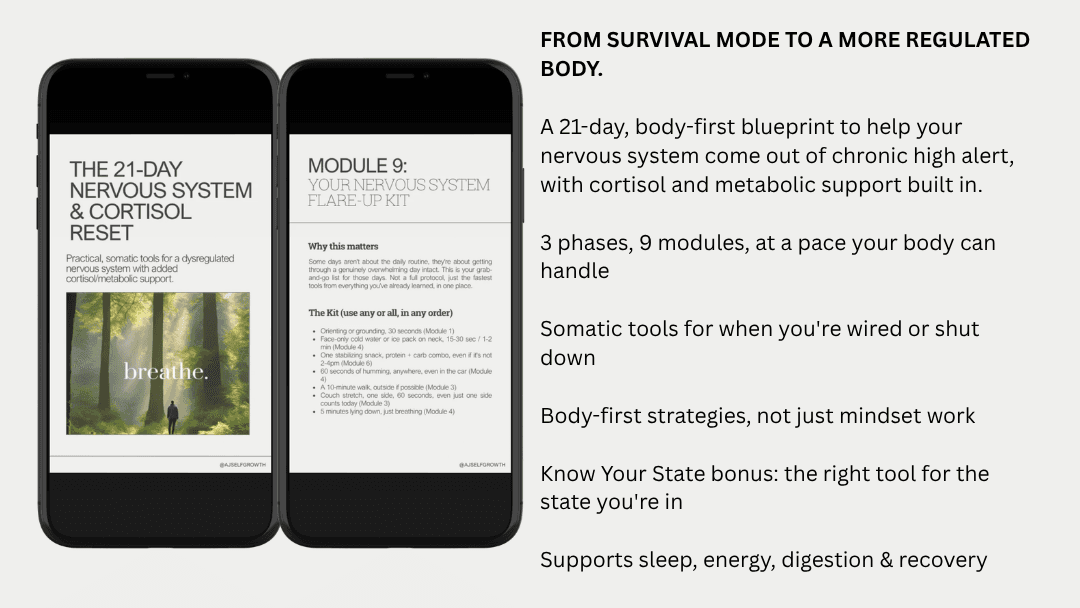
The 21-Day Nervous System & Cortisol Reset
$17$47
Get your body out of survival mode and feel like yourself again.
A step-by-step, 21-day somatic blueprint for when you know you're safe but your body hasn't gotten the message.
You finally get a quiet moment, and your body still won't settle.
Small things hit harder than they should and stay with you for hours. You're exhausted, but your body still feels like it's bracing for something.
It isn't a thinking problem. Your nervous system is running a survival response automatically, and you can't think your way out of that. This guide gives you practical, body-first tools to help it learn something new.
Sound familiar?
Some people or places set you off before you know why
Your chest tightens, your heart races, or your jaw clenches before your brain catches up
You go blank or numb during conflict, like your body just shuts down
You're tired all the time but can't wind down at night
You rest but never feel rested, and wake up foggy, bloated, or puffy
You understand your patterns, but your body hasn't caught up
You've tried meditation, supplements, even vacations, and nothing sticks
If that's you, you don't need more pressure or another wellness checklist. Your body needs physical proof that it's safe right now, again and again. That's what this guide is built around.
Your body isn't broken. It's protecting you.
Your nervous system learns from what you've lived through. If certain tones, looks, or situations once meant something bad was coming, or you've spent years running on pressure with no real break, it learns to stay on alert and react fast, before you have time to think.
Telling yourself to "just relax" when you're in fight or flight is like telling a smoke alarm to stop ringing while it still senses smoke. The alarm doesn't need a lecture. It needs a different signal.
Talking and understanding help, but your nervous system learns through experience. These tools give it that experience, and if you're already in therapy, they fit right alongside it.
And cortisol isn't the enemy. It's part of the same system. When your alarm keeps going off, your stress hormones stay busy too, and that's where a lot of the sleep, energy, digestion, and skin stuff comes from. So you don't need another cortisol hack. You need to calm the alarm and support the body that's been running on it. This guide does both.
What's inside:
Start Here: Why your body reacts before you think. A short read before Day 1, and the part that makes everything else click.
Phase 1: Building Safety (Days 1-7)
Module 1: If Even the Basics Feel Like Too Much. Orienting, grounding, resourcing, and other gentle somatic tools for when you're too overwhelmed for anything else
Module 2: Your Morning Nervous System Window. Light, food order, and hydration to start the day steady
Module 3: Afternoon & Evening Support. Getting past the 2-4pm crash and actually winding down at night
Phase 2: Building Capacity (Days 8-14)
Module 4: Movement Your Nervous System Trusts. Walks, stretches for where you hold tension, and a simple way to shake off fight-or-flight energy
Module 5: The Vagus Nerve Toolkit. Cold, humming, and breathing tools that work in the moment
Module 6: Environmental & Emotional Safety. Screens, sound, draining people, and learning to stop pushing through
Phase 3: Integration (Days 15-21)
Module 7: Gut, Inflammation & Skin. Bloating, breakouts, and puffiness, and what actually helps
Module 8: Understanding Your Symptoms. Hair shedding, facial puffiness, weight, and libido: what stress has to do with them, and when to get checked. No miracle-fix promises
Module 9: Making It Yours. Spot your patterns, build a routine for your hardest days, and handle setbacks without starting over
Bonus: Know Your State
Most guides hand you a list of tools and leave you guessing. This shows you how to tell whether you're in Safe & Social, Fight or Flight, or Shutdown, and which tool to reach for in each. Because what calms you when you're wired isn't what helps when you've gone numb.
Also included
Flare-Up Kit (printable card)
Nervous System Type Cheat Sheet
Quick Tools Index
21-Day Tracker
Who I am
I'm AJ. I have a BSc in Kinesiology and Psychology, and I work from a trauma-informed lens.
8 years ago I was stuck deep in survival mode and didn't know it. High-functioning on the outside, stuck in survival mode on the inside. I had the bloating, the wired-but-exhausted nights, snapping at people I loved, and days where I just felt numb. And my bloodwork kept coming back "fine." I treated it all as separate problems. It wasn't. It was all one thing: a nervous system stuck in survival mode.
It took a nearly a decade of living through it and studying nervous system regulation, neuroscience, and stress physiology to understand what was happening. This isn't recycled wellness trends. It's the framework I now use with the people I coach, and the one I wish I'd had back then.
What you're working toward
Before
Always braced and overstimulated
Going blank or shutting down in conflict
Small things hitting hard and lingering for hours
Resting but waking up foggy and bloated
Disconnected from your body
Trying to think your way into feeling calm
After
Settling more easily after stressful moments
Catching activation before it escalates, and coming back faster
More space between a trigger and your reaction
Steadier energy and calmer digestion
Actually understanding what your body's telling you
Knowing which tool to reach for, and when
The Investment
$17. Instant access, lifetime access, all 9 modules plus the full toolkit.
30-day money-back guarantee. Give it the full 21 days. If it doesn't give you clear, practical value, email me within 30 days for a full refund. No hoops.
This guide is educational. It isn't a substitute for medical care or therapy, and it works well alongside both.
Get Instant Access Below for Just $17

Alicia P.
Honestly, I was skeptical because of the $17 price tag. I thought it would just be a generic PDF checklist. I was totally wrong. The depth of science behind the morning cortisol window and the hip tension/survival response is insane. No fluff, no 200-page filler, just the exact breakdown of why your body feels stuck and how to fix it.
Maria J.
What stood out to me is that nothing inside felt unrealistic. I work full-time and have kids, so I don't have hours every day for self-care. These are things I could actually fit into my routine, which is probably why I finally stuck with them.
Michael F.
I’ve seen a million posts about nervous system dysregulation and cortisol online, but it always felt like a lot of fluff or super contradictory info. This guide actually connected the dots. It helped me understand why I was waking up feeling like I ran a marathon, and gave me a clear, step-by-step game plan instead of making me feel overwhelmed by 50 different things
David L.
My doctors kept telling me my lab work was 'fine,' but I was waking up feeling completely unrefreshed and running on pure adrenaline all day. Reading this was the first time someone explained what survival mode actually does to your cortisol and nervous system mechanically. Having a real, practical plan instead of guessing changed everything for me.
Priya M.
I’ve spent hundreds on adaptogens, magnesium, and meditation apps, but my brain literally could not turn off at night. This guide made me realize that trying to lower cortisol without regulating your nervous system first doesn't work. The vagus nerve tools in Module 3 brought down my baseline physical anxiety faster than anything I've tried in years.
Nikki S.
What I loved most is that AJ doesn't tell you to completely change your life overnight. He explains why your body feels the way it does, then gives you practical things that actually fit into a busy schedule. I finally feel like I have a plan instead of randomly trying supplements and hoping something works.