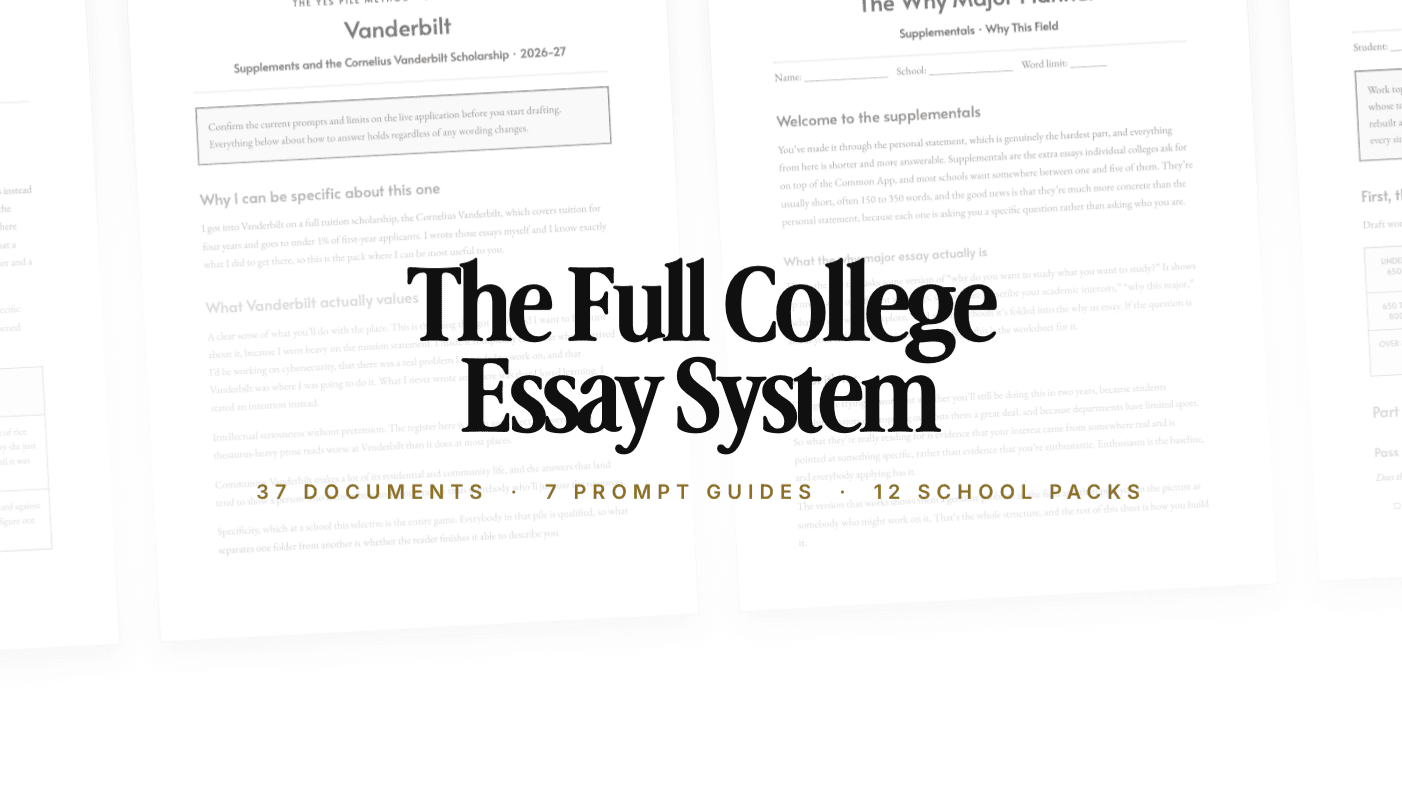
The Full College Essay System · 36 Documents
$36$50
You don't have to be the most accomplished student to get into a top school.
But you do have to know how to write a great essay, and that's a skill, which means somebody can teach it to you.
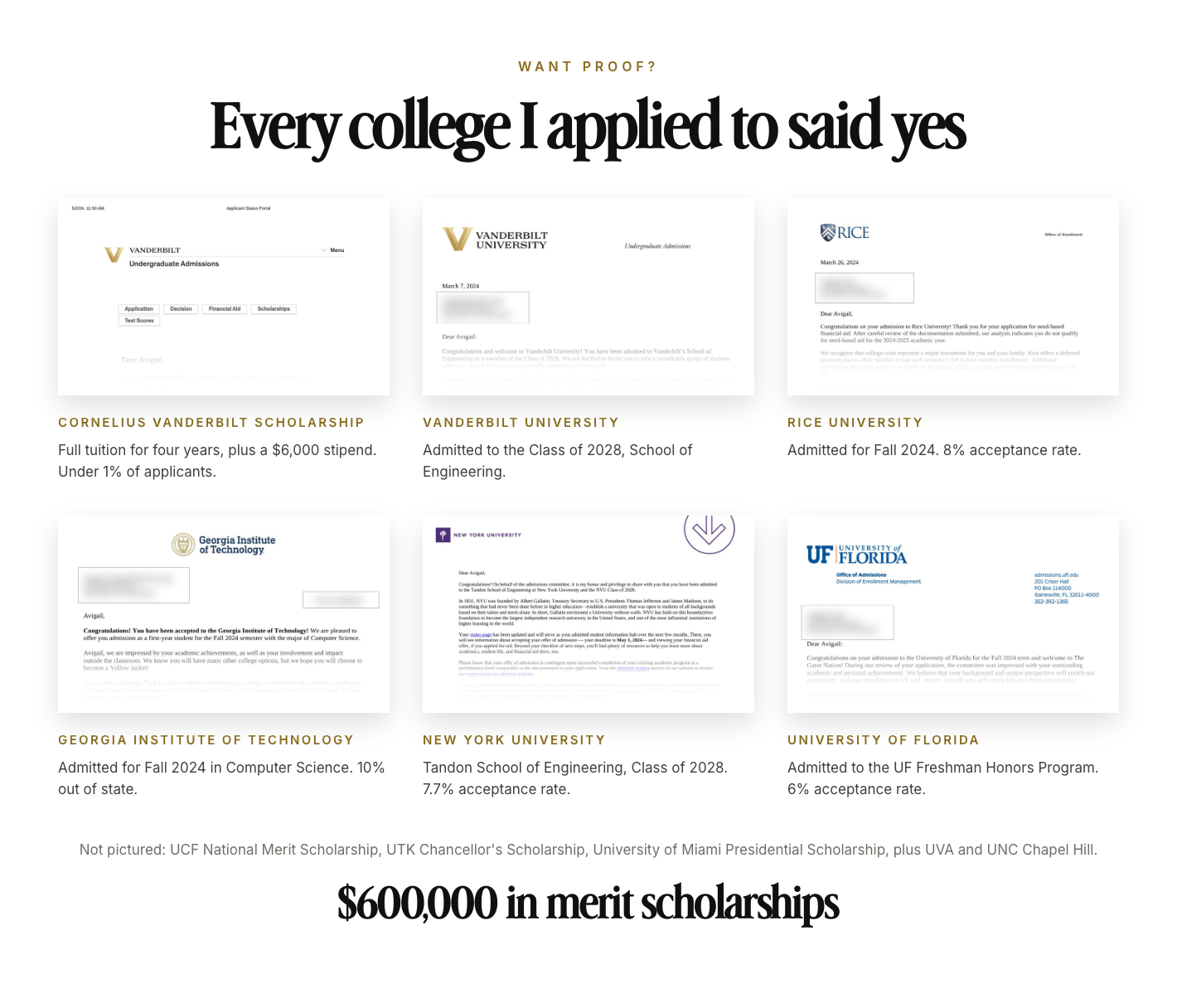
I got into EVERY college I applied to (NYU, Rice, Vanderbilt, and 8 others) and earned $600K in merit scholarships including a full tuition scholarship to Vanderbilt.
Yet I didn't found a nonprofit or win a national STEM award. What I DID do was work out exactly what makes an admissions officer stop on an essay instead of skimming it, and then write mine that way.
Since then I've taught that same strategy to over 1,000 students, and it's what got them into NYU six times over, including one full ride with housing and another worth $71,500 a year, plus Rice, Cornell, Dartmouth, Penn, UC Berkeley, UCLA, USC, UNC, Vanderbilt with a scholarship, and West Point.
Now I've taken that entire strategy and built it into a system.
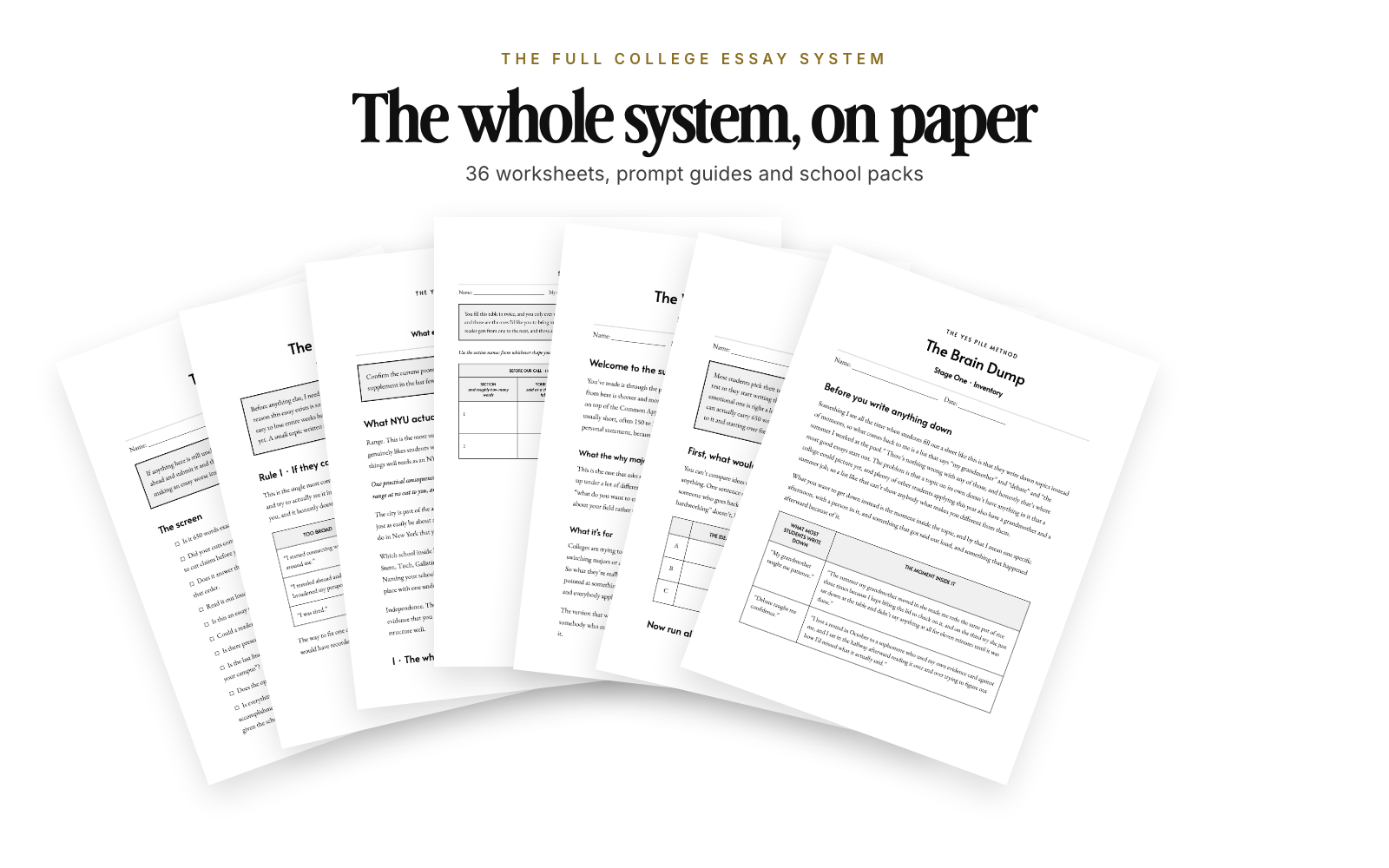
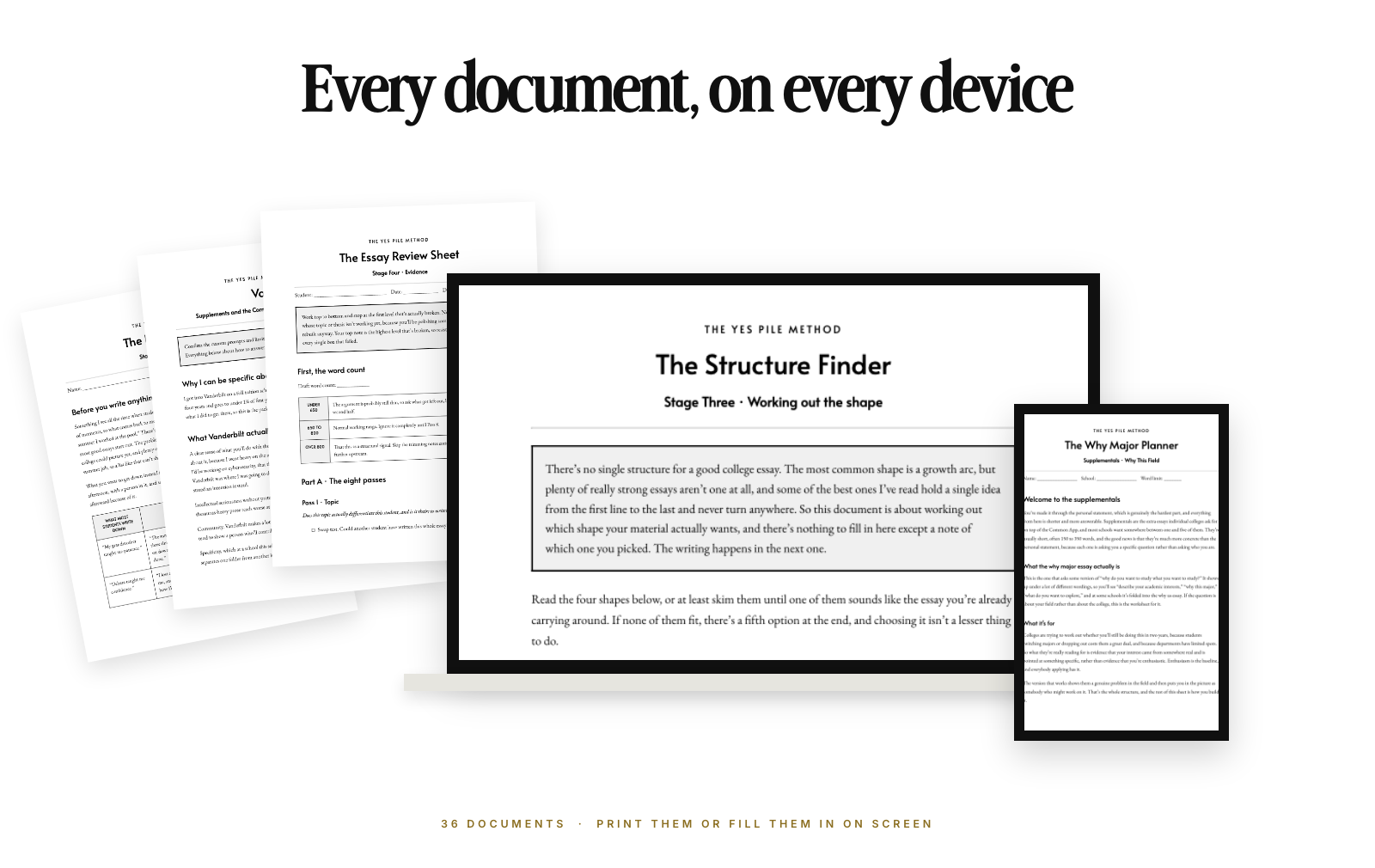
Thirty-six documents that walk you through every step of creating your Common App essay and every supplemental you have to write.
WHAT YOU GET
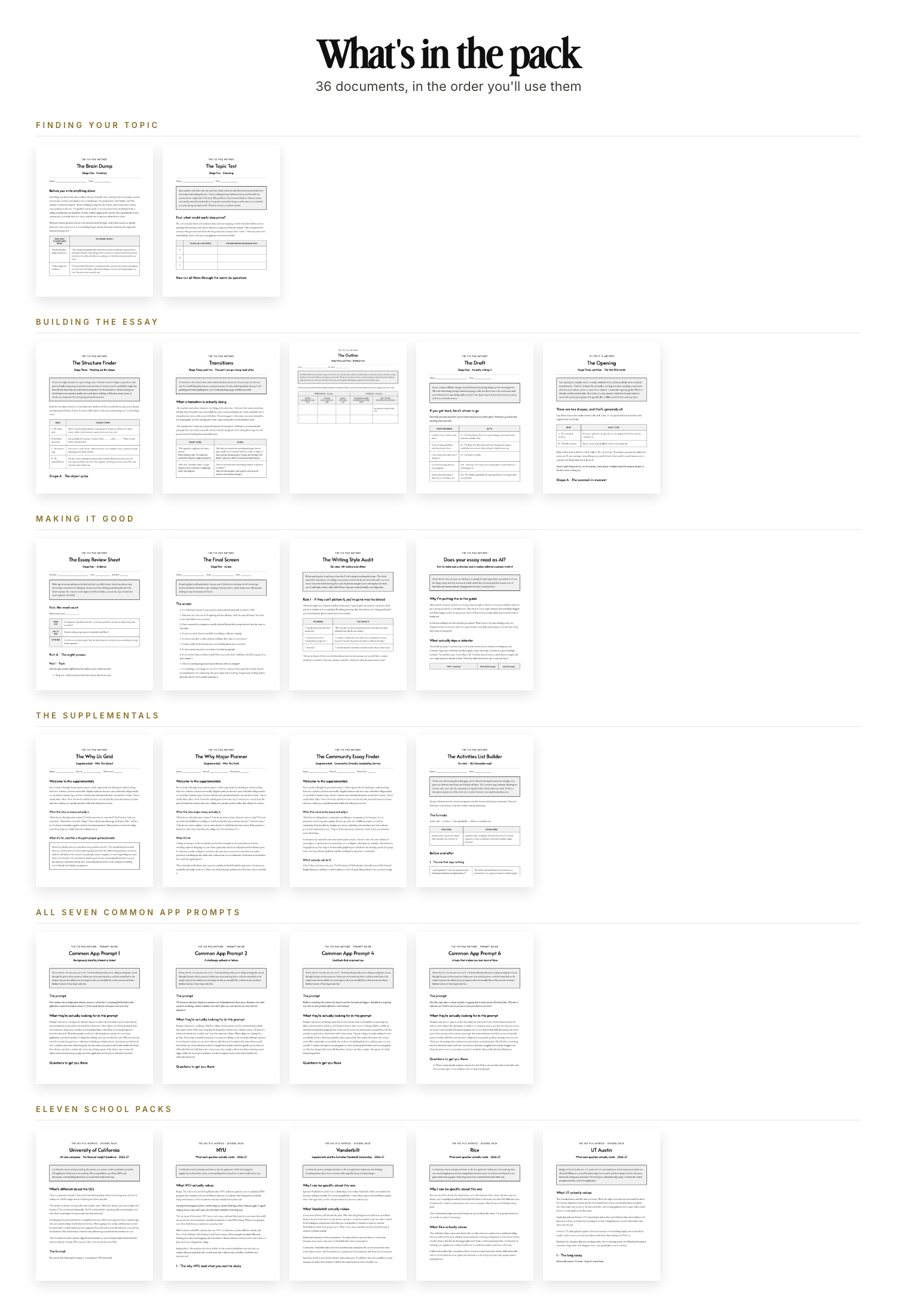
Thirty-six documents, plus the full guide as a bonus. Here's what each stage does, what usually goes wrong inside it, and which sheets fix it.
BEFORE YOU START
Terms of Use.
00 · Start Here. What everything is and what order to use it in, so you always know which document comes next.
01 · The Yes Pile Test. Ten questions, about five minutes, and at the end it tells you which of six things your essay is actually doing right now and which of the four stages below you're really at. Most students find they're a stage earlier than they thought they were, and starting on the wrong stage is the most common way a September gets wasted.STAGE ONE · FINDING YOUR TOPIC
STAGE ONE · FINDING YOUR TOPIC
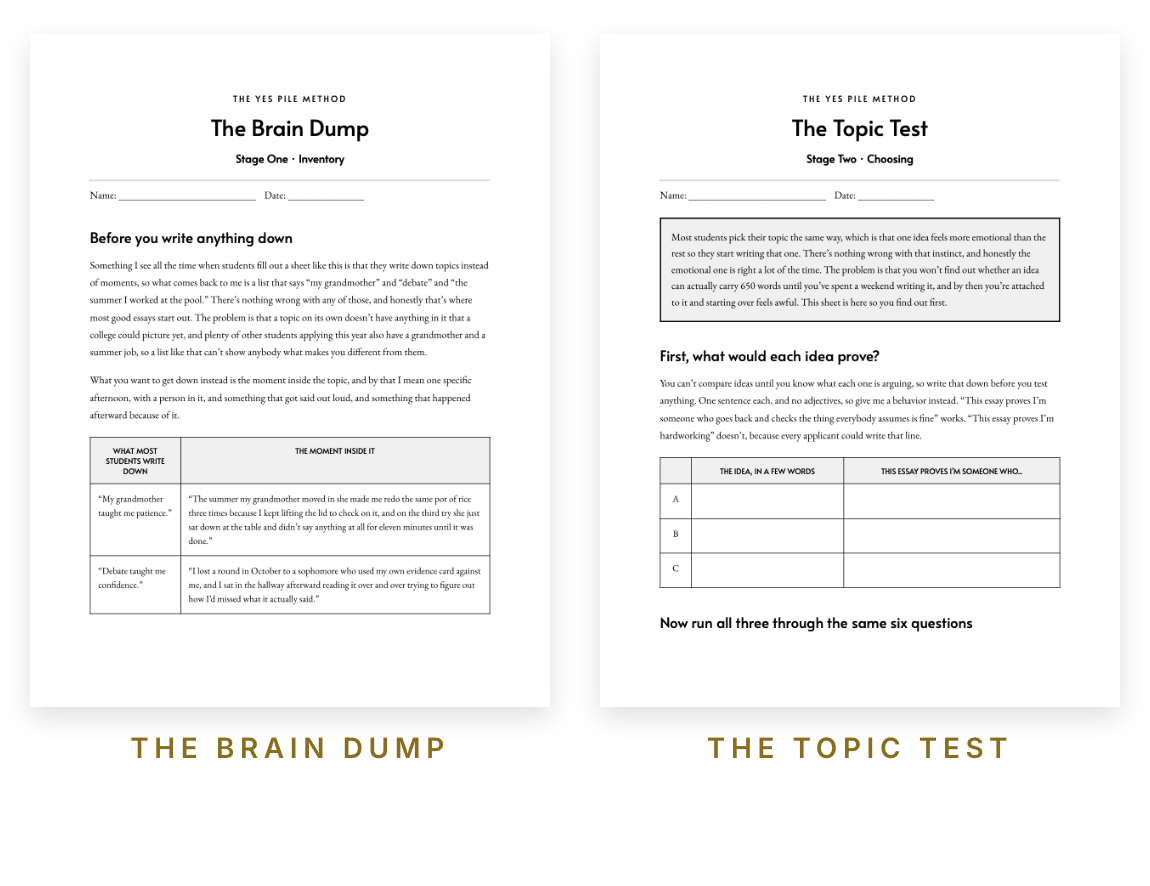
Most students tell me nothing interesting has ever happened to them, which is almost never true, they just can't tell which of their ideas is worth 650 words. So they end up picking the saddest thing that ever happened to them, because at least that feels important enough to write about. But that usually makes an even worse essay. So how do you pick a good topic?
02 · The Brain Dump gets every idea out of your head across all seven prompts, so you can finally see everything you have in front of you instead of trying to judge it while you're still remembering it.
03 · The Topic Test is the six questions I run before I let anyone commit to a topic, and you put your top three ideas through all six side by side, so by the end you know which one to write and why.
Guides for the Seven Common App Prompts
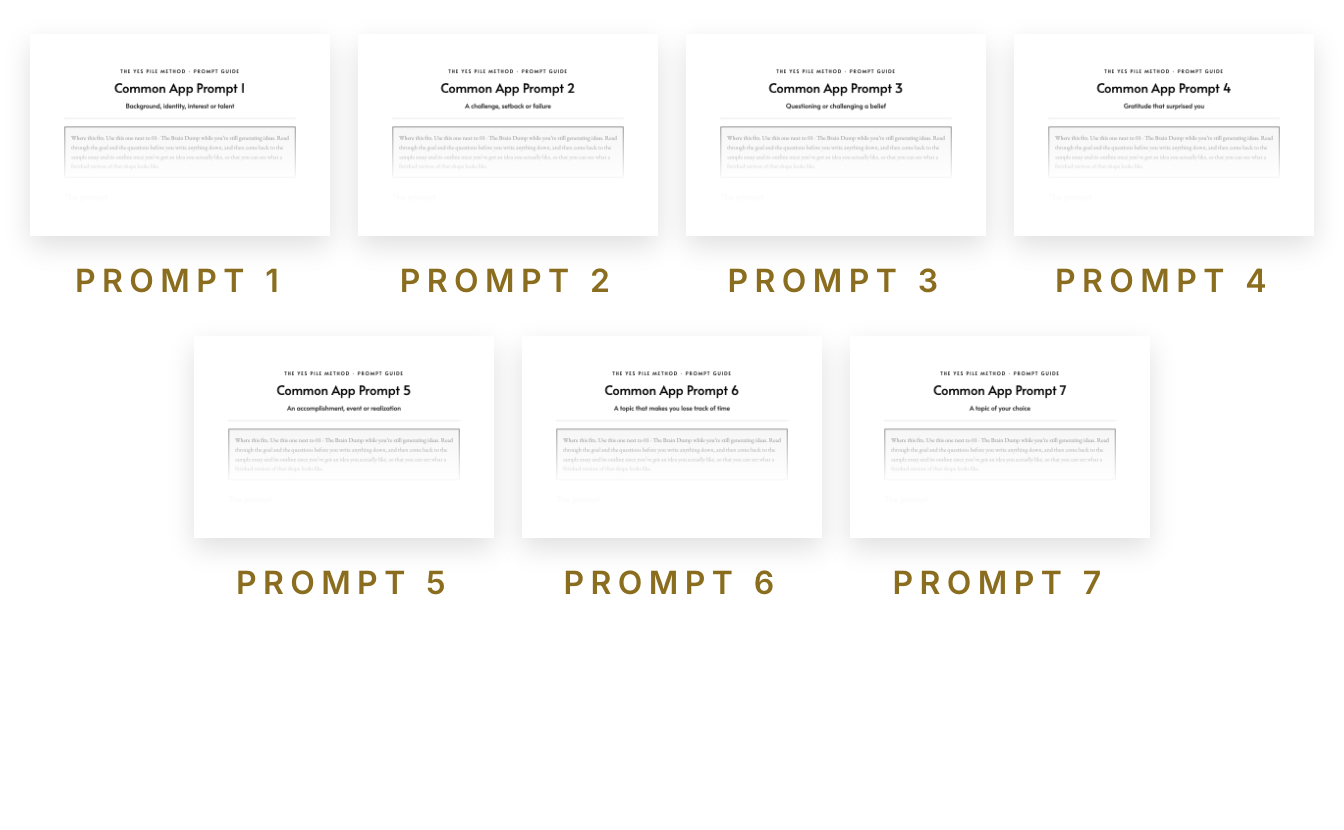
When you write your Common App essay you have to pick one of seven prompts, and they all sound fine, so most students end up choosing whichever one sounds nicest instead of the one their story actually fits. Prompt 4 is the one people get wrong the most, because it sounds like it wants a story about somebody being nice to you, and that isn't what it's asking for at all. So what does each prompt actually want?
Seven guides, one for every prompt. Each one tells you what colleges are really looking for in that prompt, gives you the questions I'd ask you on a call to work out whether you have a story for it, and then shows you a complete sample essay written to that prompt, broken down so you can see why every paragraph is where it is.
Seven prompts, seven finished essays. Whichever one you pick, you get to read a finished version before you write yours.
STAGE TWO · BUILDING THE ESSAY
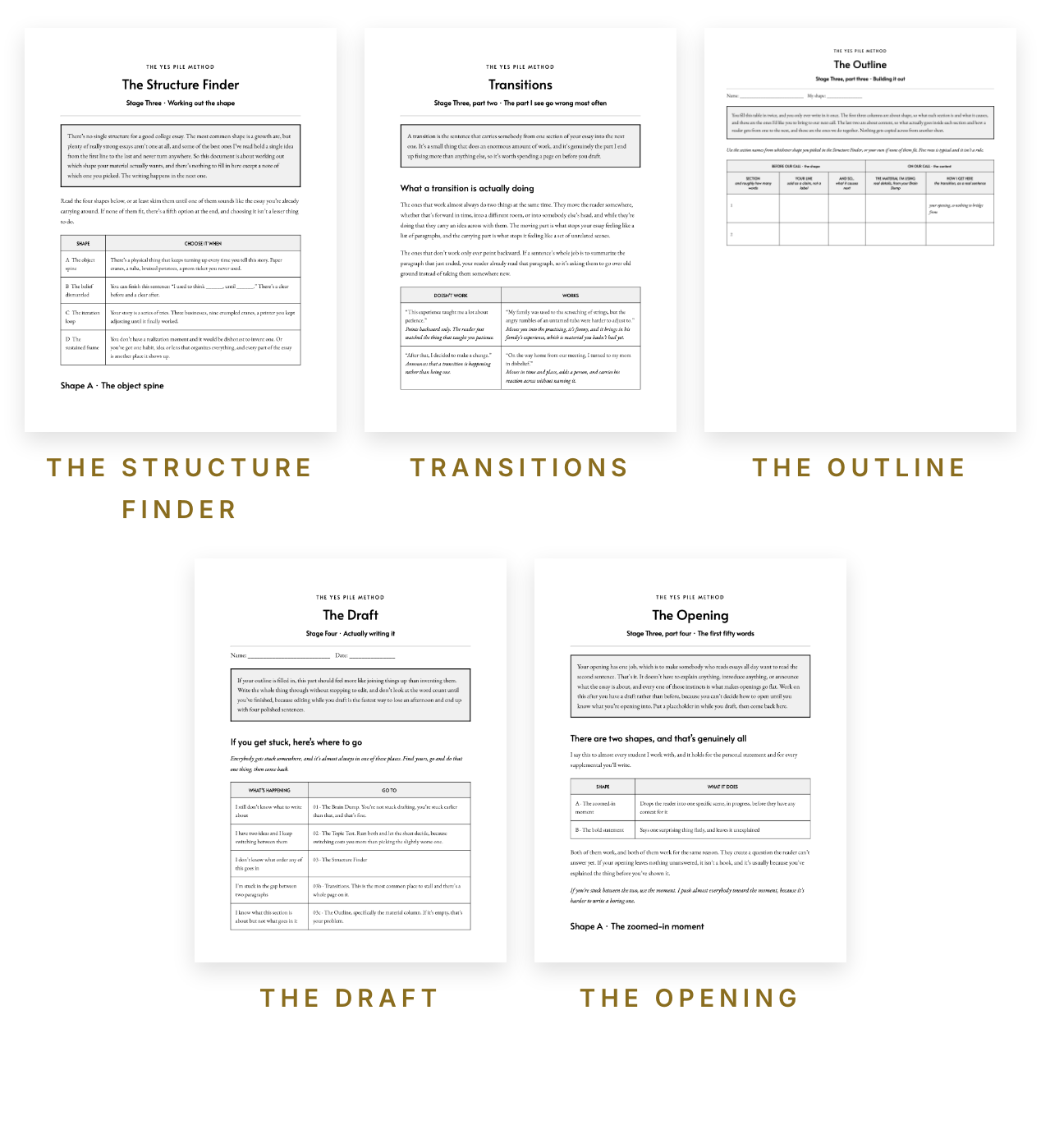
Your essay is written, something feels off, and you can't work out what. It's usually one of three things: you spent too long setting it up and not enough on what changed, or you gave the lesson away in the first line so there was nothing left to find out, or you opened on a great image and then never came back to it. So how do you tell which one it is?
04 · The Structure Finder gives you four shapes a strong essay can take, each one walked through on a real essay that got a student in, so you can see which shape your material already wants. Most people find theirs in about five minutes.
05 · Transitions fixes the thing I fix more than anything else, which is a paragraph that opens by announcing its own lesson, and it shows you what to open with instead with a before and after for each one.
06 · The Outline gets the shape down before you write, so you don't spend a weekend getting attached to sentences you're going to have to cut anyway.
07 · The Draft tells you how long each section should actually be, and gives you an index of where to look the moment you get stuck.
08 · The Opening teaches you the two hooks I use with every student, shows you the five ways openings go flat, and helps you find your real first line, which is usually already sitting in paragraph four.
STAGE THREE · MAKING IT GOOD
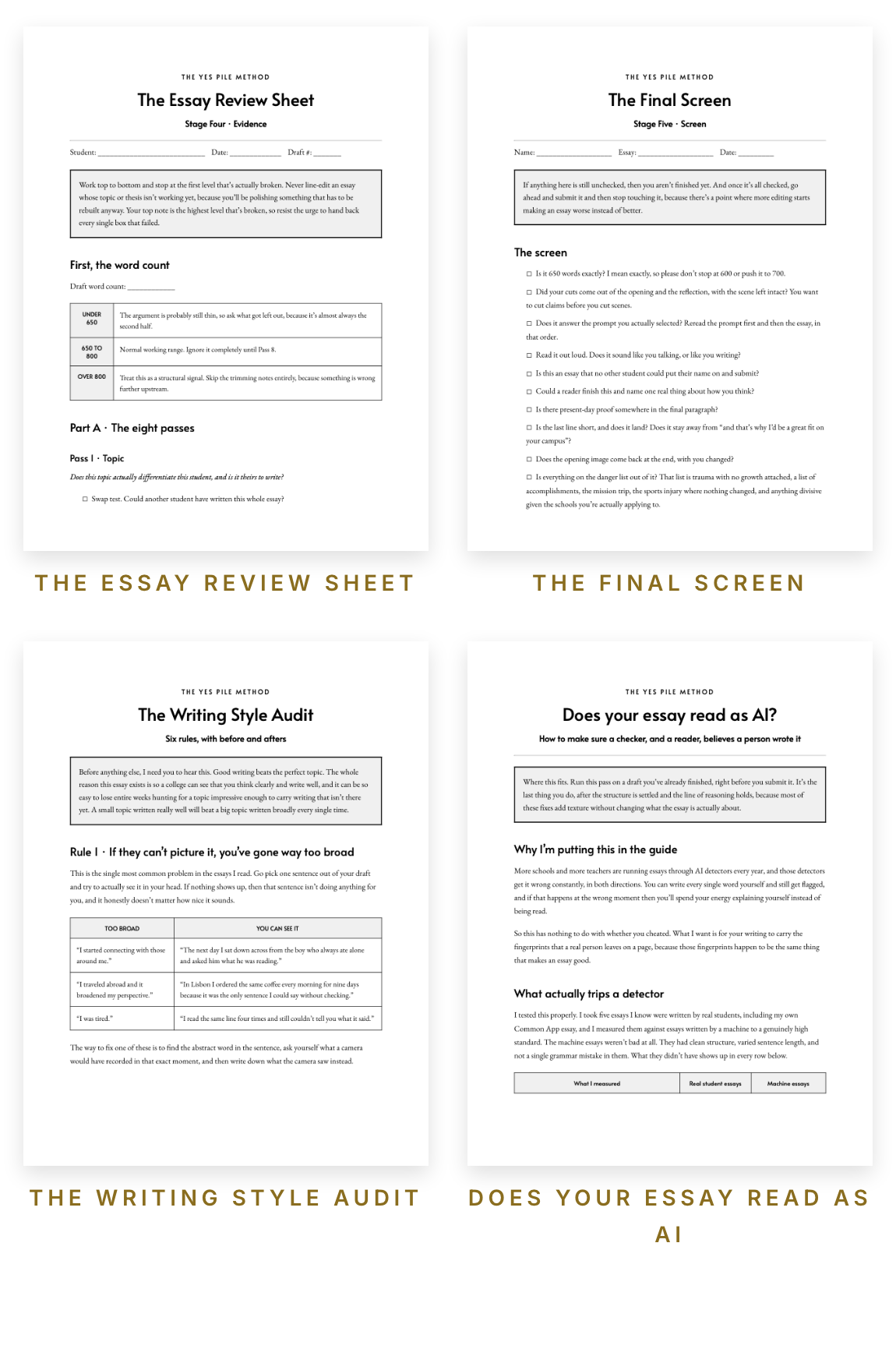
Finished isn't the same as ready, and the gap between them is almost impossible to see from the inside. You're 130 words over and every cut feels impossible, you've written "challenging" and "I learned to be a better leader" without noticing, and now you're worried the whole thing reads like AI wrote it. So how do you tell what still needs fixing?
09 · The Essay Review Sheet walks you through the eight passes I run on every essay I read, one at a time, so you're fixing one thing per pass instead of trying to fix everything at once and getting nowhere.
10 · The Final Screen is the submit-or-not checklist for the night before it's due.
11 · The Writing Style Audit gives you six rules with a before and after for each, then walks you through three passes on your own draft.
12 · Does Your Essay Read as AI came out of running real student essays and AI-written ones through detectors and measuring what was actually different, so it shows you what trips a detector and what to change so a reader believes a person wrote it.
Real Essays from Students Who Got Accepted
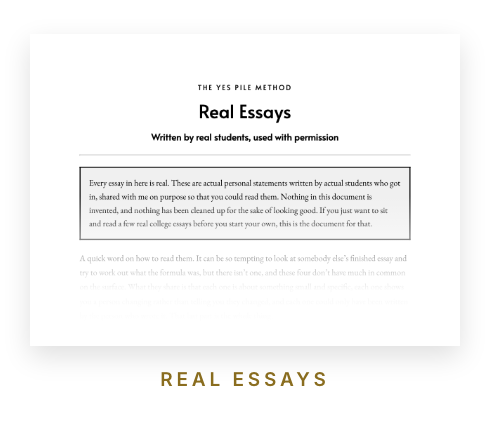
The single most useful thing I can put in front of a student is a full essay that got someone in and isn't about anything impressive, because that's the part nobody believes until they read one.
13 · Real Essays gives you complete personal statements from students who got into schools like Cornell and Dartmouth, printed in full rather than quoted in pieces, and shared with their permission.
STAGE FOUR · THE SUPPLEMENTALS
Supplementals are where applications get won and lost, and they're the part everyone leaves until the last two weeks. I read the same three problems every single day: a why-us that could be about any school, a why-major that only proves you're interested, and a community essay that describes a club instead of describing how you changed. So how do you write ones that don't do that?
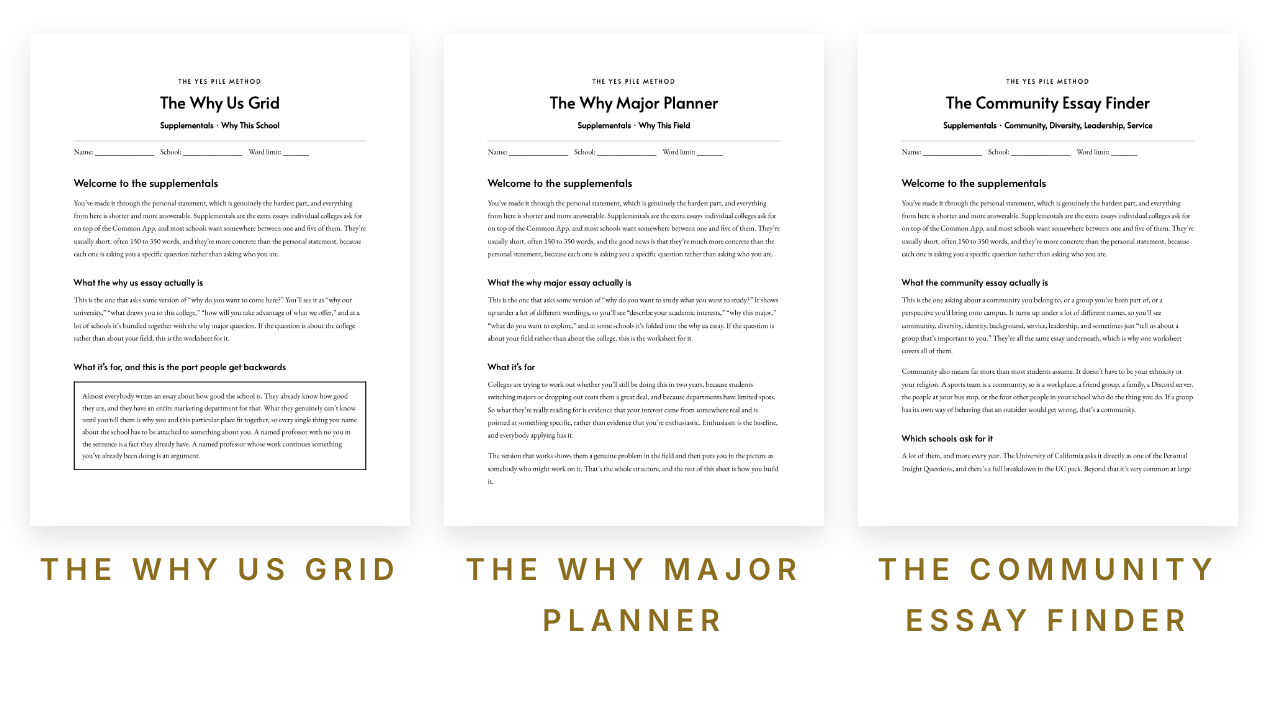
14 · The Why Us Grid shows you how to research a school properly and gives you four tests that kill a generic answer, worked through on the why-us that got me into Georgia Tech plus the shorter version I sent Rice.
15 · The Why Major Planner gives you the four-part spine of spark, problem, mission and resources, worked through on the why-major that got me into Rice.
16 · The Community Essay Finder covers community, diversity, leadership and service prompts, and helps you work out which of your communities is actually the one worth writing about.
My Real Essays
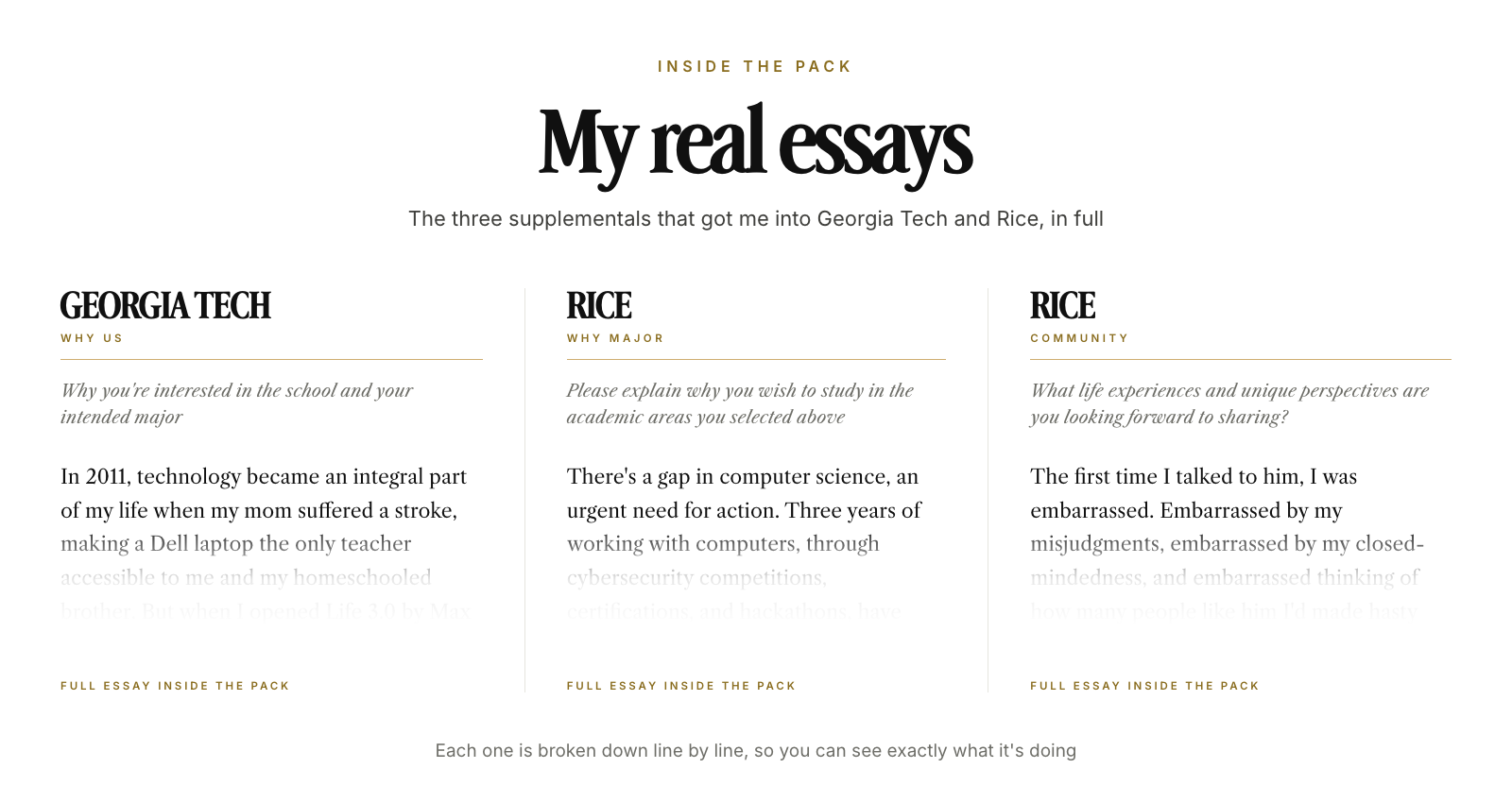
Three of my own supplementals are in the pack, complete, and each one sits inside the worksheet that teaches it and gets broken down line by line. The why-us that got me into Georgia Tech, the why-major that got me into Rice, and the community essay I wrote for Rice's residential college system.
So you read what the document is asking of you, and then you read me doing it, on the actual essay that worked.
Supplemental Help for 12 Schools
This is the part I'm proudest of. Every school words its questions differently and wants something different underneath, so a why-us answer for NYU that would work just as well at USC is the fastest way to sound like everybody else in the pile, and there's no way to work that out from reading the prompt.
So what does each school actually want?
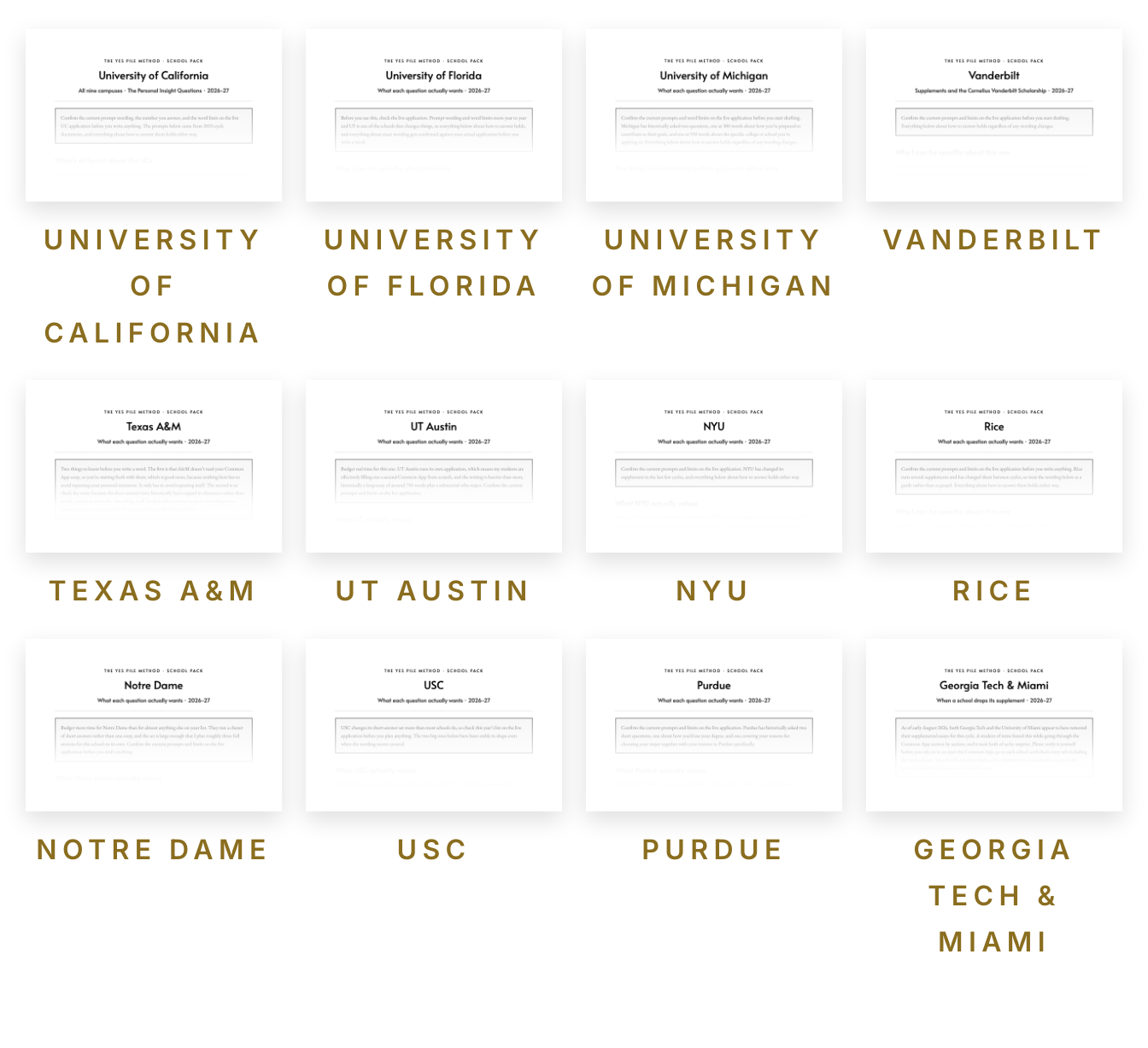
I've worked with students applying to the same schools year after year, and after enough of them you start to see exactly what the strong supplements have in common and what the weak ones keep doing. So I built twelve school packs out of that.
Each one tells you what that college actually values, what every one of its questions is really asking, the traps students fall into on that specific school, and a weak versus strong answer for every prompt.
Schools included:
Vanderbilt
Rice
NYU
USC
Notre Dame
Georgia Tech
University of Michigan
Miami
University of Florida
UT Austin
Purdue
Texas A&M
University of California: all nine campuses, all eight Personal Insight Questions
How to Build Your Activities List
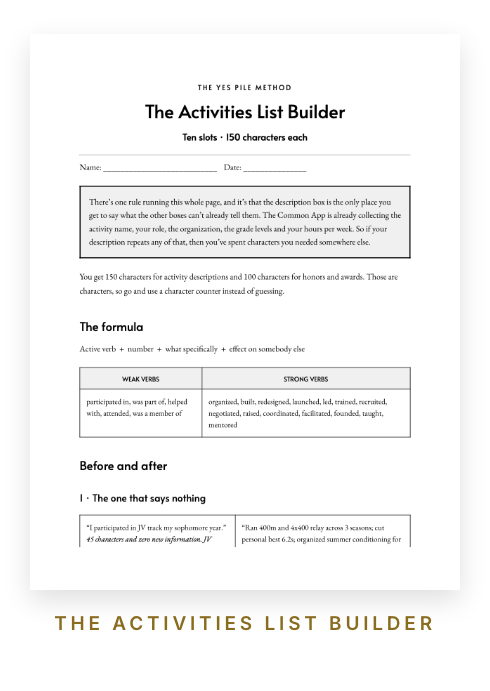
Ten slots, 150 characters each, and most students spend about twenty minutes on the whole thing after spending two months on the essay. It's the easiest place in the entire application to gain ground, because almost nobody bothers trying. So what does a good one look like?
11 · The Activities List Builder gives you ten slots with real before and afters, so a line that currently reads "member of debate team, competed at tournaments" turns into something an admissions officer actually stops on.
And as a bonus...
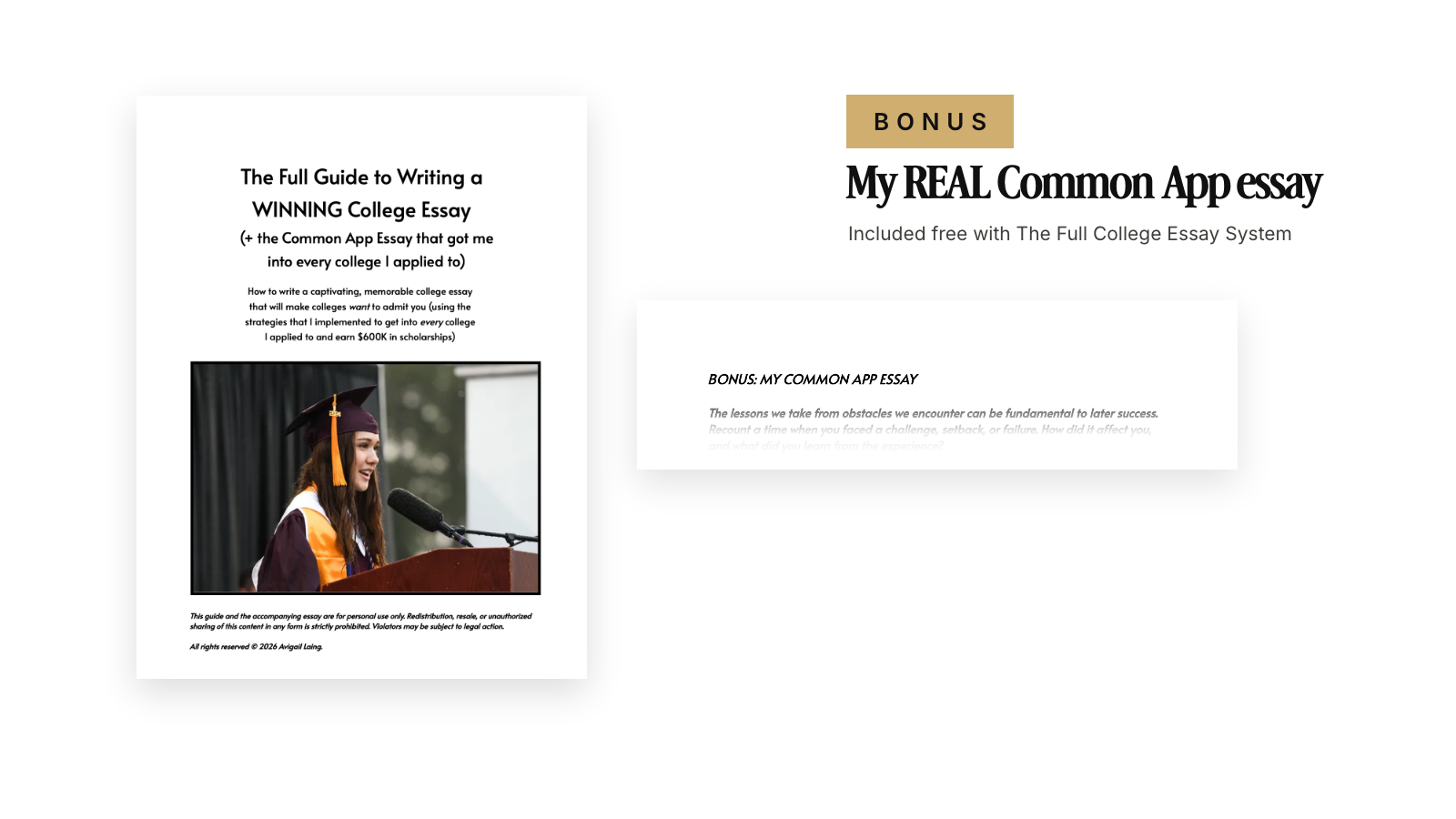
My real Common App essay. The one that got me into every college I applied to.
You get the whole thing, not a paragraph of it, with my notes down the side on what every paragraph is doing and why I wrote it that way.
Everything else in here teaches you the method one piece at a time. This is what it looks like finished.
Why Trust Me?
I get results. I have helped 1,000+ students write essays that got them into their dream schools like Cornell, Penn, NYU, Rice, Vanderbilt, Georgia Tech, UC Berkeley, UCLA, and Georgetown.
Here is what my strategy got me:
Accepted into EVERY college I applied to, including highly selective schools like NYU (7.7%), Rice (7.9%), and Georgia Tech (10% OOS)
$260K full ride scholarship to Vanderbilt University, awarded to only a few applicants across the entire pool of students who apply to Vanderbilt
$25K/year Presidential Scholarship at the University of Miami
$20K/year Gator Nation Scholarship at the University of Florida + accepted to the UF Honors Program (6% acceptance)
$2,500 National Merit Scholarship, only given to 2,500 of the 15,000 National Merit Finalists based on an essay-based application submitted by Finalists
Named one of 161 U.S. Presidential Scholars by the Department of Education, the highest honor a high school student can receive in the United States
Want proof? Here's what my students got:
Full tuition scholarship to NYU Shanghai, worth $71,500 a year
Full ride to NYU, housing included
Accepted to Penn, and to UC Berkeley with a Regents Scholarship
Accepted to Dartmouth, Cornell, Tufts, Bowdoin, UNC and UT
Accepted to Cornell ILR, plus $10K+ scholarships at UF and Indiana Kelley
Accepted to Rice
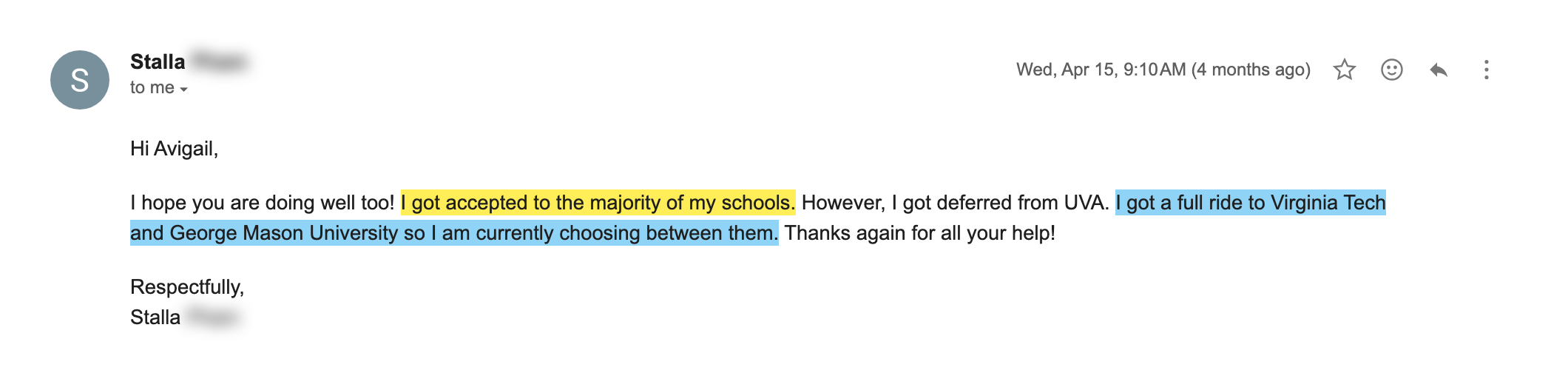
Accepted to Michigan, UCLA, UCSD, Emory and Vanderbilt with the Crescere Aude Scholarship
Accepted to West Point
Accepted to the University of Pittsburgh with a 3.18 GPA, which the student called a reach, and she believes her essay is what got her in


A NOTE ON SHARING
Each pack is licensed to one person. Please don't post it or send it on. I'd much rather your friend bought their own.
Not sure yet? Take the first document for free.
01 · The Yes Pile Test is in the pack, and it's also the one I give away, because it's the fastest way to find out whether this is built the way you need it to be.
Ten questions, about five minutes, and at the end it tells you which of six things your essay is doing right now, which of the four stages you're actually at, and which documents to open first. Most students find they're a stage earlier than they thought.
If it's useful, the other 35 are the ones that do something about what it found.