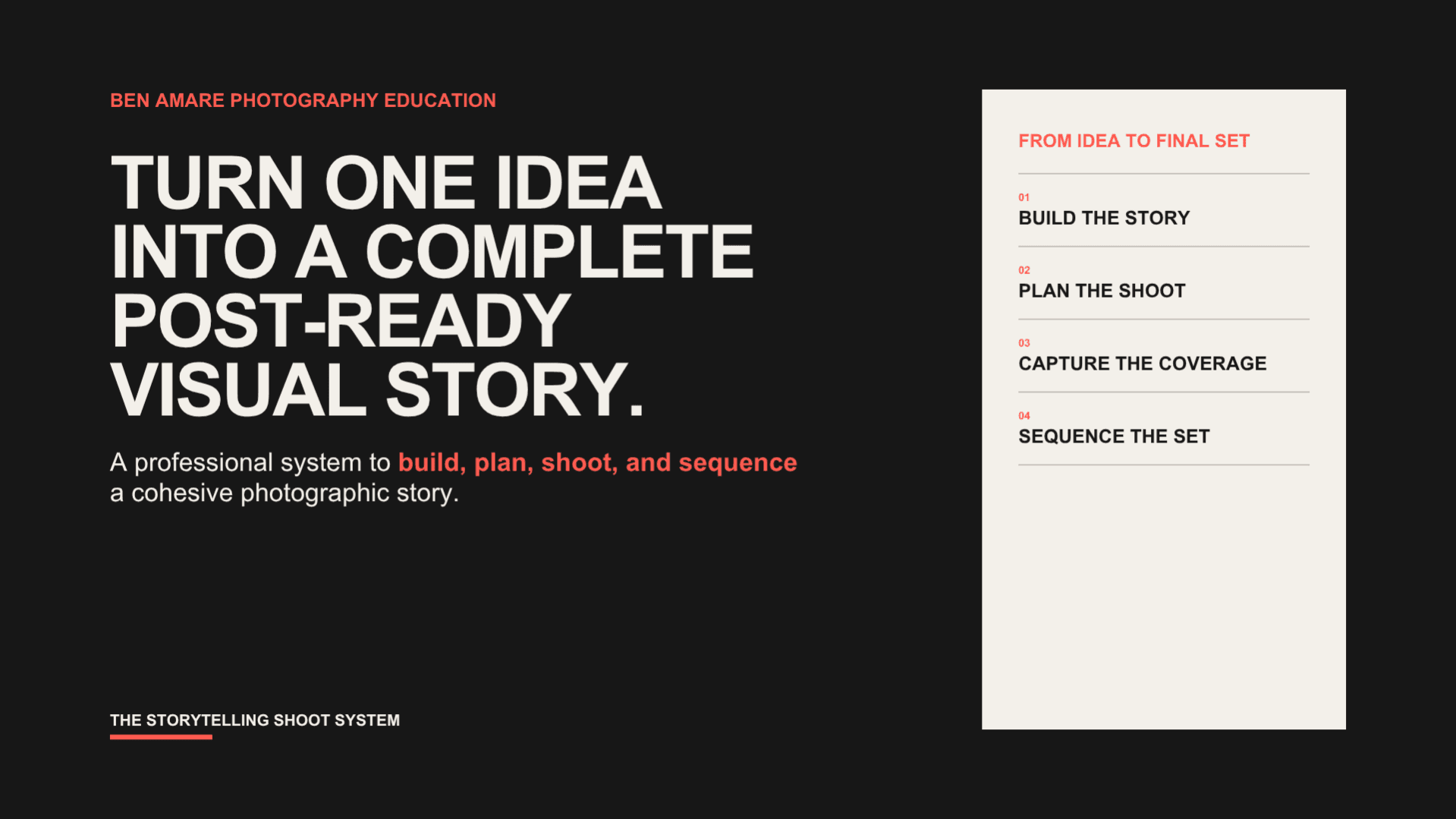
The Storytelling Shoot System
$49$69
"How do I turn a photoshoot idea into a post-ready story... not just a collection of hero photos?
You may already know how to make a strong image. The harder part is creating an entire set that feels connected, intentional, and complete.
The Storytelling Shoot System gives you the professional planning process for taking a loose idea and turning it into a story you can clearly communicate, photograph, and sequence.
Instead of arriving with a folder of inspiration and hoping the shoot comes together, you will know what the story is, what each person needs to create, which shots you need, how the day should run, and how the final images belong together.
Use the system to...
- Plan magazine submissions and editorials with enough variety and narrative flow to feel publication-ready
- Build campaigns and brand shoots from the creative idea through the team and technical execution
- Create personal projects and portfolio tests into complete bodies of work—not just isolated hero images
- Create more visually enticing Instagram carousels with curiosity, rhythm, and a reason to keep swiping
- Communicate the vision clearly to models, stylists, hair and makeup artists, assistants, clients, and collaborators
- Decide which shots, lenses, lighting setups, equipment, locations, outfits, actions, and moments the story actually needs
- Reduce repetitive coverage and leave set with intentional visual variety
- Cull and sequence the final photographs so the story is ready to submit, present, publish, or post
For the photographer who wants to...
- Walk onto set knowing exactly what they are creating
- Make images that connect instead of merely matching aesthetically
- Communicate more professionally with models, stylists, hair and makeup artists, assistants, and clients
- Capture enough intentional variety to build an editorial, campaign, portfolio story, or carousel
- Stop overshooting the same idea and hoping to find the story afterward
- Leave with a set that is easier to cull, edit, sequence, submit, and publish
What's in the guide...
- The One-Line Story: Define the simplest version of the story so every decision has one creative anchor.
- The High-Level Workflow: See how the creative, production, scheduling, and post-production layers connect.
- The Moodboard Framework: Organize references by location, wardrobe, beauty, emotion, lighting, composition, texture, and visual treatment.
- The Visual Shoot Plan: Translate the moodboard into clear directions for the model, locations, outfits, hair and makeup, props, action, and production needs.
- The Technical Master Shot List: Plan the exact frames, action or moment, lens, lighting, equipment, orientation, and technical requirements—including specialty coverage such as aerial or drone images.
- The Shot Coverage Reference: Use an expansive cheat sheet of shot types when building your custom shot list. It is a reference tool, not another workflow step.
- The Run of Show: Put the creative and technical plan into a realistic shooting order.
- The Call Sheet: Give the full team the time, place, contacts, schedule, wardrobe, and production details they need.
- The Culling Guide: Select for story, variety, emotional rhythm, technical quality, and usefulness—not personal attachment alone.
- The Post-Ready Sequence: Arrange the final set to create curiosity, rhythm, and a satisfying visual experience. Begin with a hero, a subject reveal, or an intriguing detail depending on the story and grid.
What you will leave with
By the end of the process, you will have one clear story, an organized moodboard, a Visual Shoot Plan, Technical Master Shot List, Run of Show, Call Sheet, Culling Guide, and Post-Ready Sequence—all built around the same creative vision.
What this is not
This is not a generic list of poses or a rigid formula that makes every story look the same. It is a repeatable planning system that helps you make stronger creative decisions while leaving room for intuition, discovery, and the unexpected on set.