The Job Search and Networking Tracker
$12
The Job Search Tracker
The difference between 40 applications and 4 offers isn't effort. It's follow-through.
You applied to 40 jobs. You can name maybe six.
You don't remember which recruiter you spoke to at which company. You never sent the thank-you note. The referral your old coworker offered three weeks ago is still sitting in an unanswered DM.
That's not a discipline problem. A job search is a full-time project running on top of your actual full-time job, and nobody ever hands you a project plan for it.
This is the project plan.
What actually changes when you track your search
You stop losing warm leads to silence. Most opportunities don't die from rejection. They die from a follow-up that never happened - a recruiter who said "check back in two weeks" and never heard from you again. When every conversation has a follow-up date attached, you stop leaking the pipeline you already built.
You interview better, because you prepare from notes instead of memory. When you walk into a final round already knowing what the hiring manager said in round one, which priority she mentioned twice, and what you promised to send her - you sound like someone who's already on the team. That's not a personality trait. That's a record.
You get honest data about what's working. Thirty applications with two responses isn't bad luck; it's a signal your resume or your targeting is off. But you can't see that pattern until the applications are sitting in rows in front of you. A tracker turns a demoralizing blur into a diagnosis you can actually act on.
You negotiate from a stronger position. When you can see three live processes at once with their timelines side by side, you know whether you have leverage and when to use it. People who accept the first number often do it because they've lost track of what else is still open.
You stop starting from zero. Most people delete the whole thing the day they accept an offer. The network tab is the asset - it's what makes your next search take weeks instead of months.
What's inside
Six tabs, built by an HR leader who's read thousands of applications from the other side of the table.
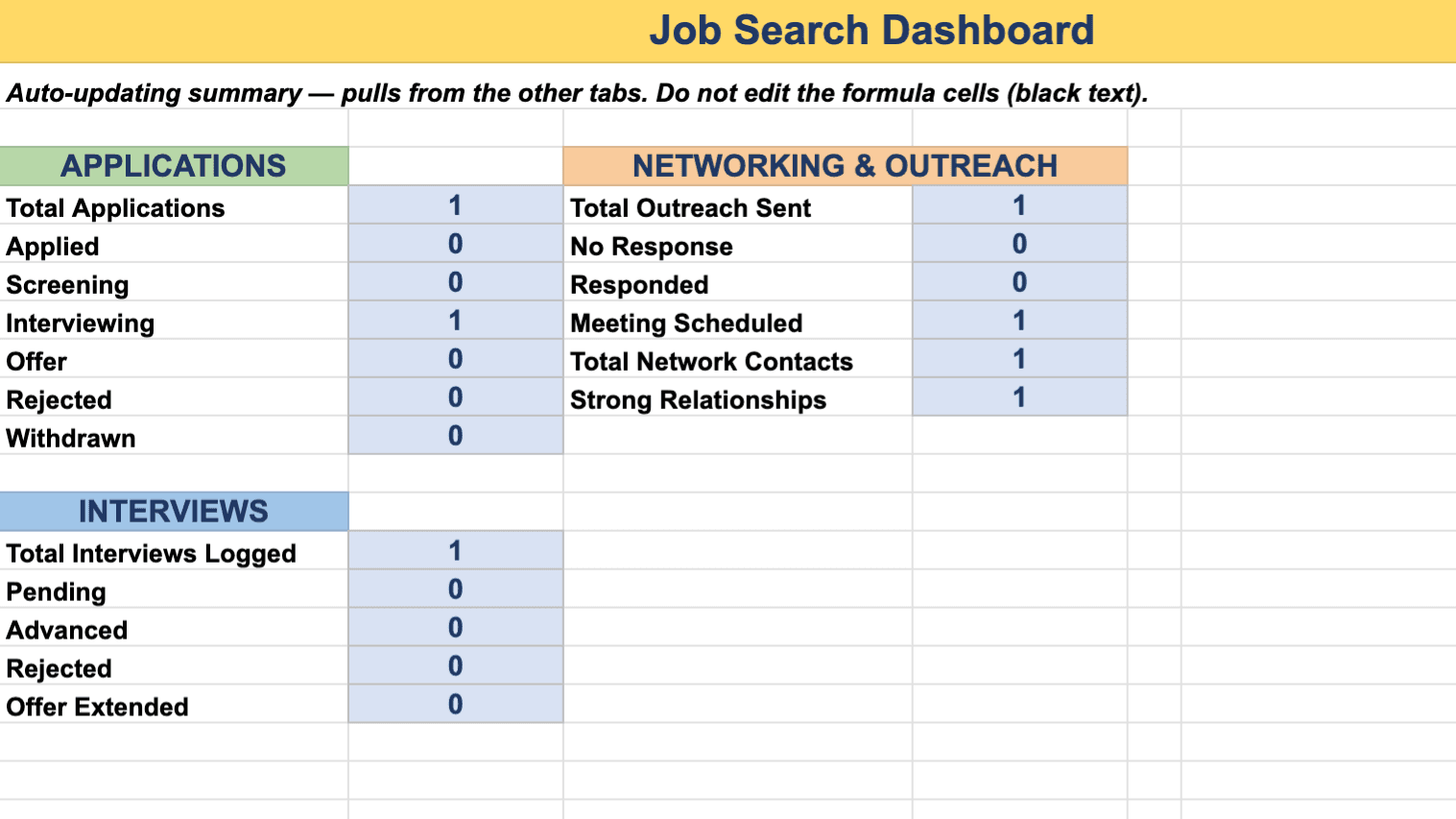
Dashboard — Live counts of where every application stands. Updates itself as you fill in the other tabs, so you always know what's actually in play.
Job Applications — Every role, source, salary range, status, and follow-up date in one place.
Interview Tracker — One row per round, with interviewer names, prep notes, and thank-you tracking.
Outreach Tracker — Cold messages, warm intros, and coffee chats, each with a follow-up date attached.
Network Connections — The relationships you keep whether you're searching or not.
How To Use It — A five-minute setup guide.
Dropdowns are pre-built. Formulas are locked. You open it, make a copy, and start typing.
Who this is for
You're actively applying and it's getting away from you.
You're passively looking while employed and need a system that survives a busy week.
You're networking your way in, and your follow-ups keep falling through.
Who this isn't for
If you want someone to rewrite your resume, this isn't that. This is the system that runs underneath the search and makes everything else you're doing actually compound.
Why I built it
I got hired in 27 days while working full time. Not because I applied to more jobs - because I always knew which conversations were live and which ones needed a nudge that week. It helped me run a successful job search in less than 5 hours a week.
The people who get hired faster usually aren't working harder. They have a repeatable system.
$12
Instant access
Google Sheets - one click to copy
Free lifetime updates
Get the tracker →