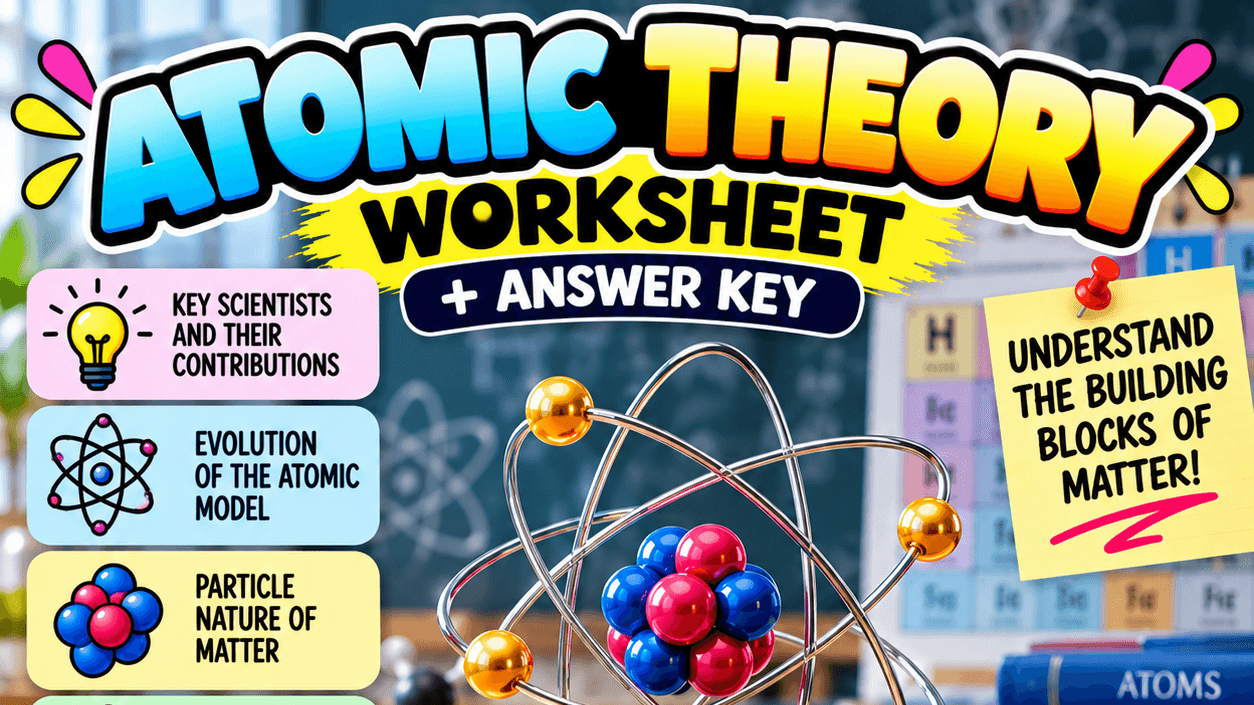
Atomic Theory Worksheet + Answer Key
$12
Take your students on the journey from Dalton's solid sphere to Schrödinger's electron cloud, and help them understand why the model of the atom kept changing. This worksheet goes beyond memorizing names and dates. It teaches students to connect each atomic model to the experimental evidence behind it.
It's ready to use as an introduction to the atomic structure unit, classwork, homework, review, or a sub plan.
What's included:
Part 1: Chronological Graphic Organizer. A visual timeline of Dalton, Thomson, Rutherford, Bohr, and Schrödinger, showing each scientist's year, key experiment, model name, and major discovery. Students sketch each model in large drawing boxes, creating a one-page summary of the unit.
Part 2: "Who Am I?" Matching & Evidence Connection
10 matching questions connecting each scientist to their model and experiment
6 evidence-based questions where students identify the scientist behind real experimental results and explain what each one proved
Worked examples to model strong answers
Part 3: Critical Thinking (CER). 2 Claim, Evidence, Reasoning questions asking students to explain why Thomson's and Bohr's models had to be replaced. Separate lined boxes for each part guide students through structured scientific writing.
Complete answer key with a drawing of each atomic model, every matching and evidence answer, and full sample CER responses you can use as exemplars.
Why teachers love it:
It supports the Next Generation Science Standards (NGSS)emphasis on how scientific models are developed and revised as new evidence appears, and the CER practice builds the reasoning and writing skills students need for standardized chemistry assessments.
Details:
6 pages (4-page worksheet + 2-page answer key). Printable PDF. Best for high school chemistry and physical science (Grades 9–12).
Created by a chemist with a Master's in Chemistry from the University of Tennessee.