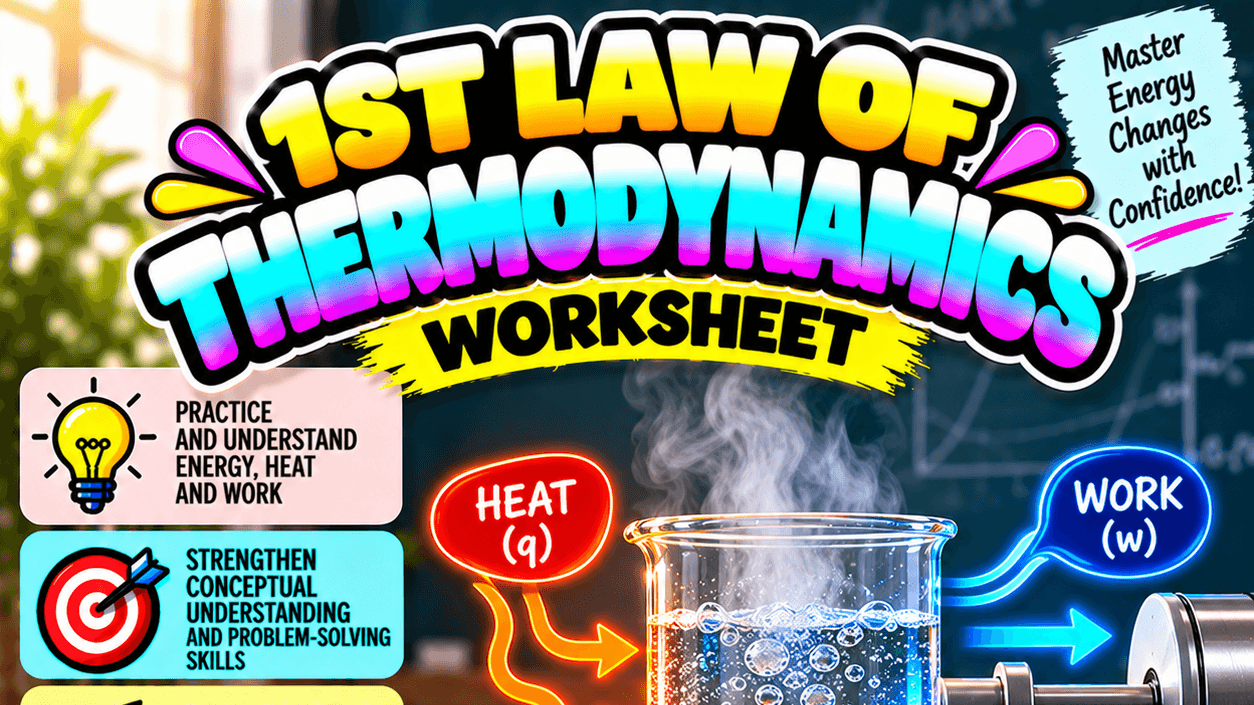
First Law of Thermodynamics Worksheet
$10
Help your students understand where energy goes in chemical reactions and phase changes. This worksheet teaches the First Law of Thermodynamics through clear explanations, visual diagrams, and everyday examples students recognize, from hand warmers and campfires to melting chocolate and fireworks.
Use it for classwork, homework, review, or a sub plan.
What’s included:
Clear introduction to the First Law. Energy cannot be created or destroyed, only transferred. Includes definitions of system, surroundings, and heat.
Exothermic vs. endothermic comparison with diagrams showing heat flowing out of or into the system, the sign of ΔH, and whether the surroundings get warmer or colder.
Helpful tip box for identifying heat flow, including how phase changes (melting, freezing, evaporating, condensing, subliming) fit in.
Part 1: System, Surroundings & Heat Flow chart. 13 real-world scenarios such as a candle burning, frying an egg, dew forming, dry ice subliming, an ice pack on a sprained ankle, and fireworks. For each, students identify:
exothermic or endothermic
the sign of ΔH (+ or −)
the system and the surroundings
where heat flows from and where it flows to
The first row is completed as an example, and there’s plenty of room to write.
Part 2: Critical Thinking (CER). A lab scenario based on instant cold packs. Students use real data to make a claim, cite evidence, and explain their reasoning using the First Law.
Complete answer key with the full chart and a sample CER response.
Why teachers love it:
Students go beyond memorizing “exothermic = hot.” They learn to identify the system and surroundings and trace the direction of heat flow, which is the foundation for thermochemistry, calorimetry, and energy diagrams.
Details:
4 pages (3-page worksheet + 1-page answer key). Printable PDF. Best for high school chemistry (Grades 9–12).
Pairs well with my Energy Diagrams worksheet for a complete thermochemistry unit.