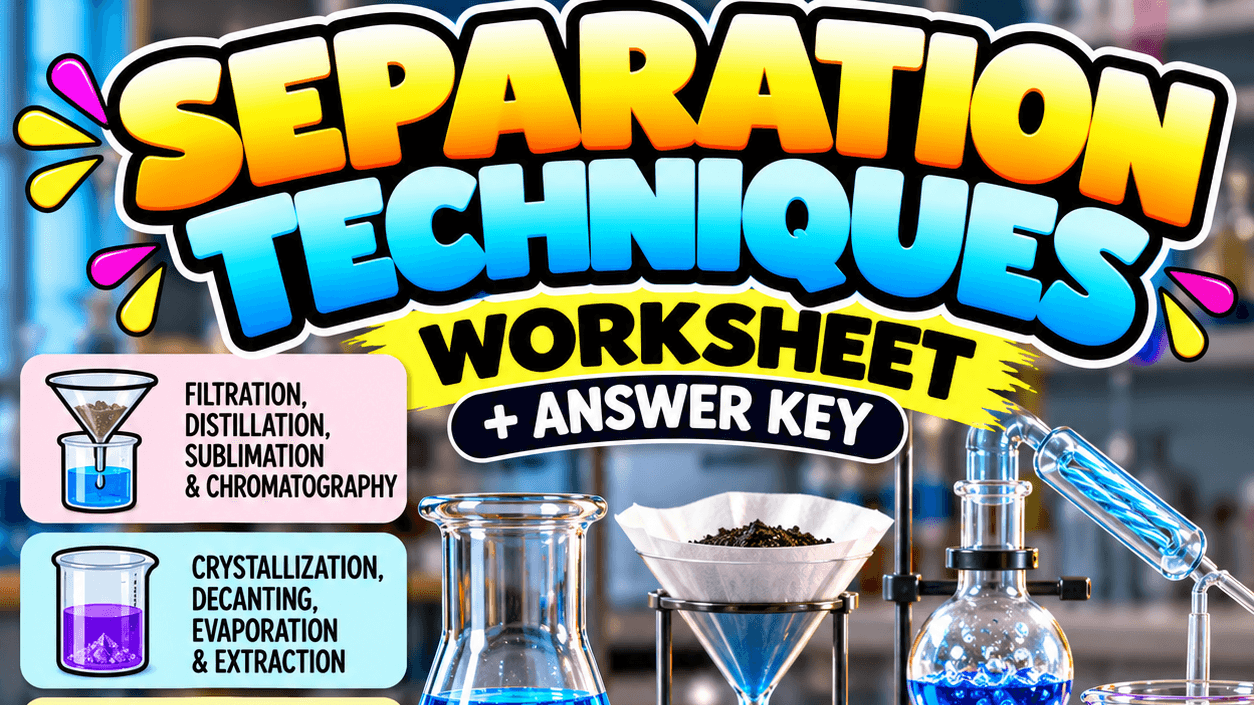
Separation Techniques Worksheet + Key | 12 Methods
$12
Teach students how to separate mixtures, and why each method works. This worksheet introduces 12 separation techniques with realistic illustrations and real-world examples, then challenges students to choose the right technique for 20 different mixtures and explain the physical property behind each choice.
It works for classwork, homework, review, or a sub plan.
What's included:
Clear introduction explaining that separation divides a mixture into pure substances using differences in physical properties such as particle size, boiling point, solubility, density, and magnetism.
12 separation techniques, each with a realistic lab illustration, the physical property it uses, a short explanation of how it works, what it's used for, and a real-world example:
evaporation, magnetic separation, chromatography, decanting
distillation, sieving, crystallization, centrifugation
filtration, extraction, sublimation, flotation
20 practice mixtures with everyday and lab scenarios like tea leaves, vanilla extract, liquefied air, recycling, and the spin cycle of a washing machine. For each one, students name the separation technique and explain the physical property that makes it work.
2 multi-step challenge problems (★) where students list several techniques in order to separate a mixture completely.
Complete answer key with the correct technique and a clear explanation for every mixture, including alternate acceptable answers.
Why teachers love it:
Students don't just memorize the names of techniques. They learn to think through how substances in a mixture differ physically, a reasoning skill that builds a strong foundation for chemistry.
Details:
5 pages (4-page worksheet + 1-page answer key). Printable PDF. Great for middle school science and high school chemistry (Grades 6–10).
Created by a chemist with a Master's in Chemistry from the University of Tennessee.