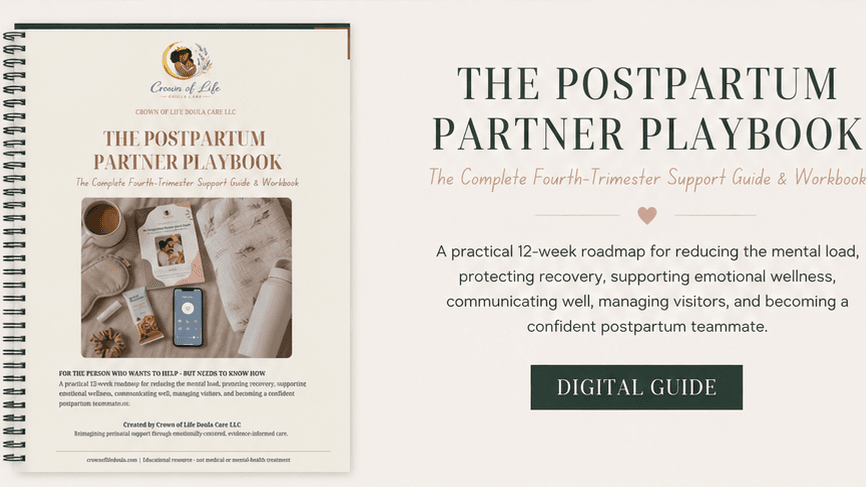
The Postpartum Partner Playbook
$37
She shouldn’t have to recover from birth, care for a newborn, manage the household and manage her partner, too.
The Postpartum Partner Playbook was created to help partners go beyond simply saying:
“Just tell me what you need.”
Because when Mom is exhausted, recovering, adjusting emotionally, and caring for a newborn, the last thing she needs is another person waiting for instructions.
This comprehensive guide gives partners a practical roadmap for learning how to notice, communicate, take ownership, protect recovery, reduce the mental load, and become an active member of the postpartum team.
🤎 Inside the Playbook:
A 12-Week Postpartum Roadmap
Understand how support needs can change from the first 72 hours through the first three months postpartum.
The First 72 Hours
Learn what to prioritize during the transition from birth to home—including recovery, rest, communication, appointments, and support.
The First Two Weeks
Get clear about meals, household responsibilities, visitors, rest, feeding support, appointments, and everyday care.
Understanding the Mental Load
Learn why completing tasks isn't always the same as taking ownership—and how to stop making Mom manage everything behind the scenes.
Maternal Mental Wellness
Learn how to recognize meaningful changes, communicate concerns compassionately, and understand when additional professional support may be needed.
Feeding Support Without Pressure
Learn how to support breastfeeding, pumping, combination feeding, or formula feeding without adding judgment or pressure.
Visitors, Boundaries & Privacy
Create a plan for visitors, family expectations, photos, social media, privacy, and protecting Mom's recovery time.
Communication & Relationship Support
Use practical check-ins to communicate needs, divide responsibilities, address resentment, and work together when you're both exhausted.
Weeks 3–12
Continue supporting recovery and adjustment even after everyone else assumes things are “back to normal.”
Return-to-Work Planning
Prepare for another major transition by discussing childcare, household responsibilities, nighttime expectations, and changing routines before the return date arrives.
Partner Wellness
Because partners can struggle during the postpartum transition, too.
PLUS — Interactive Worksheets & Tools
This isn't just something you read and forget.
You'll also receive practical tools you can complete together, including:
✓ “What Does Support Look Like to You?” Couple Exercise
✓ Mental Load & Responsibility Planner
✓ Visitor Agreement Worksheet
✓ Nighttime Responsibilities Planner
✓ Mental-Wellness Baseline Worksheet
✓ Postpartum Support Village Planner
✓ Return-to-Work Conversation Worksheet
✓ Weekly Couple Check-In
✓ Provider & Emergency Information Sheet
✓ First 72 Hours Checklist
✓ First 14 Days Checklist
✓ Real-Life Postpartum Communication Scripts
And one of my favorites:
30 Ways to Support Her Without Asking What She Needs
Because sometimes the most supportive thing a partner can do is simply notice—and take care of it.
This Playbook is for you if...
🤎 You’re expecting a baby and want to prepare as a team.
🤎 Your partner genuinely wants to help but isn’t sure what good postpartum support actually looks like.
🤎 You’re tired of hearing, “Just tell me what you need.”
🤎 You want to discuss responsibilities, visitors, boundaries, mental wellness, and expectations before you're both exhausted.
🤎 You want your fourth trimester to feel more intentional, supported, and collaborative.
You don't need a perfect partner.
You need a partner who understands that postpartum support is something you prepare for, communicate about, and actively participate in.
Created by Crown of Life Doula Care LLC
Reimagining perinatal support through emotionally-centered, evidence-informed care.
For educational purposes only. This resource does not diagnose or treat any condition and does not replace individualized medical, mental-health, lactation, pediatric, emergency, or other professional healthcare.