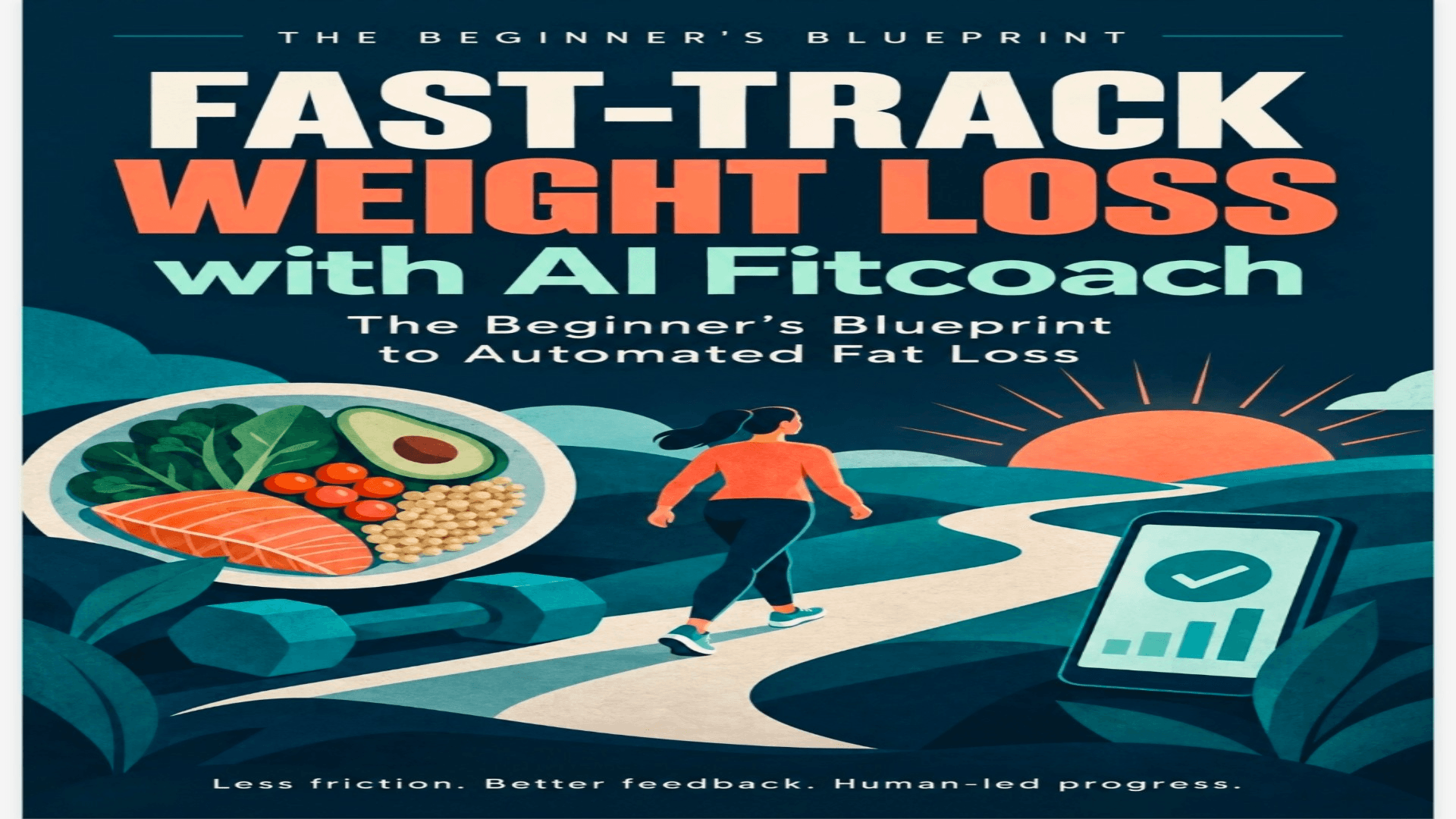
Fast Track Weight Loss
$9.99
This document, titled "Fast-Track Weight Loss with AI Fitcoach: The Beginner's Blueprint to Automated Fat Loss," is a practical guide designed to help adults use AI chatbots or fitness apps as personalized planning assistants for safe, gradual weight management and fitness. Rather than replacing human judgment or medical advice, it provides a structured framework to organize information, draft plans, and track progress with minimal setup friction.
Core Framework: The CLEAR Coaching Loop
The guide centers on an original planning framework called the CLEAR loop to maintain realistic, repeatable progress:
Check Reality: Report accurate, actual data regarding meals, movement, sleep, and available equipment.
Lower Friction: Simplify choices, save repeat meals, and request single substitutions rather than redesigning entire routines.
Execute: Complete the next small action, utilizing low-energy fallback options when necessary.
Assess: Evaluate multi-week trends in effort, recovery, hunger, and consistency.
Refine: Make one single adjustment at a time based on clear evidence.
Key Content & Chapter Overview
Chapter 1: Calibrating Your AI Reality Check
Establishes how to create an honest baseline and an onboarding "Coach Brief" specifying actual activity, equipment inventory, schedule constraints, and food preferences.
Details safety checks, equipment audits, and a 5-question quality gate to validate AI recommendations before adoption.
Chapter 2: Frictionless Nutrition via AI Photo Scanning
Explains energy deficits, protein prioritization (1.4–2.0 g/kg reference ranges for active adults), and balanced meal construction.
Outlines the Snap-Check-Save workflow to log meals via photos while correcting portion estimates and hidden ingredients.
Offers strategies for repeating familiar meals, eating at restaurants, traveling, and managing tight budgets.
Chapter 3: Forging Weekly Micro-Progressions
Outlines conservative 3-day and 4-day workout structures emphasizing strength, aerobic activity, and recovery.
Details exertion metrics using Session RPE (0–10 scale) and Set RIR (Repetitions in Reserve).
Provides a beginner movement library (squat, hinge, push, pull, core, conditioning) alongside a Readiness Traffic Light system (Green/Amber/Red) to adjust training based on fatigue or symptoms.
Chapter 4: Setting Up Proactive Behavioral Guardrails
Details how to map vulnerable eating windows and create if-then implementation plans paired with calendar reminders.
Includes three structured reset scripts to overcome all-or-nothing thinking, punishment/compensation urges, and emotional eating.
The Working Toolkit & Reusable Worksheets
Features a 14-day launch sequence, a weekly review prompt, troubleshooting steps for weight plateaus, and reusable worksheets (Baseline Audit, CLEAR Scorecard, Weekend Guardrail, and portable Coach Cards).