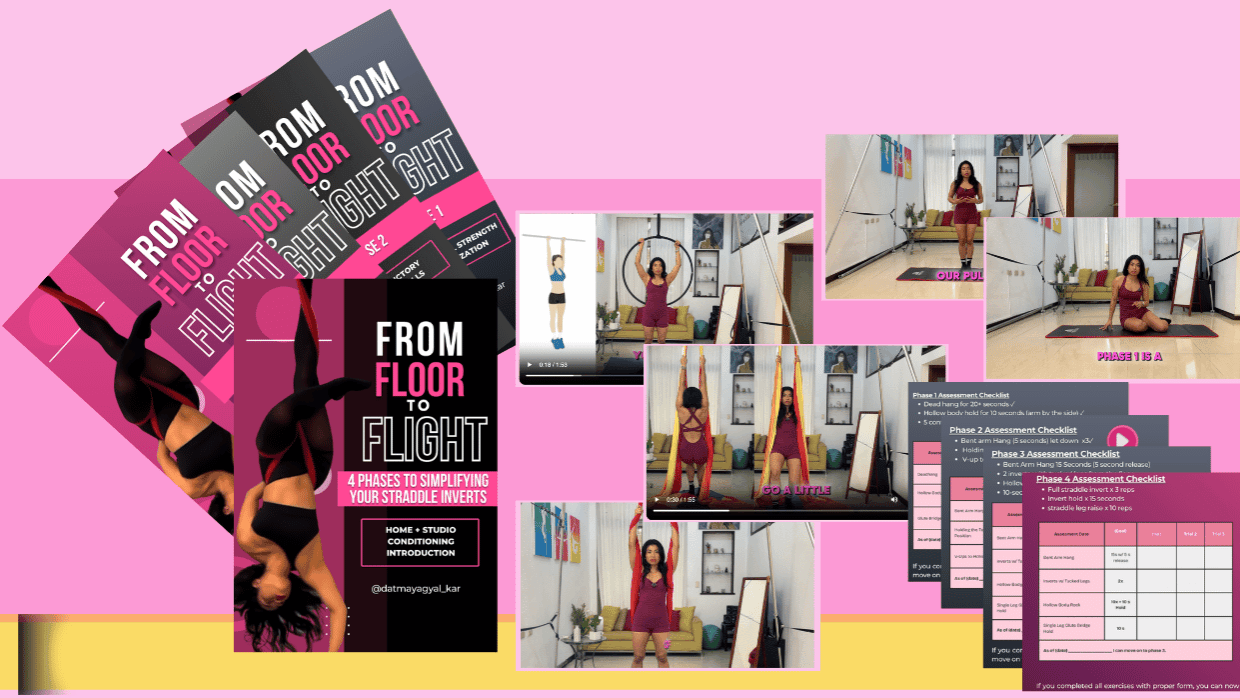
Floor-To-Flight
$78$178
Struggling With Your Aerial Invert? Stop Guessing. Start Building.
Build the strength, technique, and control to work toward clean, controlled aerial inverts.
The Floor to Flight Invert Conditioning Blueprint is a step-by-step conditioning program for aerialists training on hoop, hammock, or silks who are tired of trying random exercises and wondering why their strength isn't translating into the air.
Whether you're still building your foundation, struggling to lift your hips high enough, or relying on momentum to get upside down, you'll have a clearer path forward.
No more piecing together random drills. No more wondering what to train next.
Instead, follow a progressive system that helps you build the strength and technique your invert requires, one phase at a time.
Four progressive training phases
Ground and apparatus-specific conditioning
Progress trackers and phase assessments
Warm-up and follow-along videos
One year of program access
You're Training Hard. So Why Does Your Invert Still Feel So Hard?
You want to get upside down with control.
You want to lift your hips higher, hold your position, and stop feeling like your arms are about to give up halfway through.
But every training session seems to bring another frustration.
Your arms give out before you reach the top.
Your hips refuse to get high enough.
Your grip feels like it's crying for help.
You rely on momentum and struggle to control the position.
Your core works hard, but you still can't seem to make it happen.
You can invert from the floor, but taking that strength into the air feels like a completely different skill.
So you do more core exercises.
You save another conditioning video.
You try another set of drills.
You kick harder, squeeze everything you can think of, and hope that THIS time your hips will make it over.
And when it doesn't work?
You start wondering whether you're ever gonna be able to do it...
An Aerial Invert Is More Than Getting Upside Down
A stronger, more controlled invert can open up new possibilities in your aerial practice.
It can help you work toward:
More controlled entries into inverted positions.
Stronger, more deliberate transitions.
Better control when moving between levels.
A foundation for progressing toward more advanced skills and combinations.
Skills such as meathooks, flares, and dynamic drops may also be goals for your future training, depending on the individual skill requirements and your experience.
But here's the thing.
Just getting upside down isn't the whole goal.
You want to understand how to get there, develop the strength to support the position, and work toward controlling what happens next.
That's why this program focuses on more than simply kicking your legs overhead.
It helps you build the foundations, technique, and control required for your next stage of training.
Stop Piecing Together Random Drills. Follow a Clear Progression.
An aerial invert asks your body to coordinate several things at once.
You need foundational strength. You need grip and shoulder capacity. You need to develop your core and hip-flexor strength. You need to understand how to use your back and lats. And you need to learn how to apply those pieces to the actual movement.
Trying random exercises can leave you wondering which piece you're missing.
Floor to Flight gives you a structured path to work through instead.
Four phases. One step at a time.
PHASE 1 — Foundational Strength & Familiarization
Build your foundation before adding complexity.
Perfect if you're new to strength training, unsure how to engage your core, or still developing the foundational strength needed for aerial conditioning.
You'll work on accessible ground exercises and introductory shoulder, back, grip, core, glute, and hamstring conditioning.
The goal is to build body awareness and a foundation you can build upon.
PHASE 2 — Introductory Invert Drills
Start connecting your strength to the movement.
For aerialists who have some foundational strength and are ready for more challenging exercises.
Work on core and hip-flexor strength, bent-arm strength, lat engagement, grip, and supported inverted positions.
You'll begin developing a better understanding of the muscles and positions involved in your invert.
PHASE 3 — Intermediate & Assisted Inverts
Work toward more control instead of relying on momentum.
Build on your previous training with increasingly challenging conditioning and invert drills.
Focus on engaging your lats, controlling your inverted position, and developing the strength needed to work toward a more deliberate lift and descent.
PHASE 4 — Independent Full Aerial Inverts
Bring your training into the air.
For aerialists who have developed the necessary foundations and are ready to work toward independent aerial inversions.
You'll work toward lifting into the inverted position, achieving a stronger top position, and controlling your descent without relying on leg support.
Your progression depends on your starting point, consistency, recovery, and ability to meet the assessment criteria.
You don't have to start at Phase 1 if you already have the foundations.
Use the phase descriptions and assessments to identify an appropriate starting point, then progress when you're ready.
Real Progress Comes From Understanding What You're Doing
Meet Mariela
Mariela had been working toward her invert for around a year and a half.
When she joined Floor to Flight, she started at Phase 2.
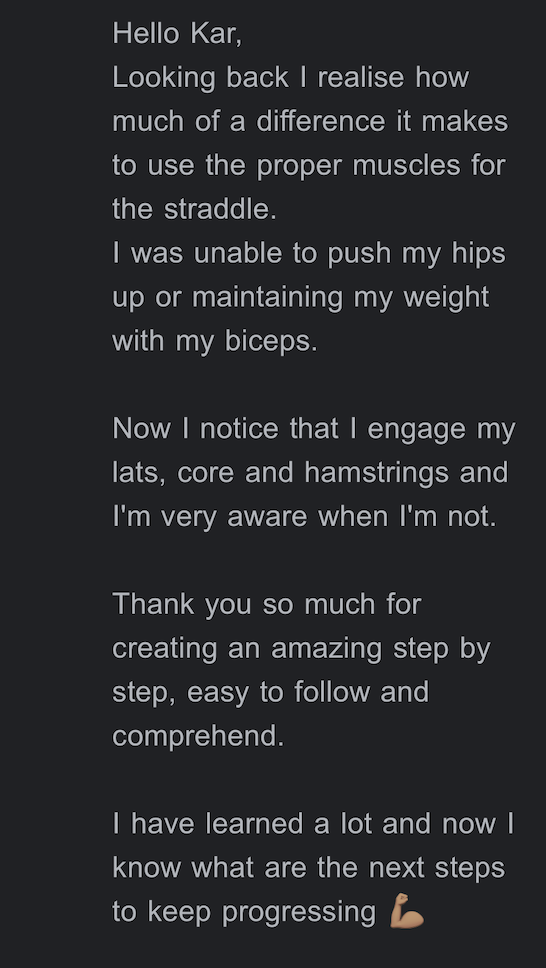
After approximately two months of training around once a week, she had developed enough control to hold her inverted top position, improved her understanding of lat engagement, passed her Phase 2 assessment, and progressed to Phase 3.
She wasn't magically transforming overnight.
She was learning how to engage her body differently and building on the work she had already done.
That's what I want for you: a clearer understanding of your training and meaningful progress you can build on.
Every aerialist starts from a different place, so your timeline and results may be different. Mariela's story is an example of what her own training journey looked like, not a promise of a particular result for everyone.
Why I Created Floor to Flight

I know how frustrating it is to work toward a skill and feel like everyone else has figured it out except you.
When I was working toward my own invert, it was easy to think that doing more core exercises, more back conditioning, or more attempts would eventually make everything click.
But effort alone didn't tell me what I needed to change.
I had to learn how to build the relevant strength, understand the technique, and break the movement down into pieces I could actually work on.
That experience shaped the way I approach teaching.
I started aerial in 2019, and teaching predominantly online has pushed me to become especially thoughtful about how I explain movement.
When you can't physically adjust a student, your cues have to make sense.
You have to identify the details that matter, explain what the student should feel or do, and help them understand how to apply it.
That's why I created Floor to Flight.
I wanted aerialists to have a structured training plan instead of having to figure out every step for themselves.
A program that helps you understand what to work on, gives you a way to track your progress, and helps you make more informed decisions about when to move forward.
Here's Everything You Get Inside Floor to Flight
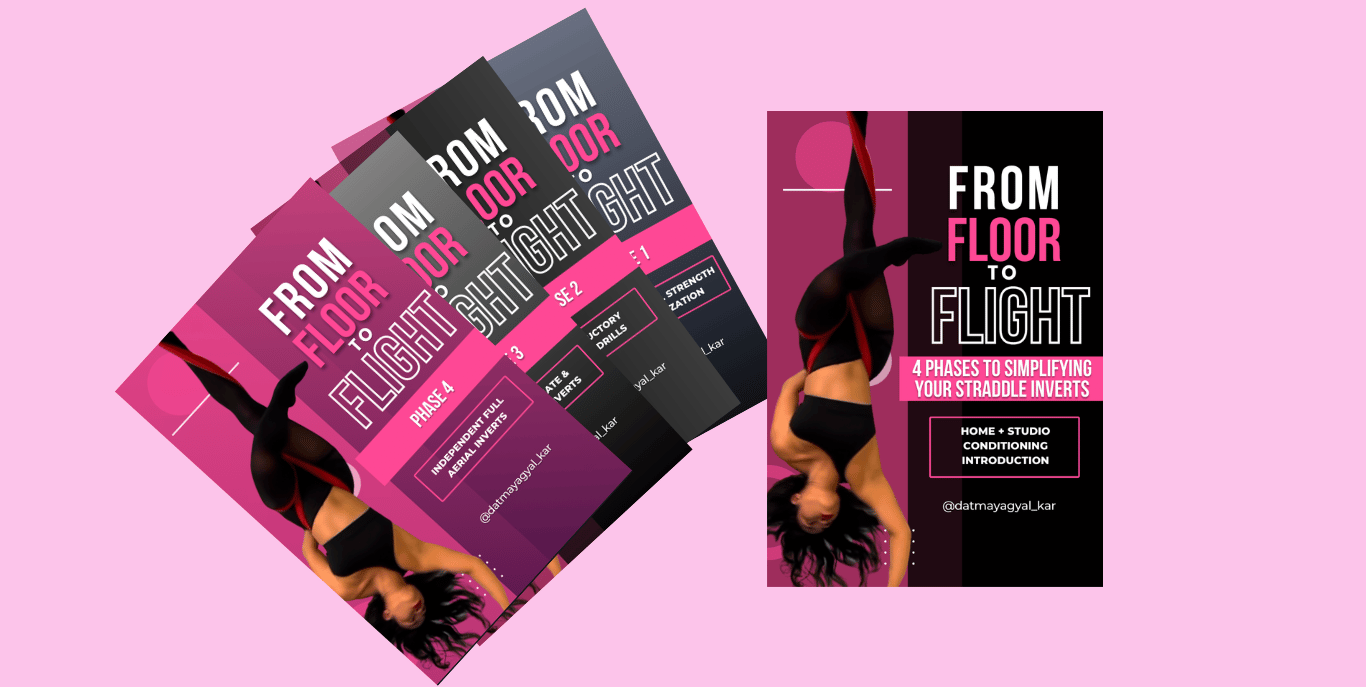
1. Four Progressive Training Phases
Instead of trying to piece together exercises from different sources, you'll have a structured sequence of training phases.
Each phase builds on the previous one so you can work on the foundations before progressing to more demanding drills.
Why it matters: You'll have a clearer idea of what to train next and how each stage fits into your bigger goal.
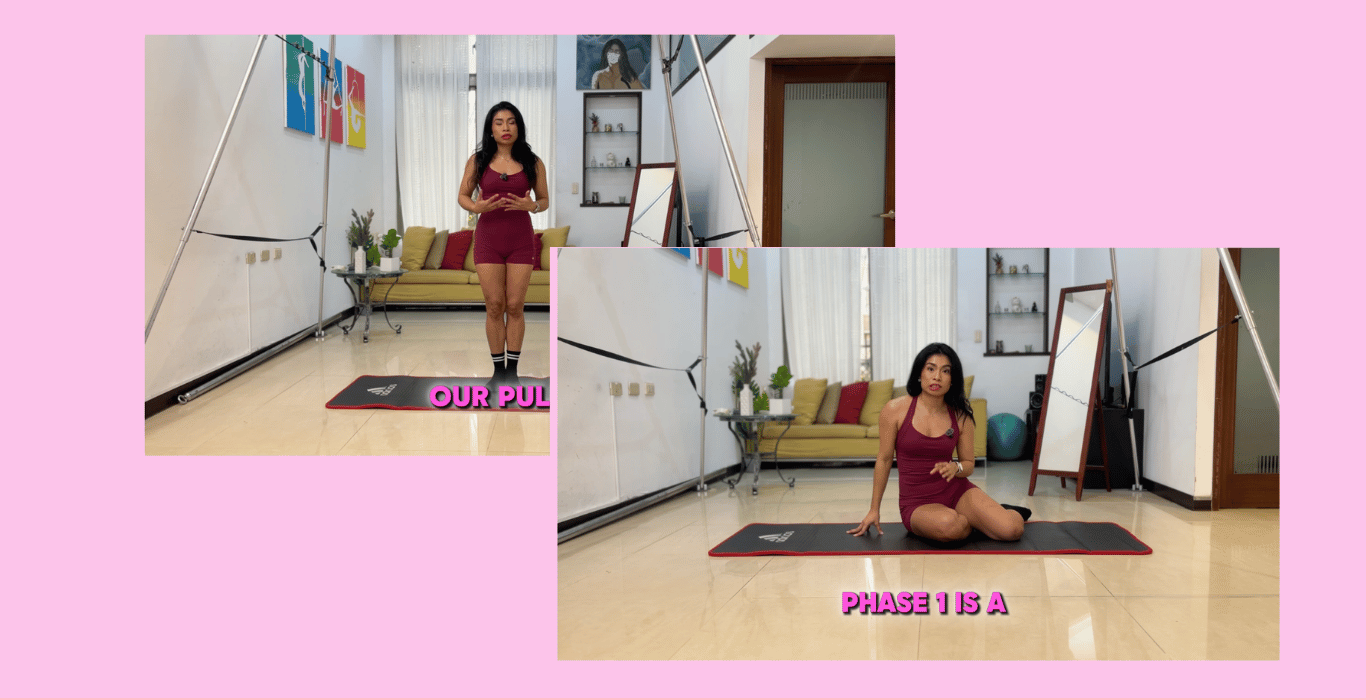
2. Ground Conditioning for Core, Glutes & Hip Flexors
Build foundational strength through targeted ground exercises.
You'll work on the muscles and movements involved in lifting and controlling your legs and pelvis.
Why it matters: You can develop relevant strength outside the apparatus instead of relying exclusively on repeated aerial attempts.
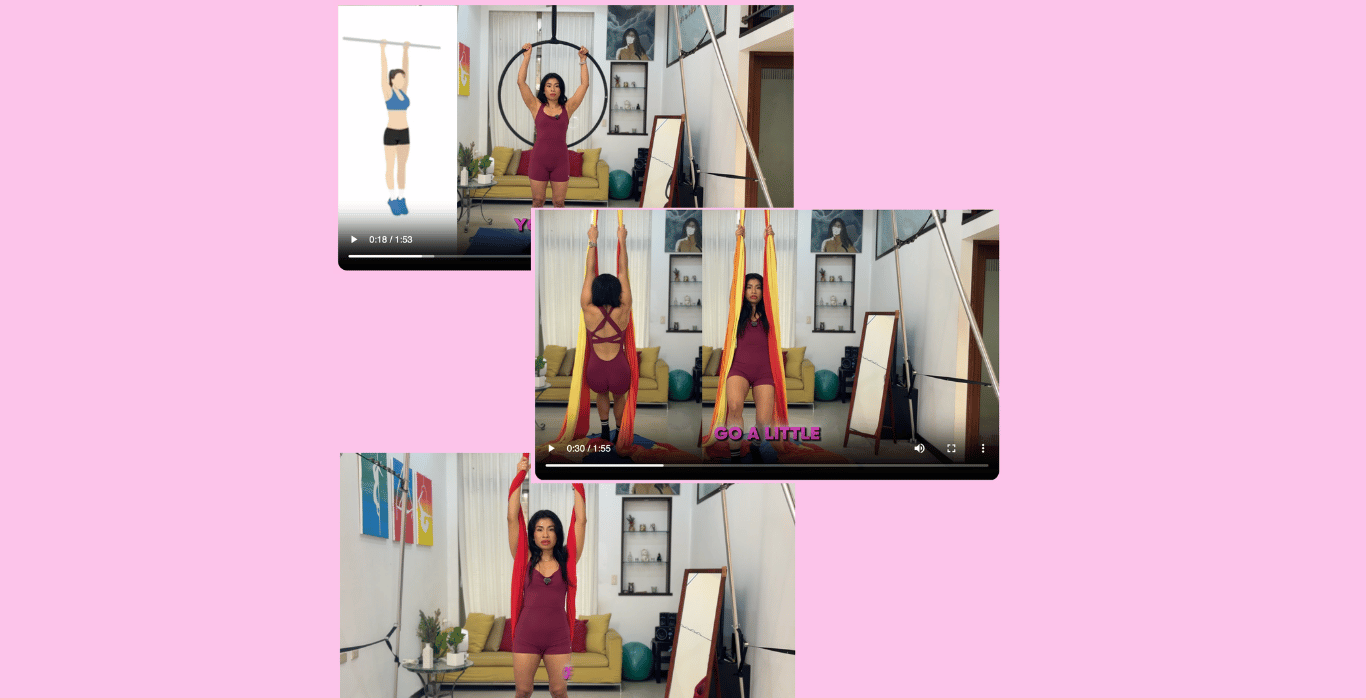
3. Apparatus Conditioning for Hoop, Hammock & Silks
Practice conditioning drills relevant to aerial training, with cues to help you understand your body position and technique.
Why it matters: You won't have to figure out how to translate every general fitness exercise into your aerial practice on your own.
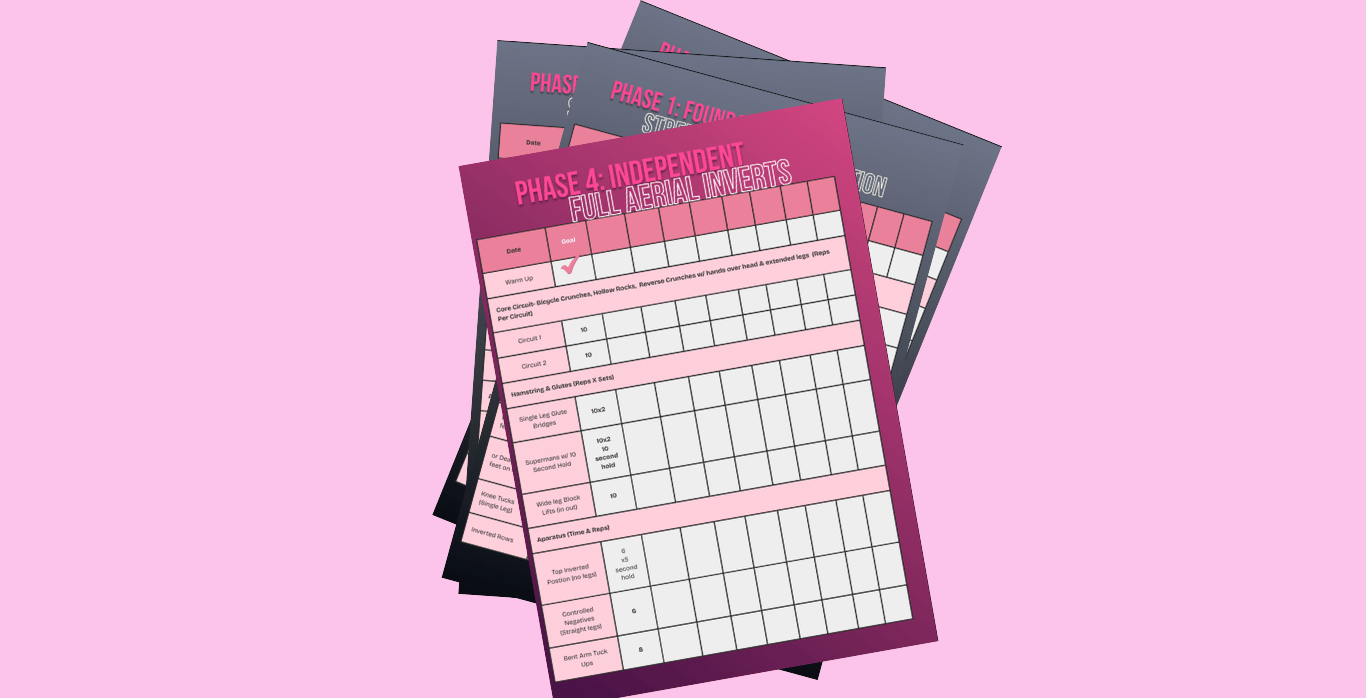
4. Progress Trackers for Every Phase
Record your training and keep track of the work you're completing.
Why it matters: You can look back at what you've done, notice changes over time, and make your progress more visible.
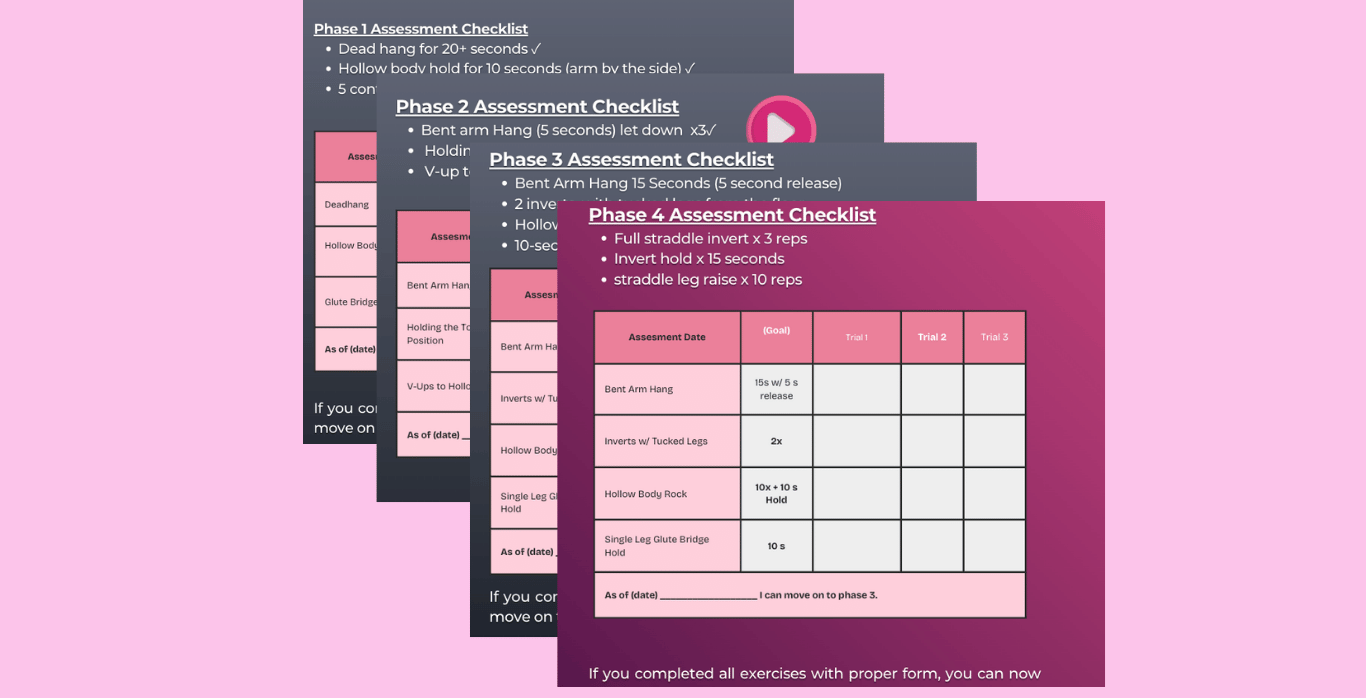
5. Self-Assessments w/ Follow Along Videos at Every Level
Each assessed phase gives you criteria to check before moving forward. Along with follow along with demonstrations of the assessment exercises.
Why it matters: You have a clearer way to evaluate readiness instead of relying only on the feeling that you're getting stronger.
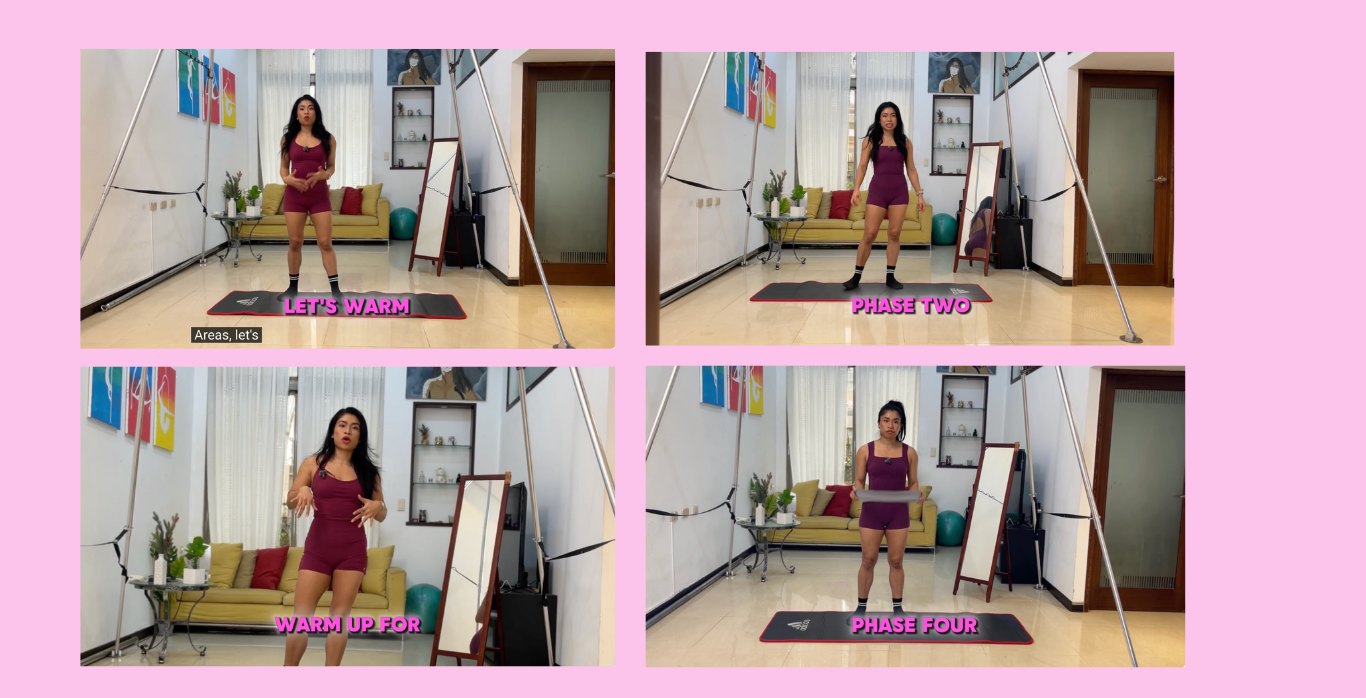
6. Warm-Up Videos for Every Phase
Follow the warm-up videos provided for your training phase.
Why it matters: You have a more structured starting point for each session.
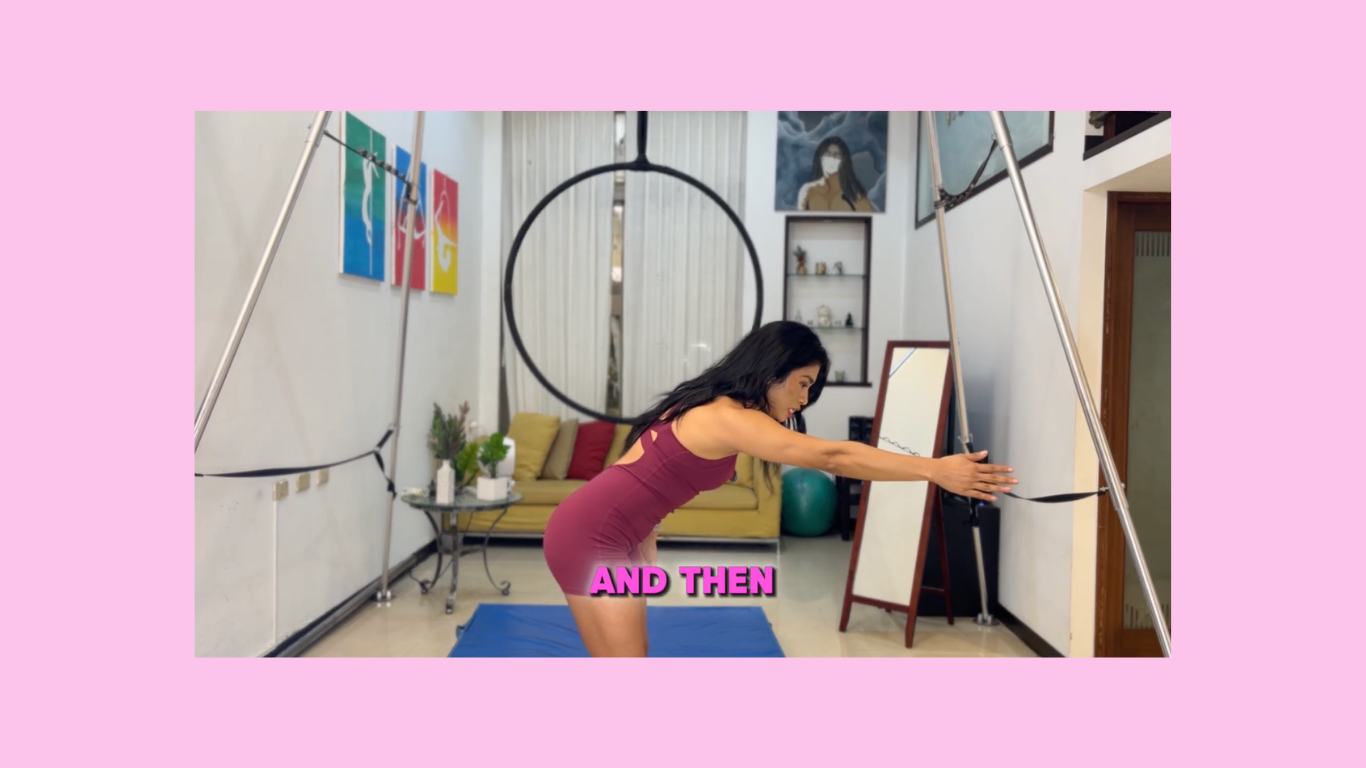
7. A Special Lat Activation Lesson
Struggle to feel your lats working during conditioning?
You're not alone. I struggled with this, too.
This lesson helps you explore lat engagement and understand the cues used throughout the program.
Why it matters: You can spend more time understanding the technique rather than endlessly wondering whether you're engaging the right muscles.
How Do You Know Which Phase to Start With?
You don't need to guess your way through the program.
Start by reading the phase descriptions and identifying the one that most closely matches your current abilities.
Then use the assessment at the end of the previous phase to check whether you can meet its criteria with the required form and control.
If you pass, you can begin the next phase.
If you don't pass yet, start with the earlier phase and work on the skills you need to develop.
If you're a complete beginner with no fitness background, start with Phase 1.
Remember that the goal isn't to reach Phase 4 as quickly as possible. It's to build the capacity you need for your next step.
This Program Is For You If...
You're an aerialist training on hoop, hammock, or silks.
You want to develop a stronger, more controlled invert.
You can kick up but struggle to control the top position.
You can invert from the floor but haven't yet translated that ability into the air.
Your arms, back, grip, or core seem to give out when you try to invert.
You're tired of collecting random conditioning drills without a clear plan.
You want a structured approach to building strength and technique.
You want to understand your progress rather than simply repeat the same attempts.
You just need to be willing to start at an appropriate level, train consistently, and give your body time to adapt.
This program is designed to help you work progressively—not to promise an instant invert.
What If You're Wondering...
"How long will it take me to get my invert?"
Every aerialist is different.
Your starting strength, technique, training frequency, recovery, and other individual factors all affect your progress.
The aim is to help you build the necessary foundations and work toward the next stage, celebrating meaningful improvements along the way.
"Can I start if I have no fitness background?"
Yes. Phase 1 is designed for people who are new to strength training and need to develop foundational strength and body awareness.
Start at the level appropriate for you rather than jumping into exercises you're not prepared to perform.
"Is this a gym program?"
No. The program is designed for at-home or studio training.
You'll work with ground exercises and your aerial apparatus.
You'll need:
Resistance bands
Yoga blocks
Access to the relevant aerial apparatus for the apparatus-based training
Make sure your training environment and apparatus setup are appropriate for the exercises you're performing.
"What if I'm already strong?"
You may be able to start at a later phase, depending on your current abilities.
Use the phase descriptions and assessments to guide your starting point rather than assuming you need to complete every exercise from the beginning.
"How often should I train?"
Follow the program's guidance for your phase, and allow adequate recovery between sessions.
Consistency matters, but more training isn't automatically better. Adjust your training to your ability, recovery, and any guidance from a qualified coach or healthcare professional where relevant.

Your 30-Day Strength & Technique Guarantee
I want you to be able to give the program a fair try without feeling like you're taking a completely blind leap.
Complete the program consistently for the first 30 days. If you see no progress in the strength or technique, you can request a full refund.
To qualify, you must:
Complete at least one training sessions per week for 30 days.
Submit before-and-after videos of your inversion attempts.
Follow the program and its relevant training instructions.
The guarantee is about progress in strength or technique—not a promise that every student will achieve a full aerial invert within 30 days.
Your Training Doesn't Have to Be Guesswork Anymore
You don't need to keep wondering whether another set of crunches will finally make your invert happen. You can stop collecting every conditioning drill you see online.
You can start where you are, build the foundations, and work toward the next step with a plan.
Floor to Flight Invert Conditioning Blueprint
A progressive conditioning program for aerialists training on hoop, hammock, or silks.
Four progressive phases
Ground and apparatus-specific conditioning
Progress trackers and assessments
Warm-up and follow-along videos
One year of access
A 30-day strength and technique guarantee, subject to the stated terms
Ps: Want Lifetime Access?
A lifetime-access upgrade is available at checkout for an additional $20, delivered as a PDF with clickable links.


Mariela Lopez H
Looking back I realise how much of a difference it makes to use the proper muscles for the straddle. I was unable to push my hips up or maintain my weight with my biceps. Now I notice that I engage my lats, core and hamstrings and I'm very aware when I'm not. Thank you so much for creating an amazing step by step, easy to follow and comprehend program. I have learned a lot and now I know what are the next steps to keep progressing 💪🏽