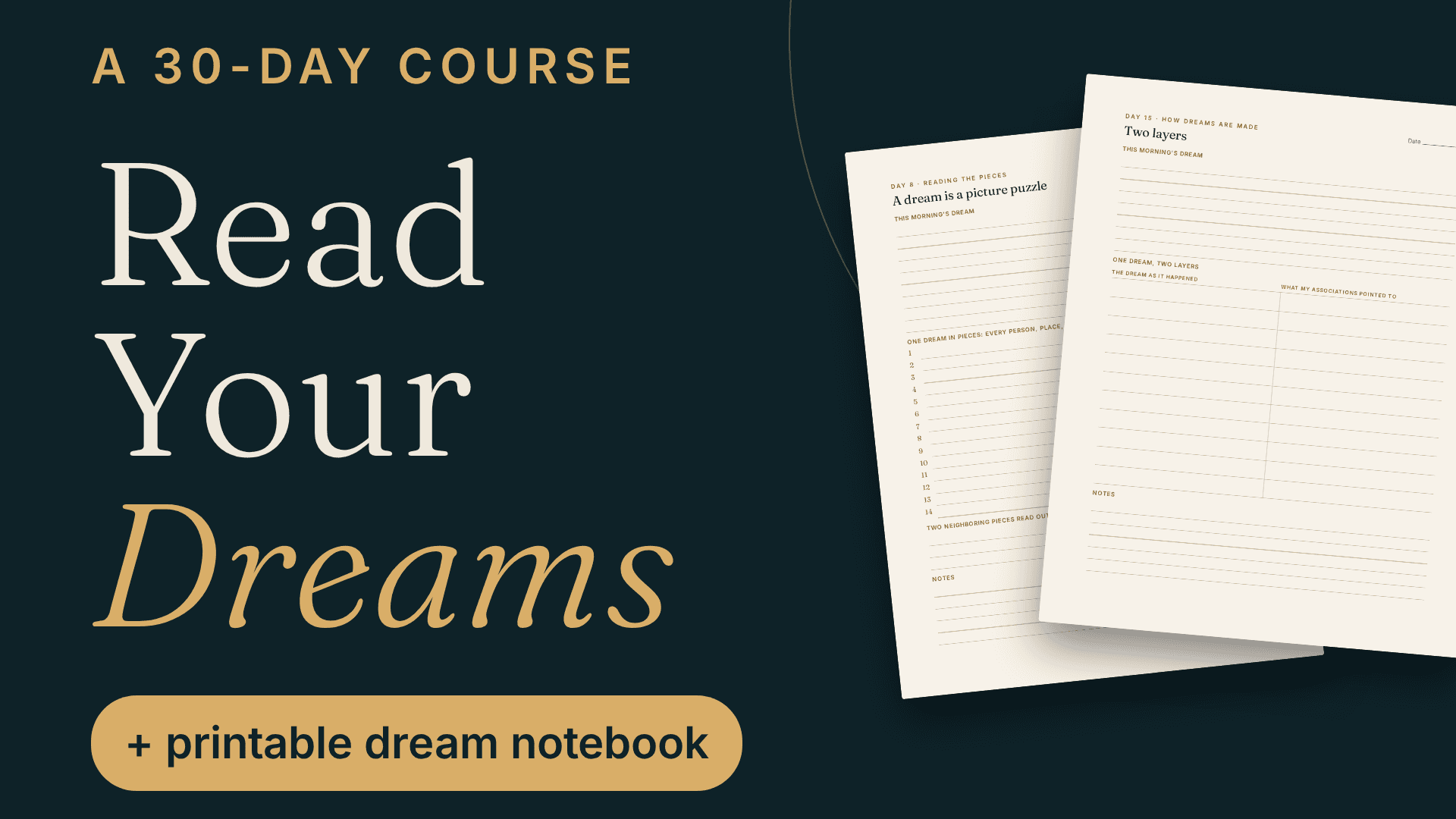
Read Your Dreams
$27
Read Your Dreams is a 30-day course of short daily lessons, five to ten minutes each, that teach you to remember your dreams and read them the way a psychoanalyst listens: through your own associations, the exact words in the dream, and the sounds, letters and languages hiding inside them.
By Day 30 you'll have a notebook full of dreams and a map of what they keep returning to.
What a dream sounds like
Composite example. A man dreamed he worked in a small bakery. There was a line out the door, and everyone wanted his bread. He spent the whole dream lying on a sack of flour behind the counter while the loaves rose and sold on their own. Every loaf had the same handwritten label: KNEADED.
These were his associations. Saying the label out loud, he heard needed. Loaf made him think of loafing around. Bread made him think of money. And all three led him to an argument from the week before, when his partner had complained that he wasn't making enough money, that she does most of the housework, and that all he did on weekends was loaf around the house playing video games.
The dream granted him a wish: to be the breadwinner, the one everyone needs, without getting up. One image holds what he wants and the way he behaves.
A dream gets past the mind's censor by changing how a thought looks. Bread is harmless, so the dream could show it, and the words stayed close enough that he could hear them once he said them out loud.
A dream dictionary would have told him something about bread. The meaning was in his own words, and the course teaches you to hear yours.
How the month works
Week 1: Catching dreams. Remember more of your dreams, and write them down the way they happened: the exact words, the feelings, the fragments.
Week 2: Reading the pieces. Break a dream into pieces and follow your associations. Listen for sound-alikes, words hidden inside other words, and the languages you grew up with.
Week 3: How dreams are made. The disguise and the piece you keep skipping. How a dream packs several things into one image, moves the importance onto a minor detail, turns phrases into pictures, and carries a wish.
Week 4: What keeps coming back. Recurring dreams and what changes when they return, anxiety dreams, the words your dreams keep using, and the role you keep playing in them.
Days 29 and 30. Put the month on one page as a dream map, and think about what it would mean to tell your dreams to someone.
What you get
30 lessons, one a day, five to ten minutes each
A printable 39-page dream notebook, with a page for each day's practice
A new week every seven days, with an email when it opens
A weekly read-back to see the patterns across your dreams
Questions
I don't remember my dreams. Most people dream every night and lose the dream within minutes of waking. Week 1 is about catching them, and every lesson works with a fragment or the first thought you woke up with.
How much time does it take? Five to ten minutes a day, plus writing down the dream when you wake up.
Do I need to know anything about psychoanalysis? No. Each idea is explained when it comes up, with an example.
Is this therapy? No. It's an educational course for studying your own mind.
Will you interpret my dreams? The course teaches you to read your own. I can't interpret individual dreams by email.
Who's teaching
I'm David M. Freshwater, LMHC, a psychoanalytic psychotherapist. I see adults by telehealth in Massachusetts and Florida, and listening to dreams is a large part of the work.
The examples in the course are composites: anonymized and disguised, part true and part fiction.