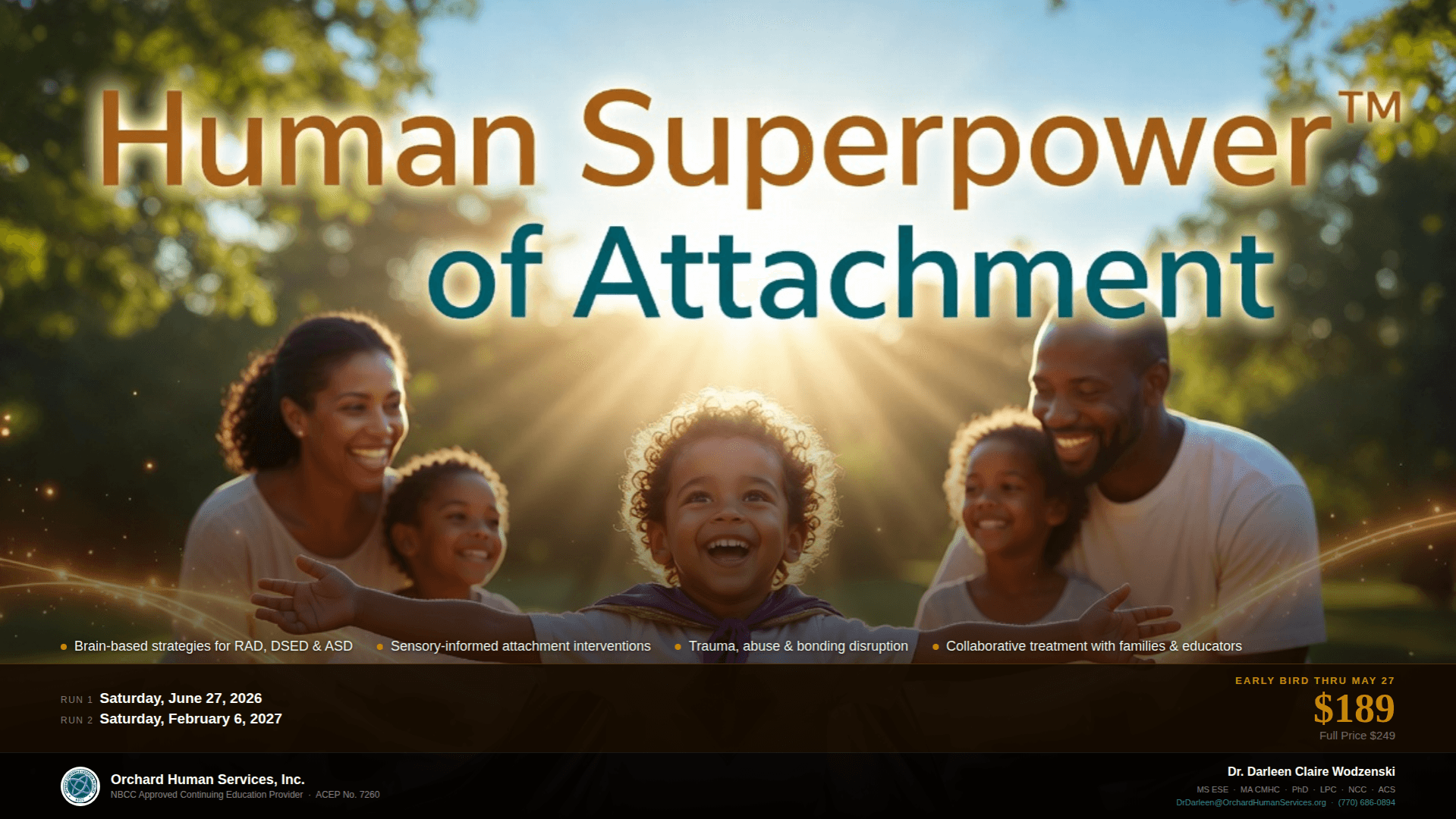
Human Super Power™ of Attachment — 6 CEs
$189$249
6 Live CE Hours · Live Interactive Webinar
The ability to understand, repair, and strengthen attachment bonds is not something AI can replicate. It is your Human Superpower™.
Attachment is not just a theory. It is the architecture of every therapeutic relationship you will ever build — and the lens through which every presenting problem your clients carry becomes legible.
This live, brain-based training takes you deep into the neuroscience of human bonding: what happens in the developing brain when attachment is secure, what goes wrong when it isn't, and what you can actually do about it in the clinical hour. Whether you work with children, adolescents, families, or adults carrying the invisible weight of early relational wounds, this course gives you the framework and the tools.
This is not an introductory overview. This is clinical depth — grounded in neuroscience, DSM-5-TR diagnostic precision, and the practical realities of working with the clients most impacted by attachment disruption.
Learning Objectives
By the end of this training, participants will be able to:
Explain the neurobiological foundations of human attachment and their relevance to clinical mental health practice
Identify diagnostic presentations of Reactive Attachment Disorder (RAD), Disinhibited Social Engagement Disorder (DSED), and Autism Spectrum Disorder (ASD) through an attachment lens
Apply sensory-informed and brain-based attachment interventions across the lifespan
Assess the impact of trauma, abuse, neglect, and bonding disruption on attachment development and clinical presentation
Design collaborative treatment approaches involving families, caregivers, educators, and multidisciplinary teams
Distinguish between secure, anxious, avoidant, and disorganized attachment styles and tailor interventions accordingly
Who This Is For
Licensed counselors, therapists, social workers, and MFTs working with children, adolescents, or families
Child welfare clinicians, foster care providers, and DFCS-affiliated professionals
School counselors and special education clinicians
Any practitioner who wants a deeper neurobiological foundation for relational work
Also Approved For
This course carries approval for DFCS-affiliated child welfare professionals, foster care clinicians, and agency staff — in addition to NBCC CE credit.
Pricing
Early Bird: $189 (closes 30 days before your selected date) Full Price: $249
Select Your Date at Registration
Run 1 — Saturday, June 27, 2026 · 10:00 AM – 6:00 PM EDT ✅ Serves GA/SC September 30 license renewal deadline
Run 2 — Saturday, February 6, 2027 · 10:00 AM – 6:00 PM EDT ✅ Serves PA February 28 license renewal deadline
Format
Live, synchronous, interactive training via webcam Full day — approximately 6 hours of instruction plus breaks Camera required for participation Certificate of completion provided same day
CE Approvals
These are 6 Core CE hours — verify your state board's requirements before registering. Offered through Orchard Human Services, Inc., an NBCC Approved Continuing Education Provider, ACEP No. 7260.
Each licensee is responsible for confirming eligibility with their state board prior to registering.
Program Developer & Presenter
Dr. Darleen Claire Wodzenski, MS ESE, MA CMHC, PhD, LPC, NCC, ACS Founder & Executive Director, Orchard Human Services, Inc. · Licensed in FL, GA, VA
Dr. Darleen brings a rare combination of credentialed special education expertise, licensed clinical mental health practice, and doctoral-level training in Neurophysiology and Biochemistry to the study of attachment. She has spent decades working at the intersection of how children learn, how they bond, and what happens when those processes go wrong — and she built this course to share what that depth of experience actually looks like in the clinical hour.
Questions?
Email: DrDarleen@OrchardHumanServices.org Text: (470) 420-9994 — include your name and permission to text back Call: (770) 686-0894 to leave a message
Orchard Human Services, Inc. has been approved by NBCC as an Approved Continuing Education Provider, ACEP No. 7260. Programs that do not qualify for NBCC credit are clearly identified. Orchard Human Services, Inc. is solely responsible for all aspects of the programs.