
THE TRINITY: SAFETY EXECUTION FRAMEWORKS
$197
Mechanistic Documentation of Advanced Hormonal Optimization
How competent operators, clinicians, and researchers execute one of the most aggressive body recomposition stack available - complete monitoring infrastructure, decision logic, and safety protocols documented.
⚠️ CRITICAL NOTICE: THIS IS DANGEROUS INFORMATION
The documentation in this course involve three pharmaceutical compounds with significant physiological effects. Improper application carries serious health risks including:
- Insulin resistance and glucose dysregulation
- Polycythemia (dangerously elevated red blood cell concentration)
- Thyroid axis suppression
- Cardiovascular strain
- Hormonal disruption requiring medical intervention
This material is not instructions for self-use.
What follows is mechanistic documentation of how sophisticated operators execute these protocols within appropriate clinical and research contexts. The information is educational - designed for understanding how competent execution occurs, not as a blueprint for unsupervised experimentation.
Individuals without baseline pharmacology knowledge, access to clinical monitoring, or medical supervision have no business applying this information.
The course exists because this protocol is being executed in the field - often poorly, with fragmented knowledge and inadequate safety infrastructure. Documentation of competent execution serves researchers, clinicians, and sophisticated individuals seeking to understand what systematic protocol management looks like.
If the goal is “running a cycle,” look elsewhere. This material documents the complexity that separates informed operation from reckless experimentation.
The Documentation Gap
The Trinity protocol - Retatrutide, Growth Hormone, and Testosterone in systematic combination - represents the current frontier of body recomposition pharmacology. The synergistic architecture is understood: three compounds removing each other’s limitations to create metabolic conditions unavailable through single-agent approaches.
What remains undocumented is operational infrastructure.
Clinical literature addresses compounds in isolation. GH for adult deficiency. Testosterone for hypogonadism. GLP-1 agonists for metabolic disease. Interaction effects, combined monitoring requirements, and multi-compound decision logic remain unexplored in peer-reviewed contexts.
Community knowledge fragments across forums and anecdotal reports. Monitoring protocols are inconsistent or absent. Decision-making occurs through pattern-matching against others’ experiences rather than individualized data interpretation. The safety infrastructure that characterizes competent operation simply doesn’t exist in accessible form.
This course documents that infrastructure - not to enable unsupervised use, but to establish what competent execution actually requires.
What Competent Operation Looks Like
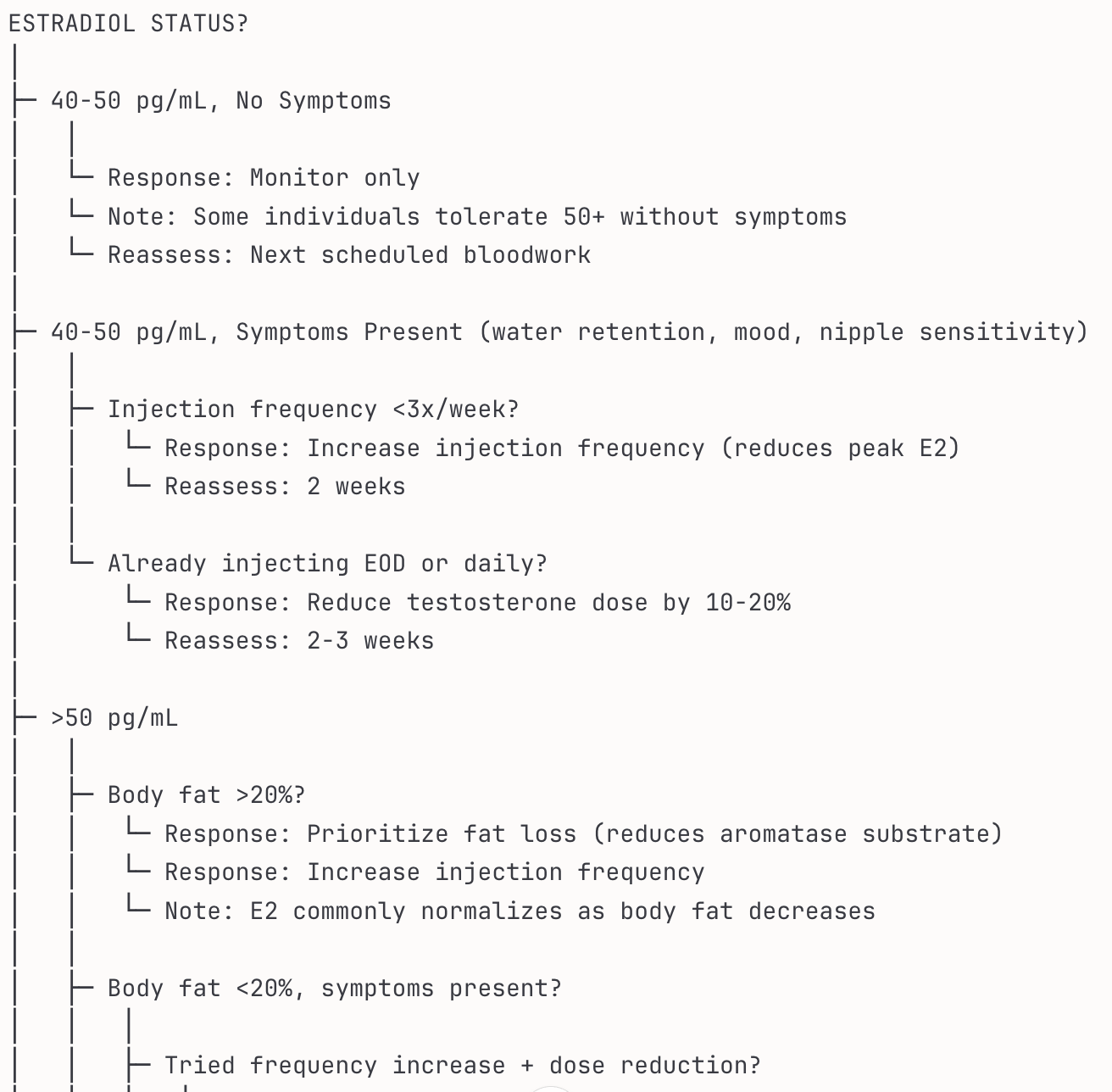
Sophisticated operators approach Trinity with systematic monitoring, predefined decision thresholds, and continuous physiological awareness. Protocol adjustments follow objective data rather than subjective assessment.
Monitoring Architecture
Competent operation involves tracking 15-20 biomarkers across metabolic, hepatic, hematological, hormonal, and inflammatory domains. Testing frequency maps to protocol phases - intensive during titration, reduced during consolidation.
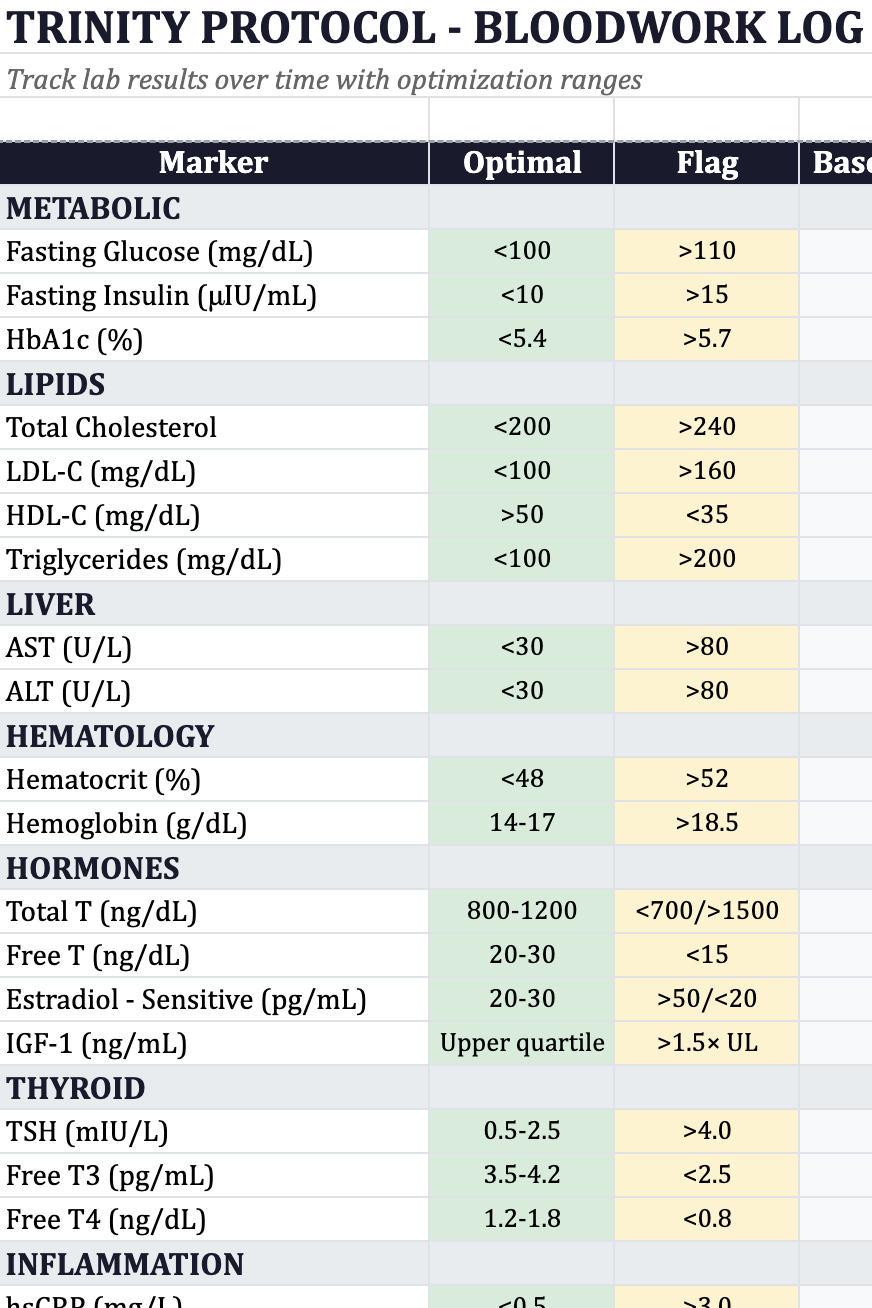
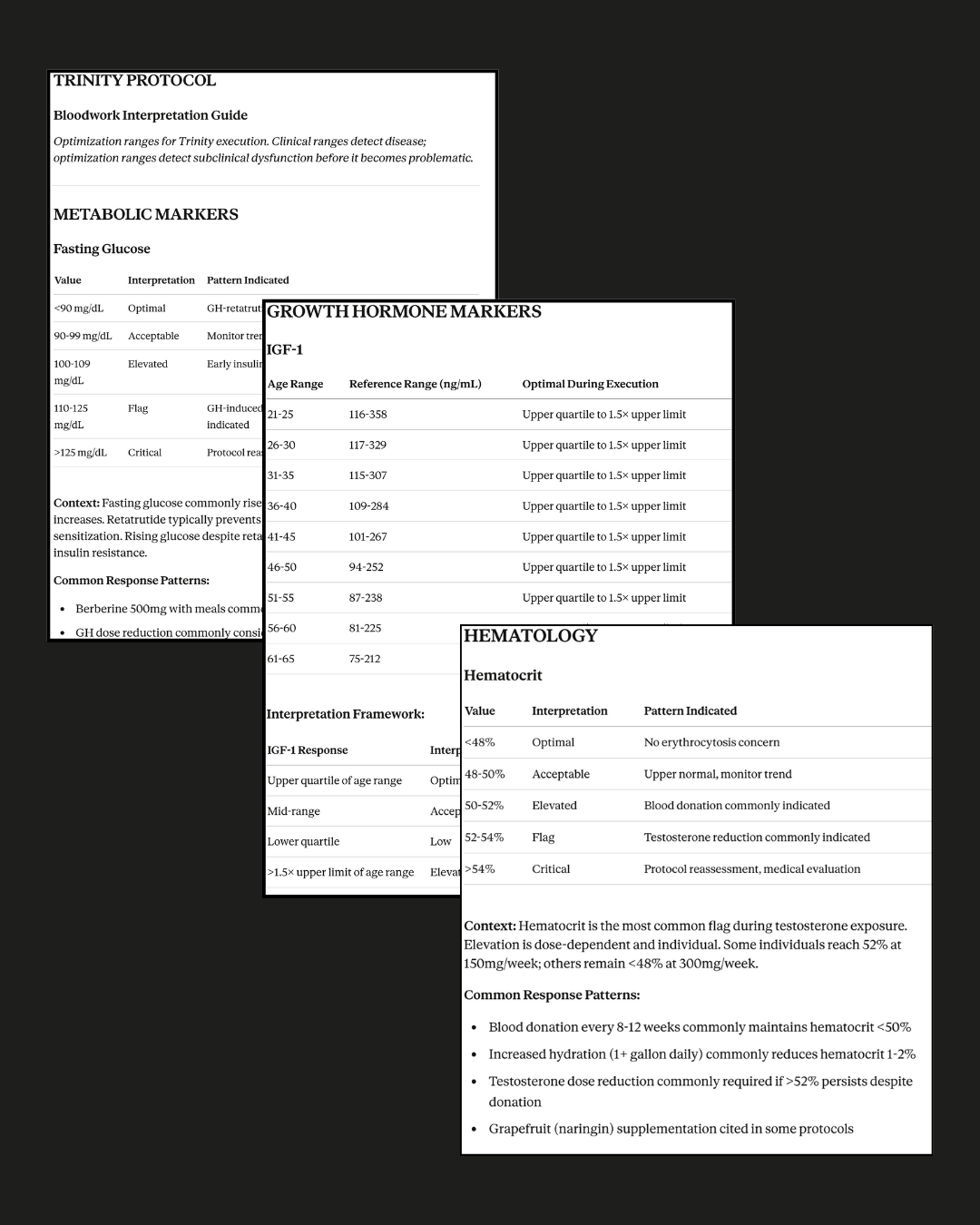
Interpretation occurs against optimization ranges rather than clinical reference ranges. Clinical ranges detect pathology; optimization ranges detect suboptimal function before pathology develops. This distinction separates proactive protocol management from reactive damage control.
Decision Logic
Protocol adjustments follow decision trees with defined triggers and responses:
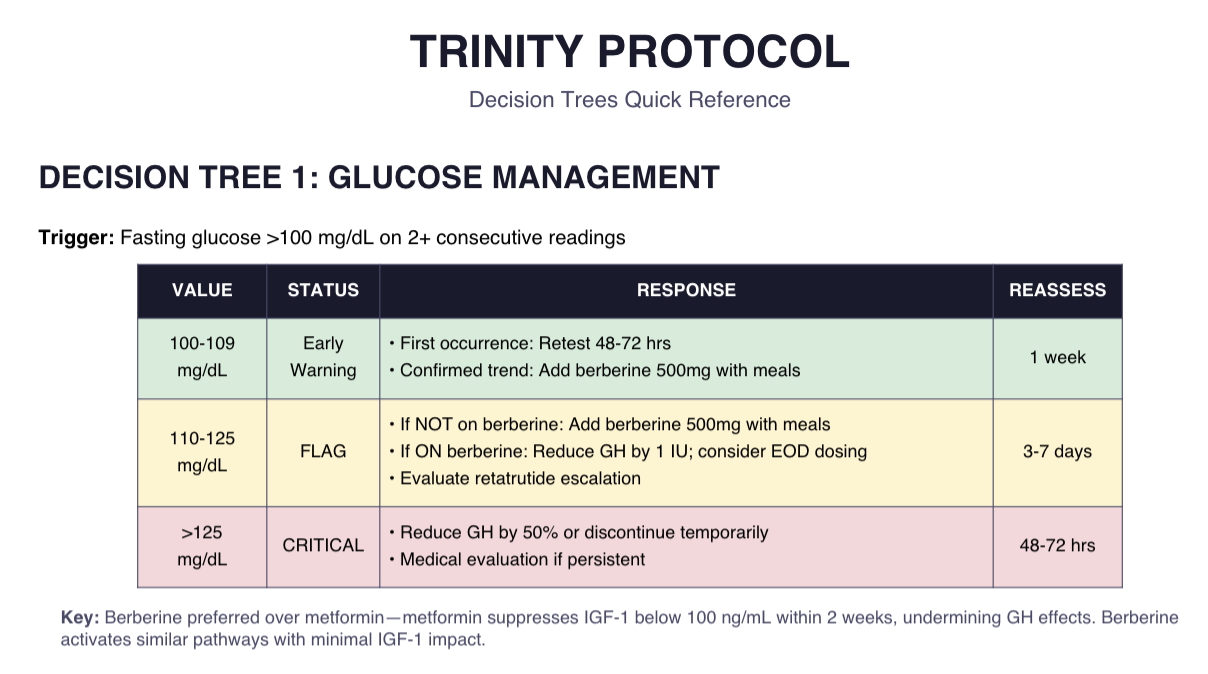
- Fasting glucose elevation initiates a specific intervention sequence
- Hematocrit approaching threshold triggers predefined action
- Estradiol management follows a hierarchy - DIM/CDG/AI, injection frequency, dose modification - before pharmaceutical intervention
Each decision point has documented criteria. Guesswork is replaced by systematic evaluation.
Phase Structure
Execution follows three phases: Foundation (weeks 1-8), Optimization (weeks 9-24), and Consolidation (weeks 25-48).
Each phase carries specific objectives, dosing parameters, monitoring schedules, and advancement criteria.
Phase transitions occur when predefined markers are achieved. Consolidation - the phase most operators neglect - determines whether transformation persists or reverts.
Course Documentation
MODULE 1: FRAMEWORK + EXECUTION LOGIC
Documents the mechanistic basis for Trinity’s synergistic architecture.
Covered:
- Why single-compound approaches plateau
- How the three compounds remove each other’s limitations
- Thermodynamic framework (dissipative structures) explaining permanent structural reorganization from temporary forcing
- Phase-by-phase protocol structure with dosing tables
- Go/no-go criteria for phase advancement
Operators studying this module understand the biological logic determining protocol structure—not just what competent execution involves, but why specific parameters and timelines apply.
MODULE 2: MONITORING + SAFETY
The core operational infrastructure that separates systematic execution from blind experimentation.
Bloodwork Protocols: The 15-20 markers relevant to Trinity execution. Testing schedules mapped to protocol phases. Ordering approaches across clinical contexts.
Interpretation Frameworks: Optimization ranges versus clinical ranges for each marker. Context-specific interpretation—what IGF-1 elevation indicates during GH exposure versus baseline. Expected changes by phase. Markers signaling protocol adjustment.
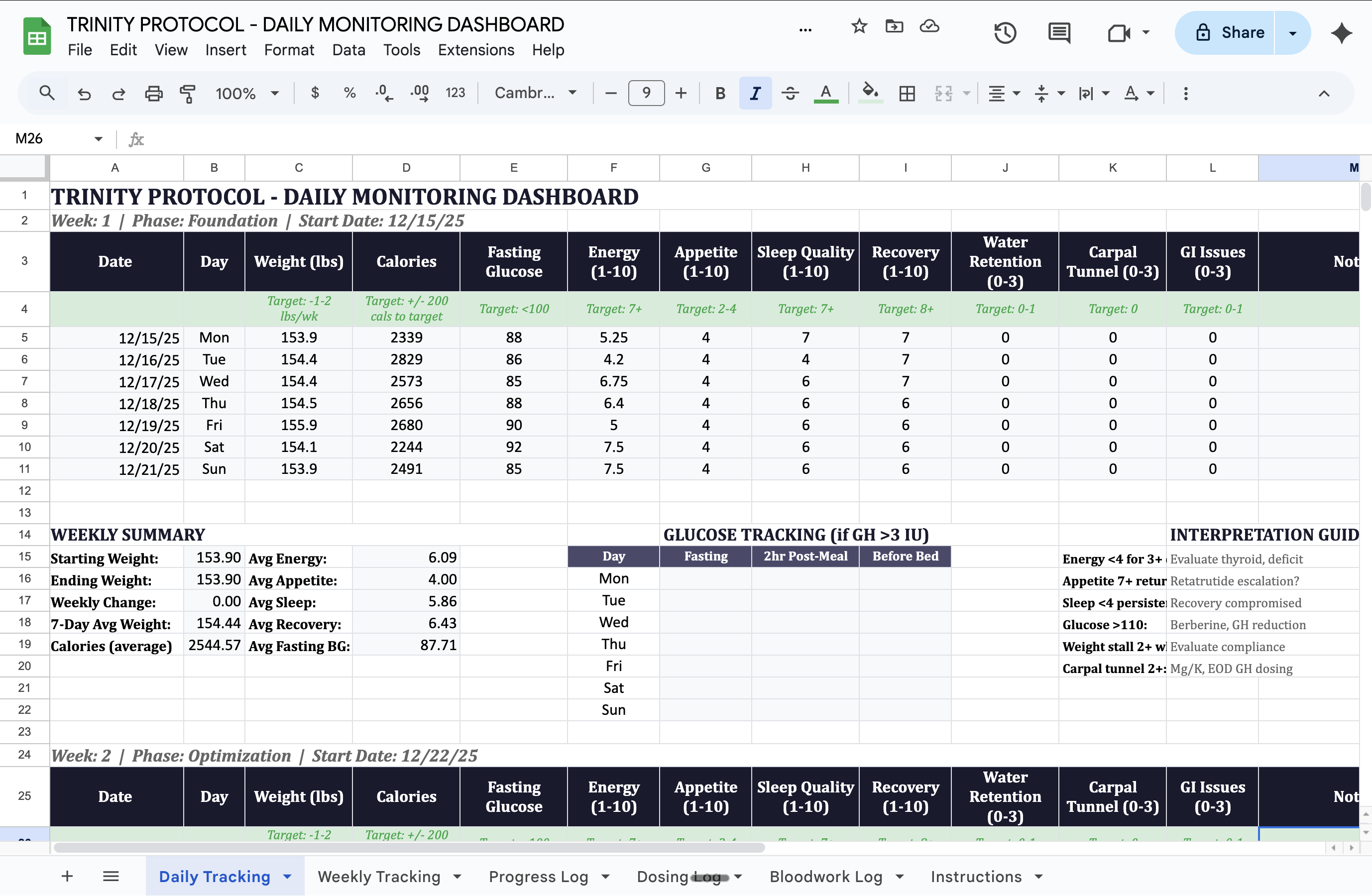
Tracking Systems: Daily and weekly monitoring capturing subjective and objective data between blood draws. Signal versus noise differentiation. Pattern confirmation protocols.
Decision Trees: Six flowcharts documenting decision logic:
Glucose management
Hematocrit management
Estradiol management
Thyroid management
Training performance decline
Fat loss stall resolution
Each tree specifies trigger conditions, evaluation sequence, intervention hierarchy, and reassessment timelines.
Documented Resources:
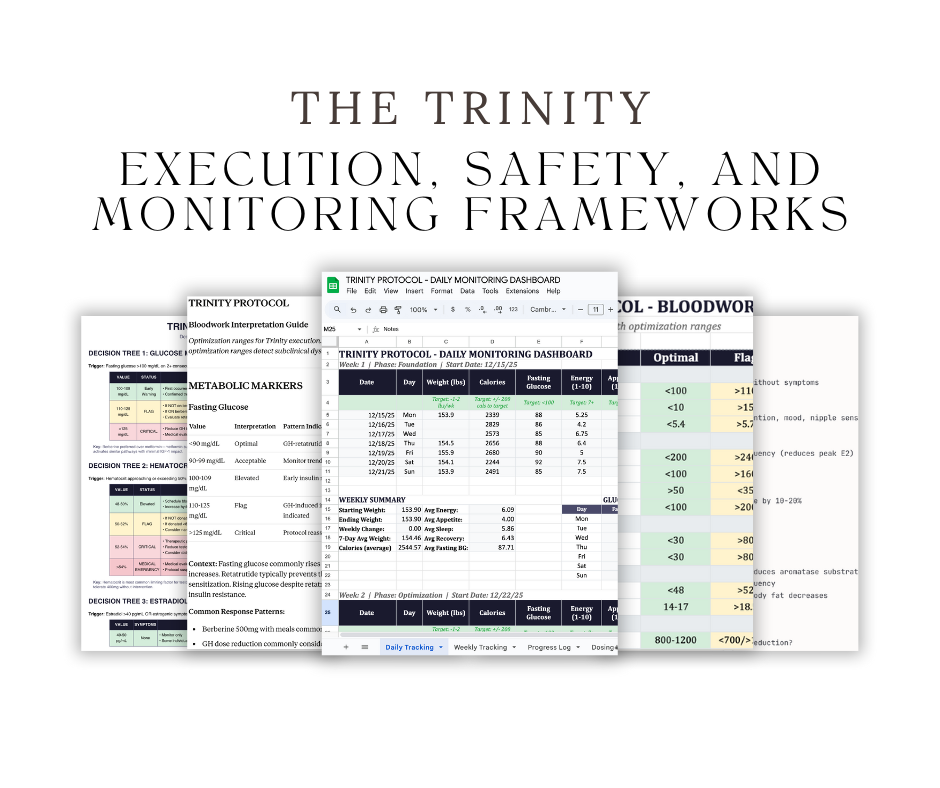
- Trinity Bloodwork Order Template (PDF + editable format)
- Bloodwork Interpretation Guide
- Monitoring Dashboard (Excel, 6 tracking sheets)
- Decision Trees Quick Reference (PDF + editable format)
MODULE 3: DOSING LOGIC
Documents the incremental approach characterizing competent dose optimization.
Covered:
- Starting parameters and titration logic
- Biofeedback interpretation for individualized adjustment
- Dose-response relationships and diminishing returns thresholds
- Side effect probability at various exposure levels
- Why standardized protocols fail and how monitoring data informs individualization
- Goal-specific parameter modification (recomposition vs. performance vs. longevity)
- GH:Testosterone ratio considerations
- Compound interaction effects on response
MODULE 4: TROUBLESHOOTING + LONG-TERM STRATEGY
Common Complications: Mechanism, early warning signs, intervention hierarchy, and escalation thresholds for:
- GH-induced glucose elevation
- Elevated hematocrit
- Thyroid suppression
- Estradiol management
Discontinuation Criteria: Conditions warranting immediate protocol suspension. Medical consultation thresholds. Distinguishing expected side effects from signals requiring clinical evaluation.
Consolidation Execution: Why this phase determines permanence. Taper protocols. Set point stabilization timelines. Completion criteria.
Post-Protocol Considerations: Maintenance frameworks. Monitoring continuation. Evaluation criteria for future protocols.
Who Studies This Material
✅ Clinicians and Researchers examining advanced optimization protocols. The monitoring architecture and decision frameworks documented here apply beyond Trinity specifically.
✅ Sophisticated Individuals with existing hormonal pharmacology knowledge seeking to understand what competent execution requires—even without intent to self-administer. Understanding how systematic operation occurs provides context for evaluating protocols, interpreting results, and assessing risk profiles.
✅ Practitioners working with clients on advanced protocols. The systematic frameworks for monitoring, interpretation, and decision-making transfer across compound combinations.
Who This Material Is NOT For
❌ Individuals seeking simplified instructions for unsupervised self-administration. This documentation covers complexity, not shortcuts.
❌ Those without baseline understanding of hormonal pharmacology. Familiarity with compound mechanisms, physiological monitoring, and risk assessment is assumed. Foundational education is not provided.
❌ Anyone unwilling to engage with systematic monitoring. The protocols documented here are inseparable from monitoring infrastructure. Execution without monitoring is not “simplified Trinity”—it is a different, substantially more dangerous activity.
What You Get
Included:
- 4 Modules (~4-6 hours of study)
- 7 Downloadable Resources
- Complete Trinity Article
Guarantee: If the material fails to provide clear mechanistic understanding of Trinity execution frameworks, monitoring infrastructure, and decision logic - full refund.
Disclaimer
This course is educational documentation of advanced hormonal optimization protocols. It is not medical advice. It is not a prescription. It is not instructions for self-treatment.
The compounds discussed are pharmaceutical agents with significant physiological effects and serious potential for harm. Use without proper medical supervision, clinical monitoring, and individualized assessment carries substantial health risks.
The information presented documents how sophisticated operators approach these protocols within appropriate clinical and research contexts. It is provided for educational purposes to support informed understanding - not to encourage or enable unsupervised experimentation.
Any individual considering hormonal optimization should consult qualified medical professionals capable of assessing individual health status, contraindications, and monitoring requirements.
By accessing this material, acknowledgment is made that content is for educational purposes only and that any application of concepts discussed is undertaken at the individual’s own risk and responsibility.
CONTENTS SUMMARY
Modules:
Framework + Execution Logic
Monitoring + Safety
Dosing Logic
Troubleshooting + Long-Term Strategy
Downloadable Documentation:
Trinity Bloodwork Order Template (PDF)
Bloodwork Order Template (editable)
Bloodwork Interpretation Guide
Monitoring Dashboard (Excel)
Decision Trees Quick Reference (PDF)
Decision Trees (editable)
Complete Trinity Article
Format: Self-paced digital documentation, immediate access