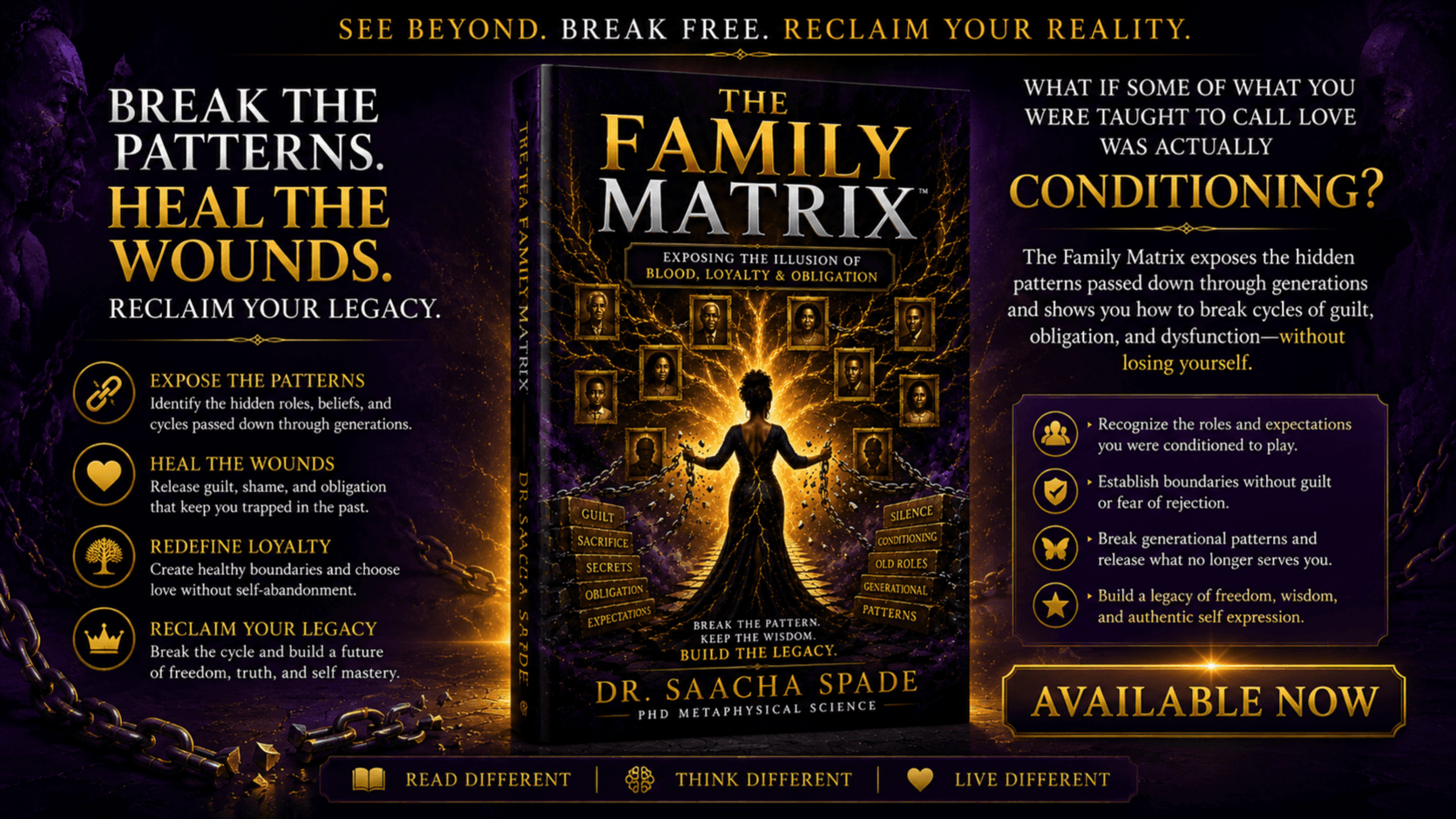
THE FAMILY MATRIX
$11.11$22.22
Exposing the Illusion of Blood, Loyalty & Obligation
What if some of what you were taught to call love was actually conditioning?
Before the world told you who to be, your family did.
Before you understood loyalty, you were shown what it meant.
Before you understood boundaries, you learned whether you were allowed to have them.
Before you knew what sacrifice was, you watched who was expected to make it.
Before you could define love for yourself, you inherited a definition from the people who raised you.
And somewhere along the way, you may have learned that being family meant you were supposed to stay, forgive, rescue, provide, protect, tolerate, remain silent, keep the secret, carry the burden—and never question the cost.
Welcome to The Family Matrix™.
Dr. Saacha Spade takes readers into perhaps the first and most powerful programming system they will ever encounter: the family they were born into.
This is not a book about blaming your parents.
It is not about abandoning your family.
And it is certainly not about convincing you that family doesn't matter.
It is about having the courage to examine what family has meant in your life—and deciding consciously what it will mean from this point forward.
Because blood can create relationship.
But blood alone does not create safety.
Blood does not automatically create trust.
Blood does not excuse dysfunction.
Blood does not eliminate the need for boundaries.
And DNA does not give another human being unlimited access to your life.
BEFORE YOU HAD AN IDENTITY, YOU HAD A ROLE
Most families have roles, even when nobody names them.
The Responsible One.
The Successful One.
The Peacemaker.
The Fixer.
The Caregiver.
The Golden Child.
The Black Sheep.
The Family Bank.
The Secret Keeper.
The Strong One.
The One Who Never Needs Anything.
Sometimes the role was assigned directly.
Sometimes you stepped into it because the family needed someone to occupy it.
And sometimes you became so good at playing the role that eventually you mistook it for your identity.
Then you grew up.
But the role came with you.
You became everyone's emergency contact.
Everyone's lender.
Everyone's mediator.
Everyone's rescuer.
Everyone's emotional container.
Everyone's solution.
And because you had been conditioned to call that love, choosing yourself began to feel like betrayal.
The Family Matrix challenges that programming.
WHEN DOES LOYALTY BECOME SELF ABANDONMENT?
There is a difference between loving people and carrying them.
Between helping and enabling.
Between forgiveness and unlimited access.
Between compassion and self abandonment.
Between honoring your family and sacrificing your entire life to keep a dysfunctional system comfortable.
And perhaps most importantly:
There is a difference between breaking the family apart and breaking the family pattern.
Sometimes the person accused of destroying the family is simply the first person willing to stop pretending.
The first person who says:
No.
The first person who establishes the boundary.
The first person who talks about the secret.
The first person who stops rescuing.
The first person who handles money differently.
The first person who refuses abuse.
The first person who questions the tradition.
The first person who decides:
THIS ENDS WITH ME.
Systems resist the person who changes because when one person stops performing their assigned role, everyone else is forced to confront the system that required the role in the first place.
THE FAMILY MATRIX DOESN'T STAY IN THE FAMILY
Family programming can quietly follow you into virtually every area of adult life.
The way you handle money.
The partners you choose.
The behavior you tolerate.
Your relationship with success.
Your ability to rest.
Your fear of disappointing people.
Your spiritual beliefs.
Your parenting.
Your relationship with authority.
Your ability to receive.
Your need to prove yourself.
Your difficulty saying no.
Your definition of responsibility.
Your willingness to become more successful than the people around you.
Even your beliefs about what you are allowed to become.
Because family programming doesn't always sound like programming.
Sometimes it sounds like:
“That's just how our family is.”
“Family comes first.”
“Don't embarrass this family.”
“We don't talk about that.”
“After everything I've done for you…”
“That's still your brother.”
“But that's your mother.”
“You only get one father.”
“Keep family business in the family.”
“You think you're better than us now?”
And one of the most powerful:
“That's what family does.”
But what if it shouldn't be?
INSIDE THE FAMILY MATRIX, YOU WILL EXPLORE HOW TO:
• Recognize the role you were assigned inside your family system
• Separate genuine love from guilt, fear, obligation, and conditioning
• Identify generational patterns that have been normalized because they are familiar
• Understand why changing your role can create resistance from people accustomed to the old version of you
• Examine the connection between family programming and adult identity
• Recognize rescuing, enabling, overfunctioning, and chronic self sacrifice
• Understand how silence can protect dysfunction instead of protecting family
• Establish boundaries without confusing boundaries with punishment
• Examine inherited beliefs surrounding money, success, faith, relationships, and responsibility
• Stop confusing access with love
• Release guilt associated with choosing yourself
• Understand why healing can make familiar environments feel unfamiliar
• Decide which traditions deserve preservation and which patterns deserve interruption
• Create healthier definitions of loyalty and belonging
• Become conscious of what you are passing to the next generation
• Love your family without losing yourself
GENERATIONAL DOES NOT MEAN DESTINED
Perhaps your grandmother carried it.
Then your mother carried it.
Then somehow it arrived in your hands.
The fear.
The silence.
The financial struggle.
The relationship pattern.
The abandonment.
The secrecy.
The anger.
The guilt.
The expectation.
The belief.
The role.
The wound.
But inheritance does not always mean something was meant to be kept.
Sometimes something reaches your generation because your generation is capable of ending it.
You are not rejecting your ancestors by healing what hurt them.
You are not betraying your family by refusing to repeat what damaged it.
You are not dishonoring previous generations by questioning what they normalized.
Perhaps honoring them sometimes means having the courage to go somewhere internally they never had the opportunity to go.
BUT NOT EVERYTHING INHERITED NEEDS TO BE BROKEN
Some things deserve to survive.
Wisdom.
Stories.
Recipes.
Land.
Businesses.
Traditions.
Resilience.
Knowledge.
Culture.
Values.
Property.
Family history.
Intellectual inheritance.
Love.
The objective is not to burn down everything that came before you.
The objective is discernment.
Keep the wisdom.
Question the programming.
Heal the wounds.
Break the cycles.
Preserve what matters.
Build what was missing.
And consciously decide what gets passed forward.
That is how family history becomes family evolution.
THE PERSON WHO BREAKS THE PATTERN OFTEN LOOKS LIKE THE PROBLEM FIRST
When you stop rescuing, someone may call you selfish.
When you establish boundaries, someone may say you've changed.
When you stop participating in dysfunction, someone may say you're dividing the family.
When you become financially successful, someone may expect unlimited access to what you've built.
When you question inherited beliefs, someone may accuse you of forgetting where you came from.
And maybe you have changed.
That may be the entire point.
Growth requires some versions of you to become unavailable.
You can love people deeply and still refuse to participate in patterns that destroy you.
You can forgive someone and change their access.
You can honor where you came from without remaining psychologically trapped there.
You can belong to your family without belonging to its dysfunction.
THIS BOOK IS FOR THE CYCLE BREAKER
The one who sees what everyone else has normalized.
The one who asks the uncomfortable questions.
The one who has carried everybody.
The one who is exhausted from always being strong.
The one who loves their family but knows something has to change.
The one who has been called selfish for developing boundaries.
The one who became successful and discovered that success created new expectations.
The one determined not to pass the same wounds into another generation.
And the one beginning to understand:
I CAN LOVE WHERE I CAME FROM WITHOUT REMAINING WHO I HAD TO BE TO SURVIVE THERE.
The Family Matrix isn't about destroying family.
It's about freeing family from unconscious repetition.
Because the greatest inheritance you leave may not be money.
It may be the pattern your children never have to heal from.
**QUESTION THE ROLE.
EXPOSE THE PATTERN.
BREAK THE CYCLE.
REDEFINE LOYALTY.
LOVE WITHOUT LOSING YOURSELF.
KEEP THE WISDOM.
END WHAT SHOULD NOT CONTINUE.**