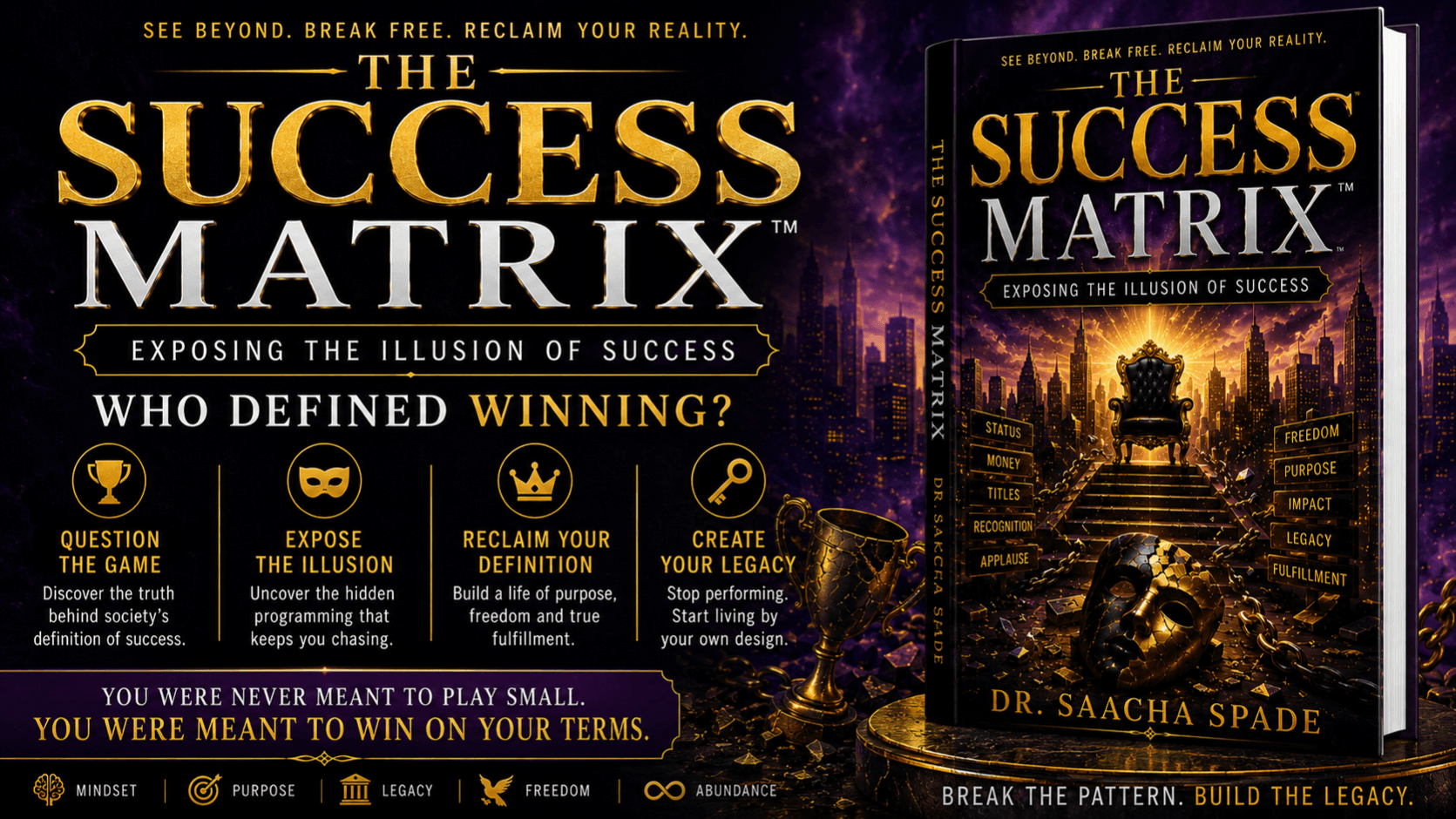
THE SUCCESS MATRIX
$11.11$22.22
Exposing the Illusion of Success
What if you're winning a game you never chose to play?
From the moment you entered the world, someone was already defining success for you.
Get the education.
Build the career.
Make the money.
Buy the house.
Drive the car.
Earn the title.
Build the business.
Gain the followers.
Get recognized.
Keep achieving.
Keep producing.
Keep climbing.
And if you do all of it well enough, one day you will supposedly arrive at a place called success.
But what if you reach the top of the ladder only to discover that you never chose where the ladder was going?
Welcome to The Success Matrix™.
In this provocative exploration of achievement, ambition, identity, purpose, and freedom, Dr. Saacha Spade exposes one of society's most powerful illusions: the belief that success has a universal definition.
Because the greatest danger isn't failure.
It's becoming extraordinarily successful at building a life you never actually wanted.
WHO DEFINED WINNING?
Long before you developed your own definition of success, the world handed you one.
Money meant success.
Titles meant success.
Degrees meant success.
Recognition meant success.
Possessions meant success.
Being busy meant you were important.
Being exhausted meant you were working hard.
Sacrifice meant you were serious.
And achievement became evidence that you were moving forward.
But The Success Matrix asks a question most people never stop long enough to consider:
Forward toward what?
You can make more money and have less freedom.
You can build a successful company and lose control of your time.
You can become respected by thousands of people while becoming disconnected from yourself.
You can own everything you were told successful people should own and still wake up wondering:
“Is this really it?”
That's because achievement and alignment are not the same thing.
And neither are success and fulfillment.
THE MATRIX DOESN'T NEED YOU TO FAIL
This is where the illusion becomes more sophisticated.
The Success Matrix doesn't necessarily keep people unsuccessful.
Sometimes it does the opposite.
It makes them incredibly successful inside a system they never questioned.
You can become excellent at performing.
Excellent at producing.
Excellent at accumulating.
Excellent at impressing.
Excellent at achieving.
Excellent at proving.
And never ask whether the person doing all that achieving is actually free.
The Success Matrix teaches you to measure your life externally:
How much did you make?
What do you own?
What is your title?
How large is your company?
How many people follow you?
What awards have you received?
What have you accomplished?
But there is another set of questions:
Do you own your time?
Do you enjoy your life?
Can you say no?
Are your accomplishments aligned with your purpose?
Can what you've built function without consuming you?
Would you still want your life if nobody could see it?
And perhaps the most important:
If nobody were watching, what would success look like to you?
WHEN ACHIEVEMENT BECOMES IDENTITY
Achievement itself isn't the problem.
Ambition isn't the enemy.
Money isn't wrong.
Growth isn't something to reject.
The problem begins when achievement stops being something you do and becomes evidence of who you are.
Then failure becomes more than an event.
It becomes an identity threat.
Rest becomes uncomfortable.
Slowing down feels irresponsible.
Someone else's success feels like evidence that you're behind.
A quiet season feels like stagnation.
And accomplishment provides only temporary satisfaction because another achievement is immediately required to maintain the identity.
So you keep moving.
Another goal.
Another milestone.
Another title.
Another acquisition.
Another zero.
Another level.
Another round of applause.
Until eventually you have to ask:
Am I building—or am I proving?
That distinction can change everything.
THE PERFORMANCE OF SUCCESS
We now live in a world where success doesn't simply have to be achieved.
It has to be seen.
Social media transformed accomplishment into performance.
We don't just experience the vacation.
We post it.
We don't just buy the car.
We reveal it.
We don't simply build the business.
We announce the revenue.
We don't merely evolve.
We brand the evolution.
And without realizing it, people can begin constructing lives optimized for visibility instead of fulfillment.
A life can photograph beautifully and feel completely empty.
A person can appear powerful online and feel powerless privately.
Someone can look successful to everyone except the person living the life.
The Success Matrix challenges you to separate:
What looks successful
from
What feels aligned.
Because those two things are not always the same.
INSIDE THE SUCCESS MATRIX, YOU WILL EXPLORE HOW TO:
• Identify where your definition of success actually came from
• Recognize when achievement has become attached to identity and self worth
• Separate ambition from unconscious programming
• Understand the difference between success, status, fulfillment, freedom, and purpose
• Examine why productivity can become an addiction disguised as discipline
• Recognize comparison as a hidden architect of ambition
• Question whether your goals are actually yours
• Identify accomplishments you pursued primarily for approval, security, recognition, or validation
• Understand why reaching a major goal can sometimes feel strangely empty
• Redefine wealth beyond income and possessions
• Examine the relationship between success and control of your time
• Stop measuring progress exclusively through external achievement
• Build success around alignment rather than appearance
• Create goals that serve your life instead of consuming it
• Define winning on your own terms
• Build something that matters beyond applause
WHAT IF SUCCESS ISN'T SOMETHING YOU REACH?
Maybe success isn't a destination.
Maybe it isn't a number.
Maybe it isn't a title.
Maybe it isn't a house.
Maybe it isn't a company valuation.
Maybe it isn't retirement.
Maybe it isn't being known.
Maybe success is the ability to consciously design a life that reflects who you actually are.
A life where money serves purpose.
Where time belongs to you.
Where achievement doesn't require self abandonment.
Where ambition doesn't destroy peace.
Where you can build without becoming imprisoned by what you've built.
Where you can evolve without needing permission.
Where your private life doesn't have to be sacrificed to maintain your public image.
Where your accomplishments become expressions of you rather than substitutes for you.
That changes the entire game.
SUCCESS WITHOUT FREEDOM IS ANOTHER FORM OF CAPTIVITY
You can build an empire and become its most exhausted employee.
You can own the company and still not own Monday morning.
You can become financially wealthy and time poor.
You can create something enormous and discover that you cannot step away from it.
So The Success Matrix asks another uncomfortable question:
If your success requires your captivity, exactly what did you win?
True success should increase your ability to choose.
Choose where you go.
Choose what you build.
Choose who receives your time.
Choose what deserves your attention.
Choose what you tolerate.
Choose when enough is enough.
Because freedom is not the absence of ambition.
Freedom is ambition that answers to you.
YOU ARE ALLOWED TO CHANGE THE DEFINITION
Perhaps the life you wanted at twenty is not the life you want at forty.
Perhaps the goal that once motivated you no longer moves you.
Perhaps something you spent years pursuing no longer represents who you've become.
That doesn't automatically mean you failed.
It may mean you evolved.
You are allowed to outgrow goals.
You are allowed to redefine wealth.
You are allowed to change direction.
You are allowed to decide that peace matters.
You are allowed to choose purpose over applause.
You are allowed to want more.
And you are equally allowed to discover that more isn't what you want anymore.
The Matrix loses power the moment you realize:
YOU GET TO DEFINE WINNING.
THIS BOOK IS FOR THE ACHIEVER WHO HAS STARTED ASKING DIFFERENT QUESTIONS
The entrepreneur.
The executive.
The creator.
The professional.
The visionary.
The first generation wealth builder.
The person chasing the dream.
The person who already caught it.
The person standing at the top wondering why the view doesn't feel the way they expected.
And especially the person beginning to realize:
“I don't want to spend the rest of my life proving that I'm successful. I want to actually experience my life.”
This book isn't asking you to abandon success.
It's asking you to reclaim it.
Keep the ambition.
Keep the vision.
Keep building.
Keep creating.
Keep expanding.
But this time—
DO IT BY YOUR DEFINITION.
QUESTION THE GAME.
EXPOSE THE ILLUSION.
RECLAIM YOUR DEFINITION.
ALIGN THE ACHIEVEMENT.
OWN YOUR TIME.
CHOOSE YOUR PURPOSE.
BUILD YOUR LEGACY.