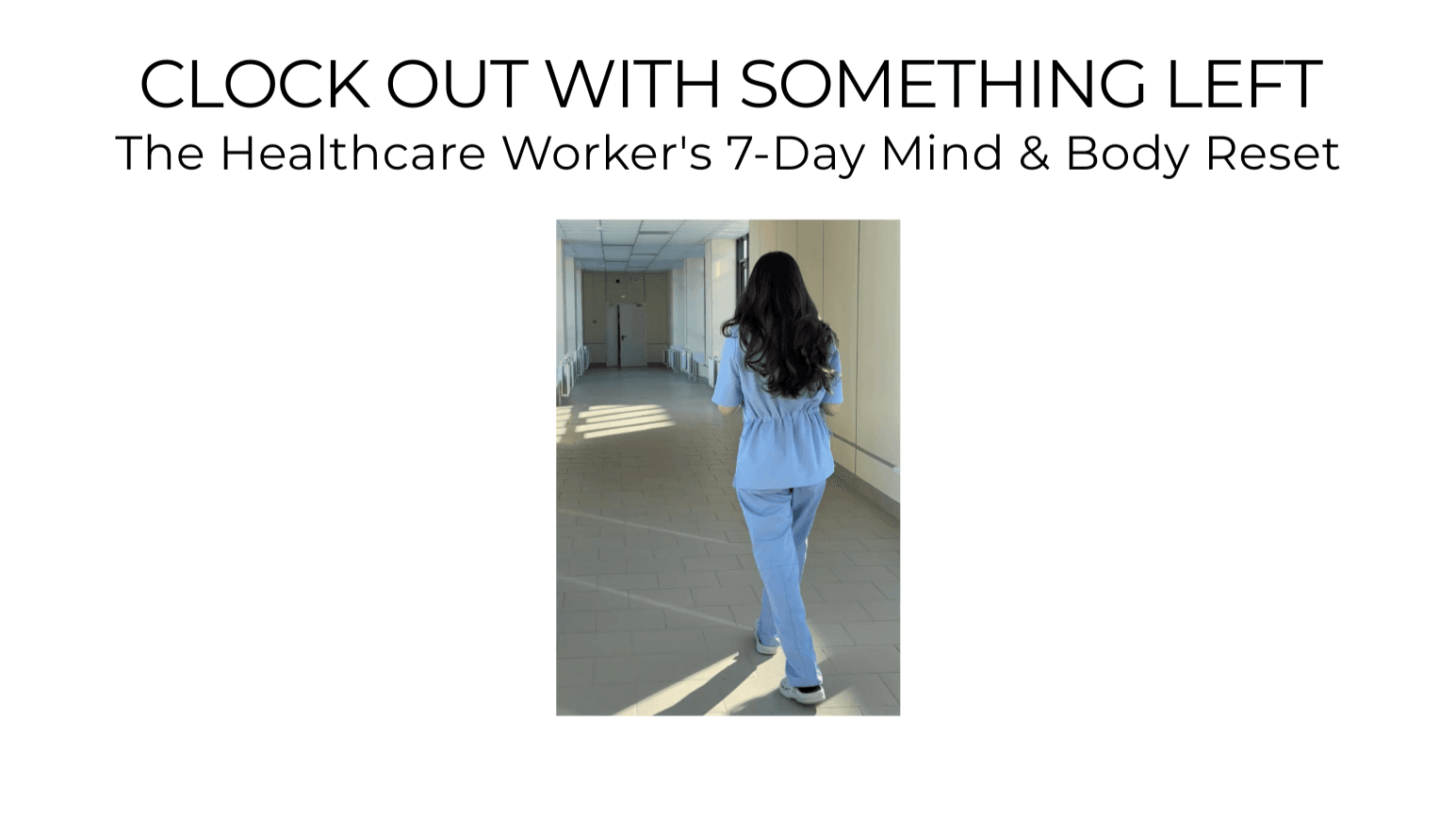
CLOCK OUT WITH SOMETHING LEFT
$27$47
You take care of people all day.
You’re on your feet. You’re thinking ahead. You’re solving problems. You’re helping patients. You’re supporting coworkers. You’re pushing through.
And then you finally clock out...
but your day isn’t over.
There may still be kids waiting for you. A spouse. An aging parent. Dinner. Laundry. School. A second job.
Or maybe you just want enough energy left to enjoy your own life.
If you’ve ever sat in your car after a long shift for a few extra minutes because you weren’t quite ready for anyone else to need you...
I understand.
I created Clock Out With Something Left™ from my own experience working long shifts as a Certified Clinical Hemodialysis Technician.
I remember the early mornings, waking up around 1:45 a.m., clocking in before 3:00, spending much of the day standing and walking, adjusting to PPE, being asked to work overtime—and then coming home to my wife and three young children.
I learned that being good at taking care of other people didn’t automatically mean I was good at protecting some energy for myself.
And that’s what this guide is about.
This isn’t another lecture about “burnout.”
You may not even call yourself burned out.
Maybe you just know:
“I’m freaking exhausted when I get home.”
This practical 7-day guide helps you start paying attention to what’s draining you physically and mentally—and build simple habits around your actual workday.
Inside, we’ll work on:
Identifying your biggest energy leaks
Supporting your feet, legs, back and body during demanding shifts
Simple 2-, 5-, 10- and 15-minute resets
10 gentle stretching and mobility movements
Using your breaks more intentionally
A simple walking reset for releasing some of the shift
Recognizing what you control, influence and need to release
Deciding whether that extra overtime shift is really worth the trade-off
Preparing for early mornings and protecting recovery
Creating a mental transition between work and home
Building your own personalized Clock-Out Plan™
Completing a practical 7-Day Mind & Body Reset
And I’m not going to tell you a five-minute walk will fix an understaffed clinic.
It won’t.
A stretch won’t fix a difficult supervisor.
And this guide isn’t going to magically make a 12-hour shift easy.
This is about the part you can influence:
How you prepare.
How you respond.
How you reset.
How you recover.
And how much of yourself you take home.
Who is this for?
This guide was created with frontline healthcare workers in mind, including:
Dialysis Technicians • CNAs • PCTs • Medical Assistants • Nurses • Caregivers • Patient-Care Staff • Other Healthcare Professionals
Especially the person who loves helping others but is tired of feeling like work gets the best version of them while everyone at home—including themselves—gets whatever is left.
The Goal Is Simple:
You don’t need to care less.
You don’t need to stop being dependable.
And you don’t need to become a different person.
You’re learning how to do your job, take care of the people who depend on you, and still have something left when the shift is over.
Your patients matter.
Your family matters.
Your responsibilities matter.
And you matter too.
Clock in. Do your job well. Take care of your patients. Support your team.
And when it’s time to clock out...