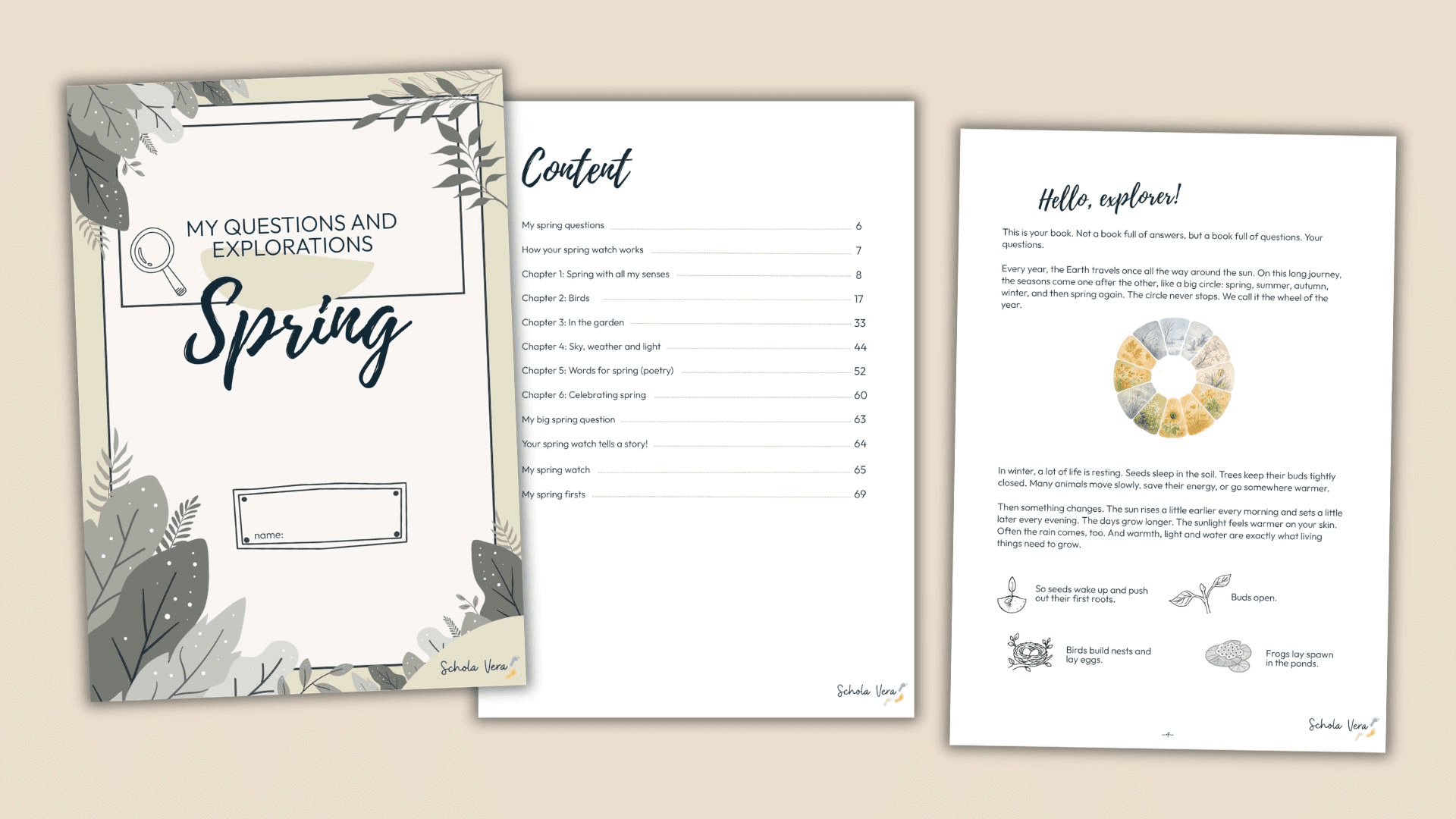
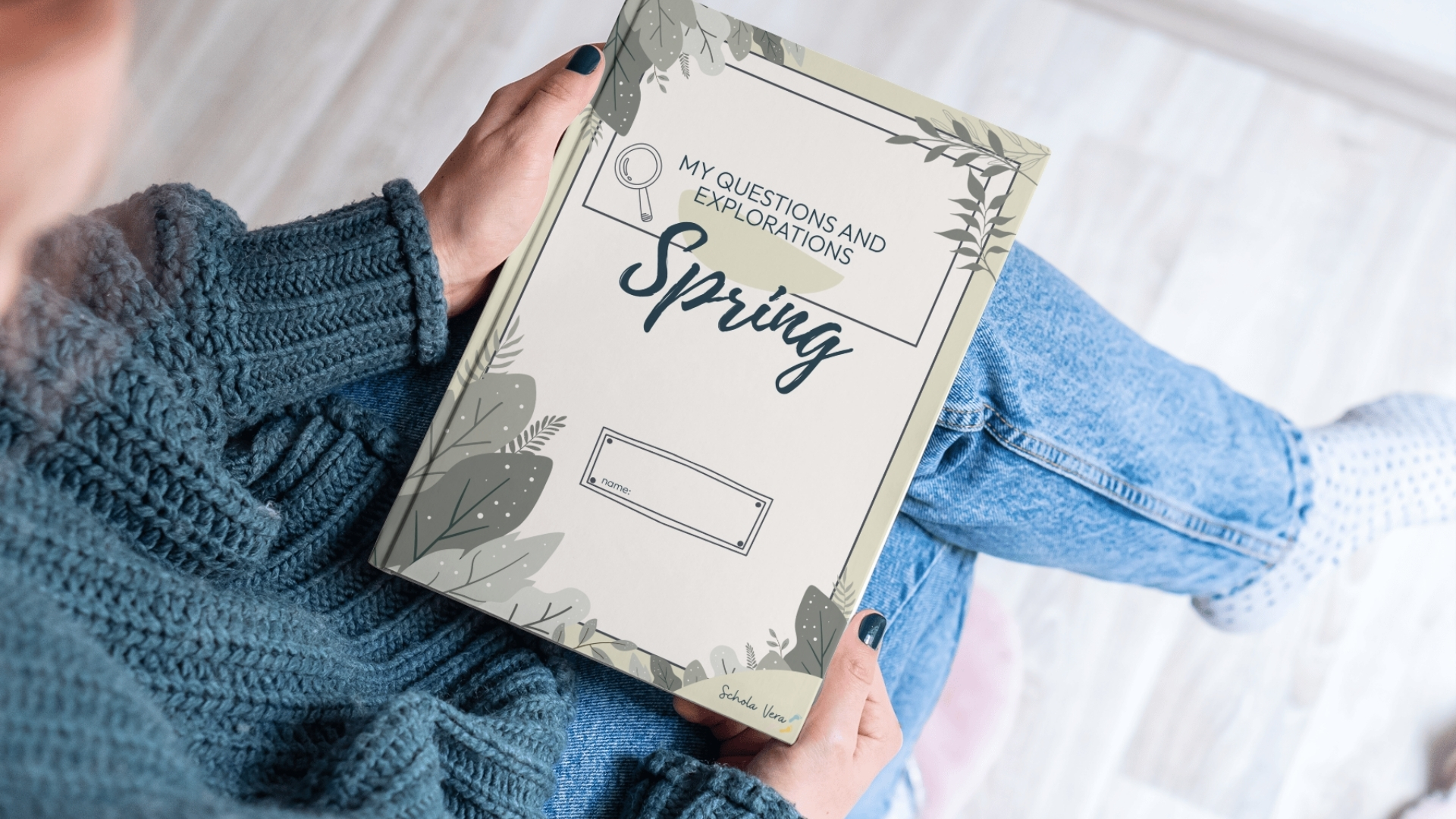
My Questions and Explorations – Spring
14 €
A printable spring unit for homeschooling families. Open questions, hands-on experiments and time outside.
Every child is born an explorer.
Watch a four-year-old in a garden. They turn over stones and talk to snails. They ask where the bird goes at night and why worms come out after rain. Nobody had to teach them to be curious. Nobody had to make them excited.
So the real question isn’t how to make children want to learn.
It is how not to lose that along the way.
At Schola Vera, the small school we founded in South Africa, this is the question we care about most. We believe every child carries something of their own that wants to unfold. It doesn’t unfold through pressure or through finding the right answer. It unfolds when a child is allowed to follow what fascinates them. They need time, real things in their hands, and an adult who listens.
You know this too. It is probably why you chose a different path for your child.
But here is the quiet problem many homeschooling families run into:
We leave school behind and bring the school day home with us.
A curriculum. A plan. Worksheets to finish. A box to tick.
None of that is wrong. Structure helps. But somewhere between maths and spelling, the thing we cared about most gets squeezed out. The wondering. The delight of finding something out for yourself. The mud on the knees. The question nobody planned for.
Questions that stay open
Every page starts with a real question. Many of them don’t have one right answer.
Why can you smell rain before it arrives?
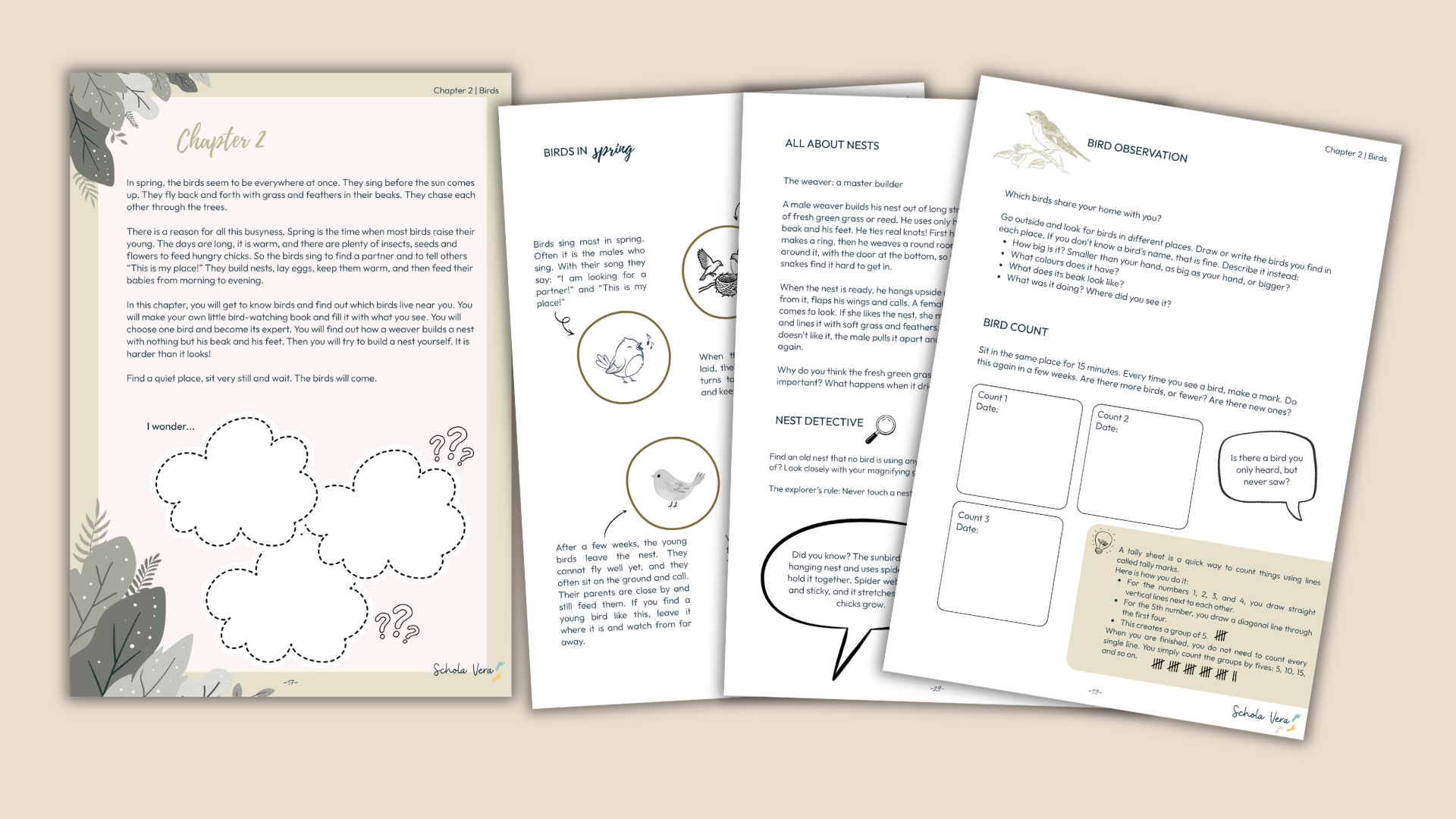
How does a bird build a nest with only its beak and feet?
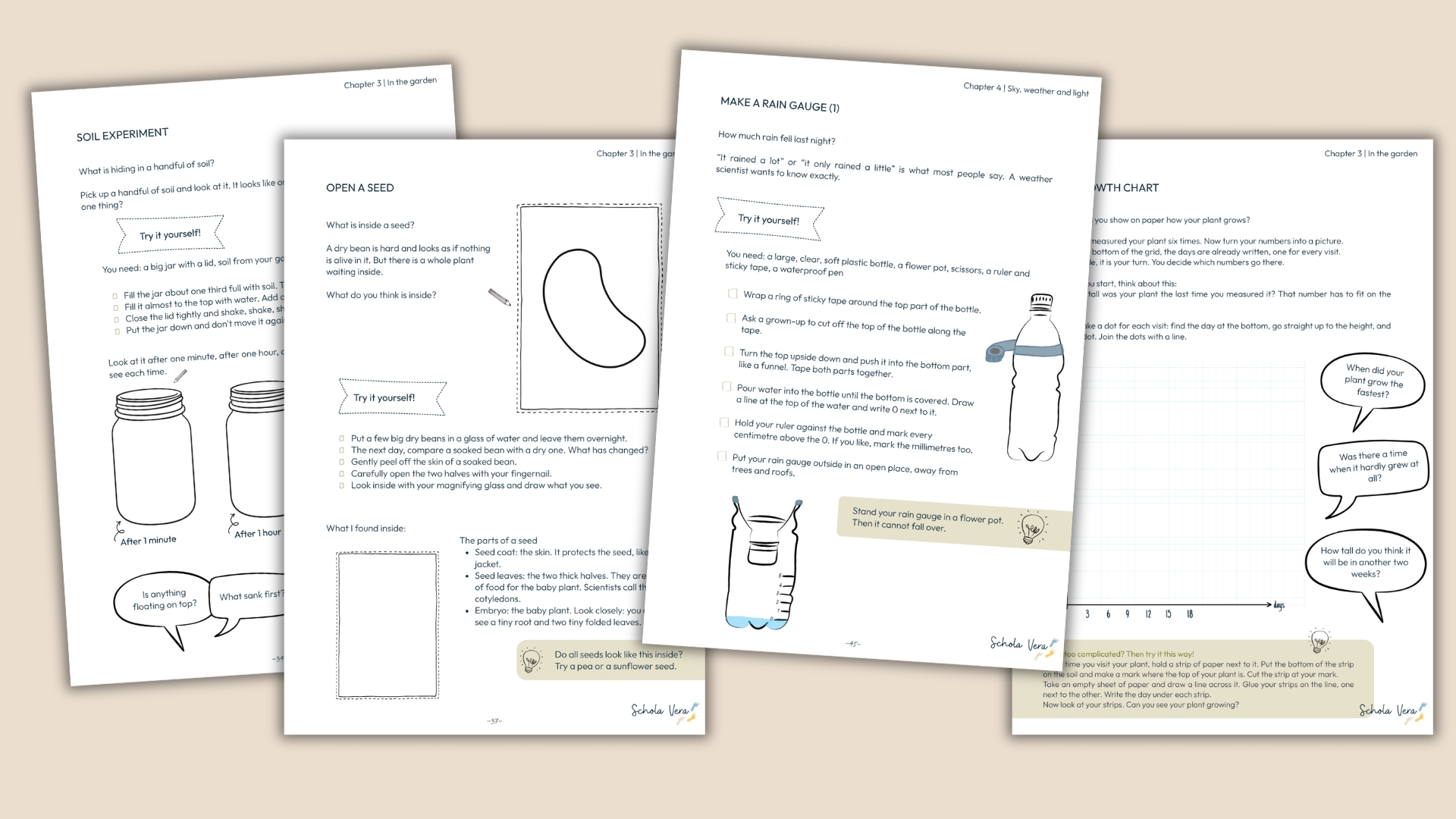
What is inside a seed before it grows?
Which way is the wind blowing today, and how can you tell?
Why is your shadow longer in the morning than at midday?
Throughout the book, “I wonder…” clouds invite your child to write down their own questions. At the very beginning, they collect everything they wonder about spring. At the end, they come back to those questions, choose one that is still open and find the answer themselves.
A good question doesn’t end with an answer. It leads to the next question. That is where real enthusiasm for learning comes from.
Real experiments, simple materials
Hands-on science doesn’t need a kit. Your child will sort soil in a jar and open a seed to find the baby plant inside. They will grow a bean behind glass and watch its roots. They will build a rain gauge, a weather vane and a bird’s nest. They will chase their shadow with chalk, make smell jars and lay a barefoot path.
Almost everything you need is already in your kitchen or outside your door.
More than science
Between the experiments there are poems, colour hunts, rain paintings, cloud spotting and a page for planning your own spring celebration. Children can look closely, write, draw, make things and celebrate. Not every page is an experiment, and that is on purpose. Every child finds their own way into a subject. Some start by measuring, others by drawing or by finding the right words.
A book that grows with your child
At 5, your child will draw what they see and tell you the rest.
At 7, they will write a few words beside the drawings.
At 10, they will write their own poems, keep a weather record and plan their own investigations.
The questions stay the same. The answers grow, and so does your child.
That is why the book is made to be used again, spring after spring. It is a spring unit study you will come back to, not one you finish.
What’s inside
My spring questions: everything your child wonders about spring, written down before they begin
Spring watch: a weather calendar and a list of spring firsts that runs through the whole season, with weekly measurements of the shadow, a plant and the length of the day
Chapter 1 | Spring with all my senses: colour hunt, look closer, sound map, draw a bird song, smell jars, why rain smells, a barefoot path
Chapter 2 | Birds: bird observation and bird count, five South African garden birds, a pocket bird booklet, become a bird expert, all about nests, build a nest, a nest-building shop
Chapter 3 | In the garden: a soil experiment, who makes the soil, open a seed, from seed to plant, a bean behind glass, a plant diary and growth chart
Chapter 4 | Sky, weather and light: why the days are getting longer, a rain gauge, a weather vane, chase your shadow, cloud spotting, what clouds tell you about the weather
Chapter 5 | Words for spring: a word garden, a spring word poem, Elfchen, haiku and spring poems by Robert Louis Stevenson, Christina Rossetti and others
Chapter 6 | Celebrating spring: spring around the world, a spring table, plan your own spring celebration
My big spring question and Your spring watch tells a story
Chapters 2 to 5 each end with a page that belongs entirely to your child.
The bird chapter introduces five South African garden birds. All activities work with the birds outside your own window, wherever you live.
For you, the grown-up
The hardest part of this book isn’t for your child. It’s for us.
It is holding back the answer. Letting the spelling be. Letting your child skip a page, start in the middle, or spend a whole week on one question.
The book opens with a short letter to parents. It explains why there is no right order and no need to finish every page. It also explains why we ask you not to correct the spelling: children who may write freely write more, and they write with joy. Most of all, it invites you to go outside and explore alongside your child.
This book is for you if
you want more nature study, curiosity and creativity in your homeschooling week
you would like your child to think for themselves, not just find the right answer
you want something you can open on a spring morning without any preparation
you are looking for one book that serves several children of different ages
It may not be for you if you are looking for tests, grades or a fixed weekly schedule.
Format: PDF to print at home, A4, 70 pages
About the author
I’m Tatiana Karcher, a teacher and the founder of Schola Vera, a small, nature-based independent school in South Africa.
For almost ten years I have been creating, designing and selling my own teaching materials. Over that time I became more and more sure of one thing: children learn best when they are allowed to follow their own questions. They need time outside, real things in their hands, and an adult who listens more than they explain. Then their curiosity turns into real enthusiasm, and each child can grow into who they are.
Schola Vera grew out of that belief, and so did this book. It grew out of my work with children, in the garden and outside.
You can find out more about Schola Vera at https://scholavera.co.za/. I write about alternative education at https://scholavera.co.za/alternative-education-blog/.