The High-Conflict Consult Playbook
$19
The High-Conflict Consult Playbook
VVetting a family law attorney when you’re not in a normal divorce. PDF + editable DOCX
Most advice about hiring a divorce lawyer assumes a normal divorce: two reasonable people, a hard season, a path to resolution. This is for the other situation. For the person who already senses theirs won't be simple. Maybe the other party has a pattern of control. Maybe communication has always been a weapon. Maybe you've heard the term post-separation abuse and felt something click into place.
Here's the hard part: not every competent family law attorney is the right attorney for a high-conflict case. Some are superb settlement lawyers who genuinely struggle when the other side has no interest in settling, and you need to find that out in the consultation, not eighteen months and twenty thousand dollars later.
The High-Conflict Consult Playbook is an educational interview-and-preparation guide for the parent vetting an attorney for a high-conflict family law case. It is a starting point to bring to a licensed attorney, not legal advice, not a finished court document, and not a substitute for an attorney. Created by a parent who navigated the family court system, sold by ValuED Sales LLC dba May Divorce Be With You.
What's inside
What's inside, five parts, structured so you walk into every consult knowing what to listen for:
•Part 1, Litigation Readiness. Is this attorney genuinely comfortable in a courtroom, or only at a settlement table? Questions on contested-trial recency, enforcement actions, and when to file for contempt, plus how to defend a contempt or sanctions motion aimed at you without handing the other side ammunition. Includes a quiet bit of public-records homework you can do before you even book.
•Part 2, Local Knowledge and Your Decree. Do they know your bench, your opposing counsel, and how to read the decree you already have? Including the question almost no one asks, tell me about a ruling that caught you off guard.
•Part 3, Coercive Control Fluency. Does this attorney understand post-separation abuse, or will they reduce it to high emotions? Plus a plain-language box on the changing legal landscape and how to look up what your own state has done, so you walk in informed enough to ask sharper questions.
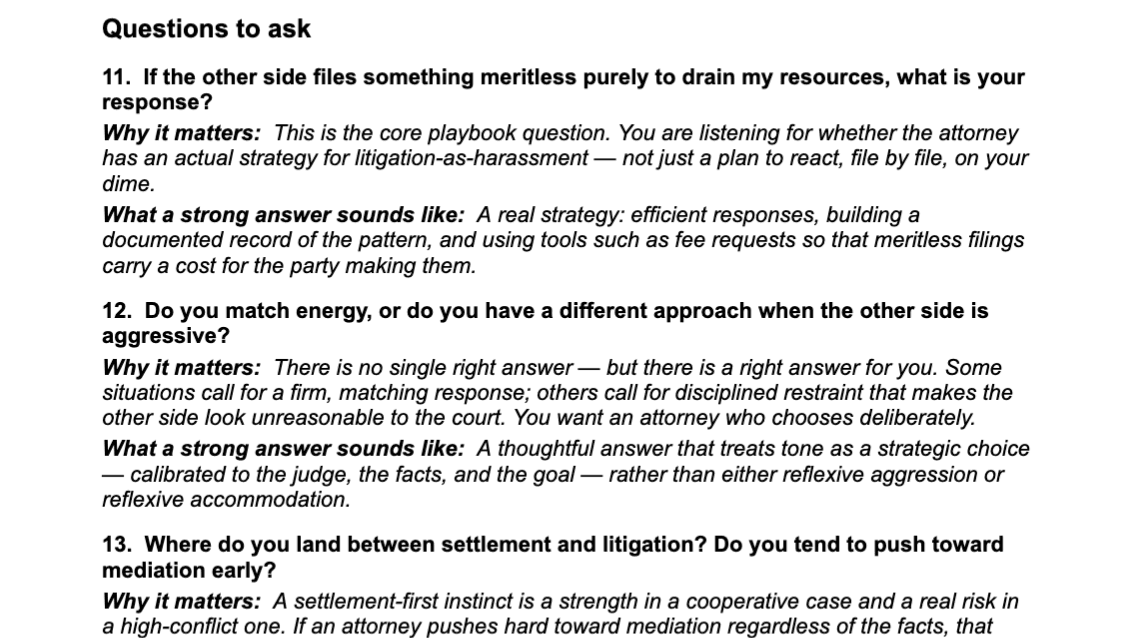
•Part 4, Strategy: Mediation, Filings and Fees. How they actually litigate, whether they'll keep advocating through trial or primarily settle, how they run a mediation and prep you for the room, how they handle aggressive filing, and fee-shifting in both directions, including your own exposure.
•Part 5, After the Consult. The high-conflict fit test, green flags and red flags matched to everything above.
Every question comes with two notes, why it matters and what a strong answer sounds like, framed as one parent's observations and what other parents describe, never as legal analysis. Whether any of it applies under your state's law is for your attorney to determine.
Which one fits
•The free Consult Checklist carries the universal consult prep: the one-page summary, the timeline, fee and retainer questions, and local-court basics. Start there if you want the foundation.
•This playbook is the high-conflict layer. Reach for it when you already know the fight won't be ordinary.
This may fit your situation if
•You already sense this won't be a normal divorce
•You want to know in the first meeting whether this attorney is ready for the fight you're actually in
•You've been through one consult that felt wrong and want to know what you missed
What this is not: Legal advice. A legal service. An opinion about your specific case, your discovery obligations, or what you should produce, withhold, or file. A finished or court-ready document. A substitute for an attorney licensed in your state. A guarantee of any outcome. It's an interview and preparation guide, with no forms, templates, or court documents.
⚠ Read Before Purchase
This is an educational publication, not legal advice. The author is not an attorney. Purchase does not create an attorney-client relationship, and no information shared with the seller is protected by attorney-client privilege. Materials were drafted with reference to Utah law. Statutory citations and procedural references will not match other states' law without modification. An attorney licensed in your state must review and approve every provision before use, including in Utah.
This product is written for high-conflict situations, and that raises the bar, it doesn't lower it. If your situation involves any of the circumstances listed below, your need for a skilled, licensed attorney is urgent, not optional. This playbook is designed to help you find and hire that attorney faster and more carefully. It's never a reason to delay real representation, and not a substitute for it.
Do not use this product as your starting point if any of the following applies to your case: domestic violence; active protective order; substance abuse affecting parenting; CPS or DCFS involvement; abuse allegations (substantiated or not); active mental health crisis; international parental abduction risk; significant special needs; complex finances or hidden-asset concerns; or active parental alienation. In any of those situations, go directly to a licensed family law attorney.
This may not be the right starting point right now if any of these describe you: you're afraid of what the other parent will do if they learn you're preparing; there has been physical violence or a threat of it; there have been threats to take or harm the children, or you; the other parent monitors your phone, location, accounts, or movements; there's a current or recent protective order in either direction; or there's active substance abuse, severe untreated mental illness, or suicidal ideation in the home. Some of the preparation described here can increase danger in a relationship that's already dangerous. If even one applies, work with someone trained in safety planning first. A domestic violence advocate can help sequence things for your situation. National Domestic Violence Hotline: 1-800-799-7233 (text START to 88788), 24/7, free, confidential. In immediate danger: 911, always.
Refunds. All sales are final. These are instant digital downloads, delivered immediately on purchase, so we do not offer refunds. Two exceptions: if a file fails to download or arrives corrupted, email sruff@valuedsales.com and we will re-deliver or refund. And if you bought the wrong custody structure, email within 14 days and we will exchange it at no cost.
Limitation of liability. To the maximum extent permitted by law, ValuED Sales LLC's liability for any claim arising from this product is limited to the amount you paid for it.
Privacy. Your email and payment information are processed through Stan and Stripe to deliver the file and may be used for occasional related updates. Unsubscribe anytime. See Privacy Policy.
Reviewed and updated July 2026.
By completing purchase, you confirm you have read and agree to the Terms of Service and the Read Before Purchase scope statement above.
▲ PASTE ENDS HERE ▲
25. The Consult Checklist
INTERNAL, do not paste. SEO title line: 20 questions to ask before you hire a family law attorney — Keywords: questions to ask divorce attorney, hiring a family law attorney, divorce consultation checklist, first consult with lawyer, how to choose a divorce lawyer
▼ PASTE EVERYTHING BELOW THIS LINE INTO STAN ▼
Free educational guide · Not legal advice · Written by a parent, not a lawyer
You sit down across from the attorney. The meter starts. And then most people spend that expensive hour doing the one thing a lawyer can't actually help with: telling the story. The betrayal. The timeline. The things that were said. The way it all felt.
Your story matters. Your feelings are valid. And a paid consultation is the single most expensive place in the world to process them.
This is the free checklist one parent built so you walk in prepared instead, so your money goes to legal strategy and a real read on your situation, and the feelings go to the people who love you and aren't billing you by the hour. A consultation is a job interview, and you're the employer. This is how you come ready to do the hiring.
What's inside
What's inside, including the questions most people don't know to ask until they're already paying for the answer:
•A before-the-consult prep section, the one-page summary, the short timeline, the documents to bring, and the financial snapshot that turn billed fact-gathering into billed strategy.
•Twenty questions organized by theme: local knowledge and track record, staying current on the law, strategy and communication, fees and billing, and logistics and fit, each with a plain-language note on what to listen for in a strong answer.
•The conflict-of-interest question to ask in the first five minutes, before you've told a stranger your whole story.
•Two things you notice rather than ask: what happens between now and hiring, and whether this person actually listened or talked over you.
•Green flags and red flags to weigh before you sign anything, including the one about an attorney who talks about your spouse with heat instead of strategy.
•A read-this-first scope section, the situations where your need for an attorney is urgent and this guide is only for hiring one fast and well.
You don't have to have decided anything yet to use this. It's for the first consult, the second opinion, or just figuring out whether the person across the table is the right one.
Which one fits
•This checklist gets you through the first consult.
•For a high-conflict case, where the other side may use the process itself as a weapon, The High-Conflict Consult Playbook goes deeper.
•When you move from hiring to preparing and drafting, The Pre-Filing Workbook and the parenting plan templates pick up from there.
This may fit your situation if
•You have a consult booked and don't want to spend it telling the story
•You're getting a second opinion and want to compare the two fairly
•You want to walk out knowing whether to hire this person
What this is not: Legal advice. A legal service. An opinion about your specific case. A substitute for an attorney licensed in your state. A guarantee of any outcome. It's a preparation and interview guide, with no forms, templates, or court documents.
⚠ Read First
This is an educational publication, not legal advice. The author is not an attorney. Downloading or reading it does not create an attorney-client relationship, and nothing you share is protected by attorney-client privilege. It was written with reference to Utah law and will not match other states' law without modification. An attorney licensed in your state must advise you on what actually applies.
Do not use this product as your starting point if any of the following applies to your case: domestic violence; active protective order; substance abuse affecting parenting; CPS or DCFS involvement; abuse allegations (substantiated or not); active mental health crisis; international parental abduction risk; significant special needs; complex finances or hidden-asset concerns; or active parental alienation. In any of those situations, go directly to a licensed family law attorney.
This may not be the right starting point right now if any of these describe you: you're afraid of what the other parent will do if they learn you're preparing; there has been physical violence or a threat of it; there have been threats to take or harm the children, or you; the other parent monitors your phone, location, accounts, or movements; there's a current or recent protective order in either direction; or there's active substance abuse, severe untreated mental illness, or suicidal ideation in the home. Some of the preparation described here can increase danger in a relationship that's already dangerous. If even one applies, work with someone trained in safety planning first. A domestic violence advocate can help sequence things for your situation. National Domestic Violence Hotline: 1-800-799-7233 (text START to 88788), 24/7, free, confidential. In immediate danger: 911, always.
Free download. Your email is used to deliver the guide and for occasional related updates. Unsubscribe anytime. See Privacy Policy. Share it freely in its complete, unmodified form.
By downloading, you confirm you have read and agree to the scope statement above.