The Temporary Orders Complete Bundle
$87
The Temporary Orders Complete Bundle
Everything your temporary order needs, in one set. PDF + editable DOCX
Whatever your temporary order says is what your life looks like for the next twelve to thirty-six months, and the baseline the court assumes should continue when it writes the final decree. Most parents treat it like a placeholder. It's the bedrock the whole case runs on.
The catch: the right temporary order depends on a custody question you may not have answered yet, and even once you have, the order is two layers, not one. There's the universal core every temporary order shares, and there's the custody-and-schedule layer that's different for nesting, equal time, primary-residence, and split arrangements.
The three structures, in plain language
What “Joint 50/50” means, in plain language. Both parents share joint legal custody, meaning both participate in major decisions about education, medical care, and welfare. Physical custody is shared close to equally. “Close to equally” is doing real work in that sentence. Equal-time schedules vary widely, week-on/week-off, 2-2-3, 5-2-2-5, alternating blocks, and the overnight counts don't have to land on exactly half to be treated as an equal-time arrangement. What this framework addresses is the structure: two full households, symmetric authority, and a schedule both parents read the same way. The specific calendar is yours and your attorney's to set.
Sole physical / joint legal, in plain language. The children live primarily with one parent; the other has a defined parent-time schedule. The part most people get wrong: “sole physical” describes where the children sleep most nights. It doesn't transfer decision-making. Joint legal custody is preserved in most of these arrangements, so major decisions stay shared. How much parent-time the other parent has varies enormously, from the statutory minimum to something close to equal, and the structure still holds.
Split custody, in plain language. Two or more children, with at least one living primarily with each parent. Both parents typically still share joint legal custody of every child, not just the one in their home. The schedules don't have to match between siblings, and sibling time together is its own provision rather than a byproduct of the split. This is the arrangement with the most moving parts, which is exactly why consistent language across every stage matters most here.
Which structure describes your case is a legal question, and not one I can answer. I'm not an attorney. This describes what the framework covers so you can recognize whether it's in the neighborhood, then confirm it with counsel.
The Temporary Orders Complete Bundle is an educational drafting set containing Foundations of Temporary Orders plus all four custody frameworks. It is a starting point to bring to a licensed attorney, not legal advice, not a finished court document, and not a substitute for an attorney. Created by a parent who navigated the family court system, sold by ValuED Sales LLC dba May Divorce Be With You.
Why one set instead of pieces
Buy a single framework and you get one custody arrangement, plus the Foundations it depends on. That's the right call when you're certain. But temporary-orders custody questions aren't always settled when you start, and they don't always stay settled. A 50/50 plan can become primary-residence when one parent moves; a primary-residence arrangement can shift toward a split as a teenager's life changes. This bundle exists so you can compare arrangements side by side before you commit, and so a change of direction doesn't mean buying again.
What's inside
What's inside, Foundations plus all four frameworks:
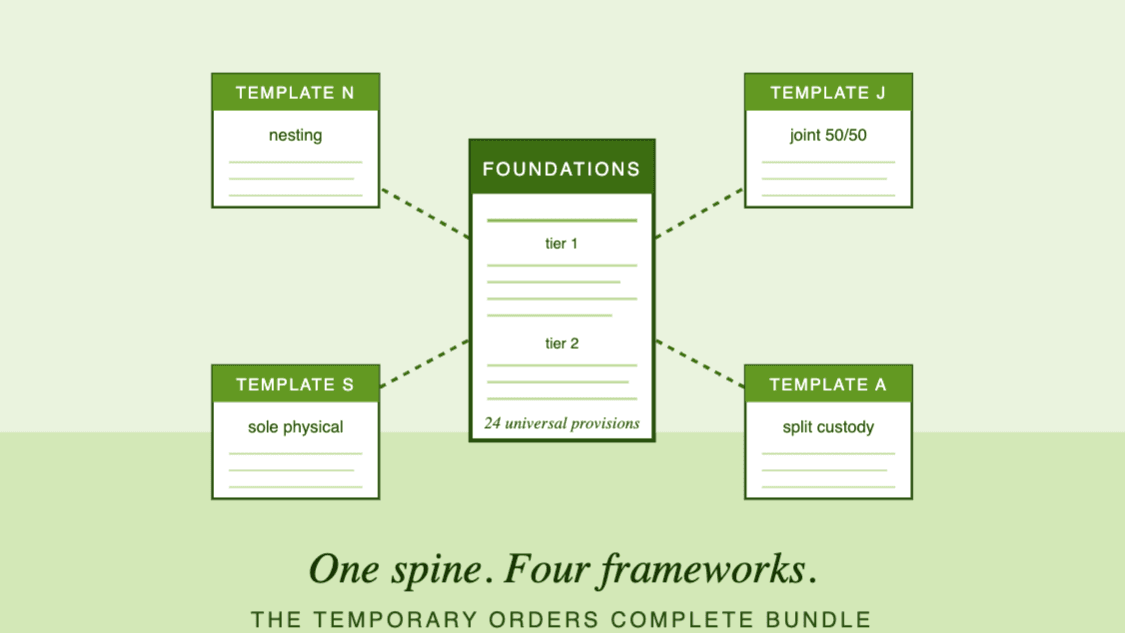
•Foundations of Temporary Orders, the universal core every temporary order shares: plain-language education on what a temporary order is and why filing on time matters, the status-quo lock, and roughly two dozen universal provisions, plus a provisions checklist. This is the spine; read it first.
•Template N, Nesting. The children stay in the family home and the parents rotate. Nest-and-rotation structure, off-duty housing options, an absolute new-partner rule, and a sunset and transition clause. Requires both parties' agreement; a court won't impose nesting.
•Template J, Joint 50/50. Equal parent-time in two households. Three rotation patterns, exclusive use of the marital home, a 50/50-specific new-partner rule, and two child-support options side by side, because equal time doesn't automatically mean zero support.
•Template S, Statutory Minimum / Sole Physical. Children primarily with one parent, statutory minimum parent-time for the other, drafted to keep the primary-residence designation administrative only, with joint legal custody and decision-making preserved.
•Template A, Split Custody. Each parent the primary home for at least one child, with sibling-time provisions as the centerpiece and netted child support. Uncommon; for cases where a split has already been concluded, with counsel, to serve the children.
Each framework incorporates the Foundations universal provisions by reference and modifies only what's framework-specific. Read Foundations first, then your chosen framework, and the combination is your operative draft. Every framework also includes its own attorney notes and lessons, framed as one parent's observations. Not sure which framework is yours? Start with Foundations. The whole point of the bundle is that you don't have to know yet.
Which one fits
•The Pre-Filing Workbook and Bundle cover the quiet work before you file. They end where Foundations begins.
•This bundle covers the temporary-orders stage: Foundations plus all four frameworks.
•The Parenting Plan templates and Complete Bundle are for drafting the final decree, after the temporary-orders stage.
This may fit your situation if
•You haven't settled the custody question and want every arrangement on the table
•You expect the arrangement may shift before the case is over
•You want the most economical way in if you need more than one framework
What this is not: Legal advice. A legal service. A finished or court-ready document. A determination of which custody arrangement is right for your family. A child-support calculation for your case. A substitute for an attorney licensed in your state. A guarantee of any outcome.
⚠ Read Before Purchase
This is an educational publication, not legal advice. The author is not an attorney. Purchase does not create an attorney-client relationship, and no information shared with the seller is protected by attorney-client privilege. Materials were drafted with reference to Utah law. Statutory citations and procedural references will not match other states' law without modification. An attorney licensed in your state must review and approve every provision before use, including in Utah.
The drafting language was prepared with reference to Utah law, with statutory citations reflecting Utah's family law framework as renumbered into Title 81, effective September 2024. It will not match other states' law without modification. An attorney licensed in your state must review, modify, and approve every provision before any use in any proceeding, including in Utah.
A few framework-specific notes: nesting requires both parties' agreement and is not something a court will impose; equal parent-time does not by itself produce a zero child-support figure in most income-shares states; and split custody is uncommon and approached cautiously by courts. Each framework's own scope page covers this in full.
Do not use this product as your starting point if any of the following applies to your case: domestic violence; active protective order; substance abuse affecting parenting; CPS or DCFS involvement; abuse allegations (substantiated or not); active mental health crisis; international parental abduction risk; significant special needs; complex finances or hidden-asset concerns; or active parental alienation. In any of those situations, go directly to a licensed family law attorney.
This may not be the right starting point right now if any of these describe you: you're afraid of what the other parent will do if they learn you're preparing; there has been physical violence or a threat of it; there have been threats to take or harm the children, or you; the other parent monitors your phone, location, accounts, or movements; there's a current or recent protective order in either direction; or there's active substance abuse, severe untreated mental illness, or suicidal ideation in the home. Some of the preparation described here can increase danger in a relationship that's already dangerous. If even one applies, work with someone trained in safety planning first. A domestic violence advocate can help sequence things for your situation. National Domestic Violence Hotline: 1-800-799-7233 (text START to 88788), 24/7, free, confidential. In immediate danger: 911, always.
Refunds. All sales are final. These are instant digital downloads, delivered immediately on purchase, so we do not offer refunds. Two exceptions: if a file fails to download or arrives corrupted, email sruff@valuedsales.com and we will re-deliver or refund. And if you bought the wrong custody structure, email within 14 days and we will exchange it at no cost.
Limitation of liability. To the maximum extent permitted by law, ValuED Sales LLC's liability for any claim arising from this product is limited to the amount you paid for it.
Privacy. Your email and payment information are processed through Stan and Stripe to deliver the file and may be used for occasional related updates. Unsubscribe anytime. See Privacy Policy.
Reviewed and updated July 2026.
By completing purchase, you confirm you have read and agree to the Terms of Service and the Read Before Purchase scope statement above.