What This Actually Costs | Divorce Legal Fees
$17
What This Actually Costs, The Money Side of a Family Law Case
Retainers, fee agreements, and eight ways people pay for this. 46 pages. PDF + editable DOCX
Somebody quoted you a retainer and your stomach dropped. Or nobody quoted you anything, and the silence is worse, so you've been building the number yourself out of forum posts and worst-case arithmetic at two in the morning. Either way you're stuck at the same place: you don't know what this costs, you don't know where the money would come from, and you've quietly concluded that people who get through this must have something you don't.
What actually determines the bill, in plain language.
Three things, and none of them is the number you're afraid of.
A retainer is generally a deposit, not a price. It's held in a trust account, billed against as work is done, topped up when it runs low, and the unearned portion generally comes back at the end. It tells you what a firm wants to hold before starting. It does not tell you what your case costs.
Costs attach to stages, and most cases never reach the expensive ones. Filing, service, temporary orders, discovery, settlement effort, and only rarely a trial. Published sources describe roughly 95% of contested divorces settling before trial. Trial-preparation costs are only incurred by cases that prepare for trial.
In an hourly arrangement, hours are the cost. Some of what generates hours is outside your control. A meaningful portion isn't, and that portion is where an actual strategy lives.
Which means the real questions aren't "how much is this." They're: what do I need to begin, what paths exist besides writing a five-figure check, and what am I signing when I sign a fee agreement.
This can't tell you what your case will cost or what you qualify for — courts, programs, and plan administrators decide that, applying their own rules to your facts. Every dollar figure inside is a published national range included for scale, never a quote. I'm not an attorney. This is built to get you into a consultation already knowing what to ask.
What This Actually Costs is an educational guide. It's a starting point to bring to a licensed attorney, not legal advice, not a finished court document, and not a substitute for one. Created by a parent who navigated the family court system; published by ValuED Sales LLC dba May Divorce Be With You.
What's inside
46 pages, eleven parts, delivered as a PDF and an editable Word document:
Part 1 — The belief that stops people. Why the imagined structure of the cost stops more people than the cost does. What a retainer actually is. Why "I have no income" is a named, anticipated category rather than a dead end.
Part 2 — The vocabulary. Every term you'll hear, in five reference tables. Retainer, trust account, evergreen clause, billing increment, limited scope, fee waiver, interim fees, guardian ad litem, QDRO, discovery, modest means panel, and the rest.
Part 3 — The full cost inventory. Every line item that can appear, from court costs to neutrals to process costs — with published national ranges — plus the eight costs nobody budgets for and no fee schedule mentions.
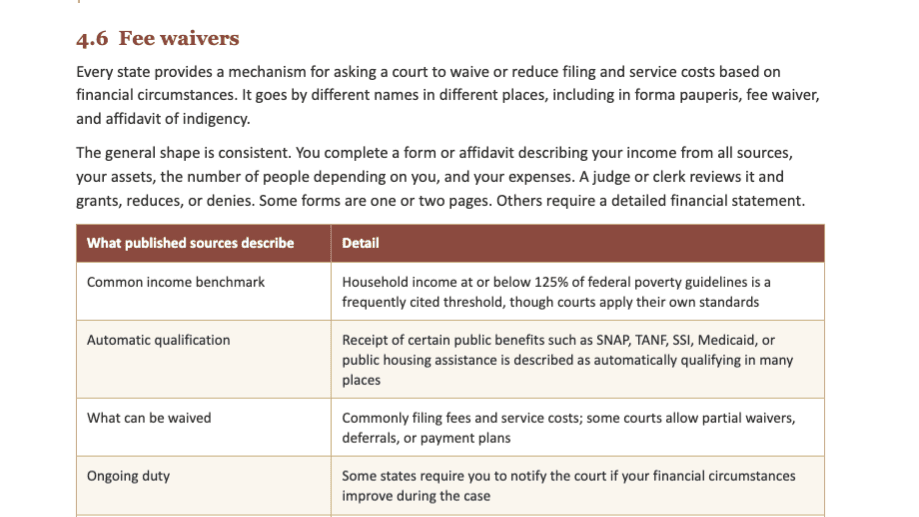
Part 4 — Eight paths people actually use. Full representation · limited scope and unbundled services · mediation · legal aid, clinics, and self-help centers · employer legal plans · fee waivers · court-addressed fees between parties · payment arrangements with a firm. Each with who it tends to fit, the honest trade-off, and the catch. Plus all eight side by side.
Part 5 — Reading the fee agreement before you sign it. The rate range that isn't what it looks like. Rate escalation clauses. Billing increments and how the difference compounds. What "non-refundable" should make you ask. Replenishment clauses. Scope. Withdrawal. Ends in a twelve-item checklist to take into the room.
Part 6 — Advocate for yourself. What to look for on every invoice. What to do when your attorney doesn't appear, the firm sends a substitute, and the issue doesn't get addressed — and the bill arrives for all of it. How to raise it in writing so it gets answered. The escalation ladder. Bar fee arbitration programs, which almost nobody knows exist. Why a fee dispute and a conduct complaint are different doors.
Part 7 — What actually drives the bill. What adds hours, what reduces them, and why being organized is itself a cost strategy.
Part 8 — The honest conversation about settling. What the published numbers show about when cases settle and what the timing costs — followed by the counterweight, which is that the cheapest agreement to reach is a vague one, and vague terms get paid for later.
Part 9 — The money consult. The questions in order, grouped so you get comparable answers across two or three attorneys, with a scoring sheet for comparing what you heard.
Part 10 — If you're worried about money access. Preparation and documentation for a financially dependent spouse, with one firm rule at the top about what not to do.
Part 11 — Five worksheets. Household monthly baseline · what I need to begin · resources I've checked · running cost tracker · path decision worksheet. Plus a consolidated list of questions to take to your attorney, and a note on where every number came from.
Here's what it deliberately doesn't contain: drafting language, any state's law, any statement of what you qualify for, and any prediction of what your case will cost. Those absences are explained inside, and they're why the guide stays accurate when a court changes a fee or a legislature changes a rule. What you get instead is the vocabulary, the questions, and the map.
This may fit your situation if
The money is the reason you haven't started
You've been quoted a retainer and don't know what you're actually being asked for
You're about to sign a fee agreement, or you signed one and never read it closely
Something has already gone sideways with a firm and you don't know whether you're allowed to say so
You want to walk into a consultation with the money questions already organized
What this is not: Legal advice. Financial advice. A quote, estimate, or prediction for your case. A statement of what you qualify for. A recommendation of any path, any attorney, or any fee arrangement. A substitute for an attorney licensed in your state.
⚠ Read Before Purchase
This is an educational publication, not legal advice. The author is not an attorney. Purchase does not create an attorney-client relationship, and no information shared with the seller is protected by attorney-client privilege. This guide contains no statutory content — it does not reproduce, summarize, cite, or characterize any state's statutes, rules, forms, or defaults, and it does not describe what any state, court, or program requires, permits, or provides. Eligibility for legal aid, fee waivers, clinic programs, employer legal plans, and court-addressed fees is determined by the organization, the plan administrator, or the court applying its own rules to your specific facts — never by a published guide. Every dollar figure inside is a published national range included for scale, never a quote. Costs vary enormously by state, county, and market, and court fees and program thresholds change. An attorney licensed in your state is the source for what applies to you.
Do not use this product as your planning framework if any of the following applies to your case: domestic violence; active protective order; substance abuse affecting parenting; CPS or DCFS involvement; abuse allegations (substantiated or not); active mental health crisis; international parental abduction risk; significant special needs; complex finances or hidden-asset concerns; or active parental alienation. In any of those situations, cost planning is not the first problem to solve — go directly to a licensed family law attorney.
This may not be the right starting point right now if any of these describe you: you're afraid of what the other parent will do if they learn you're preparing; there has been physical violence or a threat of it; there have been threats to take or harm the children, or you; the other parent monitors your phone, location, accounts, or movements; there's a current or recent protective order in either direction; or there's active substance abuse, severe untreated mental illness, or suicidal ideation in the home. If someone controls your access to money as a way of controlling you, that is a recognized pattern and it is not a budgeting problem. A domestic violence advocate can help sequence things for your situation. National Domestic Violence Hotline: 1-800-799-7233 (text START to 88788), 24/7, free, confidential. In immediate danger: 911, always.
Refunds. All sales are final. These are instant digital downloads, delivered immediately on purchase, so we do not offer refunds. Two exceptions: if a file fails to download or arrives corrupted, email sruff@valuedsales.com and we will re-deliver or refund. And if you bought the wrong product, email within 14 days and we will exchange it at no cost.
Limitation of liability. To the maximum extent permitted by law, ValuED Sales LLC's liability for any claim arising from this product is limited to the amount you paid for it.
Privacy. Your email and payment information are processed through Stan and Stripe to deliver the file and may be used for occasional related updates. Unsubscribe anytime. See Privacy Policy.
Reviewed and updated August 2026.
By completing purchase, you confirm you have read and agree to the Terms of Service and the Read Before Purchase scope statement above.