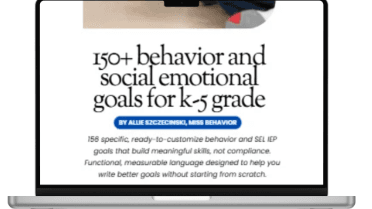
150+ Behavior & SEL IEP Goal Bank for K-5
$15
Writing a meaningful behavior or SEL goal can take FOREVER.
You know the skill you want to teach. You know what the student is struggling with. Then you open the IEP and somehow have to turn all of that into specific, measurable goal language.
This goal bank does that part for you!!
The K–5 Functional Behavior & SEL IEP Goal Bank includes 156 ready-to-customize goals across 52 functional skill areas, all designed to give you specific language you can individualize for the student in front of you.
The goals focus on skills that actually matter for students: communicating needs, recognizing frustration, accessing support, navigating change, solving problems, advocating for themselves, managing school responsibilities, setting boundaries, and more.
WHAT’S INCLUDED:
★ 156 ready-to-customize IEP goals
★ 52 specific functional skill areas
★ 3 goal options for every skill area: With Structured Support, With Available Supports, and Across Natural Settings
★ A “Use This Goal When…” section for every skill area to help you determine when the goal may be a good fit
★ Suggested progress-monitoring methods for every goal area
★ “Keep in Mind” notes throughout the guide to help you think through common concerns with behavior and SEL goals
★ A guide to choosing a meaningful, individualized mastery criterion
★ Specific guidance for writing goals that account for AAC devices, visual supports, co-regulation, accommodations, sensory needs, and other individualized supports
GOAL AREAS INCLUDE:
★ Emotional awareness & self-regulation
★ Self-advocacy & communication
★ Flexibility, change & uncertainty
★ Frustration, challenge & persistence
★ Problem solving & decision making
★ Peer relationships, conflict & repair
★ Executive functioning & school access
★ Independence & self-determination
Within those areas, you'll find specific goals for skills like:
Requesting a break. Asking for clarification. Communicating when a task is inaccessible. Expressing disagreement. Setting boundaries. Navigating unexpected changes. Managing disappointment. Responding to mistakes. Identifying barriers when stuck. Solving problems. Navigating peer conflict. Initiating tasks. Planning for unfinished work. Requesting accommodations. Evaluating supports. Participating in personal goal setting.
And a LOT more.
THE MASTERY CRITERIA ARE LEFT BLANK ON PURPOSE.
You will not see every goal automatically end with “80% accuracy” or “4 out of 5 opportunities across 3 consecutive data collection periods.”
The mastery criterion is something the IEP writer should determine based on the student's baseline, needs, supports, environment, and the specific skill being measured.
The guide includes support for choosing a meaningful criterion using percentage of opportunities, frequency, level of support, rubrics, duration, generalization across settings, and other measures.
You get the language for the skill and the structure for making it measurable, while still having the flexibility to individualize the goal.
THESE GOALS ARE DESIGNED WITH FUNCTION IN MIND.
Behavior goals can get vague very quickly.
“Demonstrate appropriate behavior.”
“Remain on task.”
“Accept no.”
“Follow adult directions.”
Those statements tell us very little about the skill a student actually needs to learn, & this bank will help you get more specific.
A student may need to learn how to communicate that a task is inaccessible. They may need to recognize when they are becoming overwhelmed, request an accommodation, navigate disappointment, identify a barrier, ask for clarification, set a boundary, solve a problem, or figure out which support will actually help.
Those are meaningful, teachable skills. The guide helps you put them into IEP goal language.
THIS GUIDE IS A GREAT FIT FOR:
★ Special education teachers
★ School social workers
★ School psychologists
★ Related service providers
★ IEP team members who support behavior, SEL, executive functioning, or self-advocacy skills
★ Anyone who has ever spent WAY too long trying to figure out exactly how to word an IEP goal
Use the bank to find the skill area that matches the student's identified need, choose the level of support that makes sense, customize the language, add an individualized mastery criterion, and you have a much stronger starting point for your goal.
LESS TIME WORDSMITHING. MORE SPECIFIC GOALS.
You shouldn't have to reinvent IEP language every single time you sit down to write a goal.
This bank gives you 156 specific starting points so you can spend your time individualizing the goal and planning how you're actually going to teach the skill.
156 specific, ready-to-customize behavior and SEL IEP goals for K–5 that focus on meaningful, functional skills students can use at school and beyond.