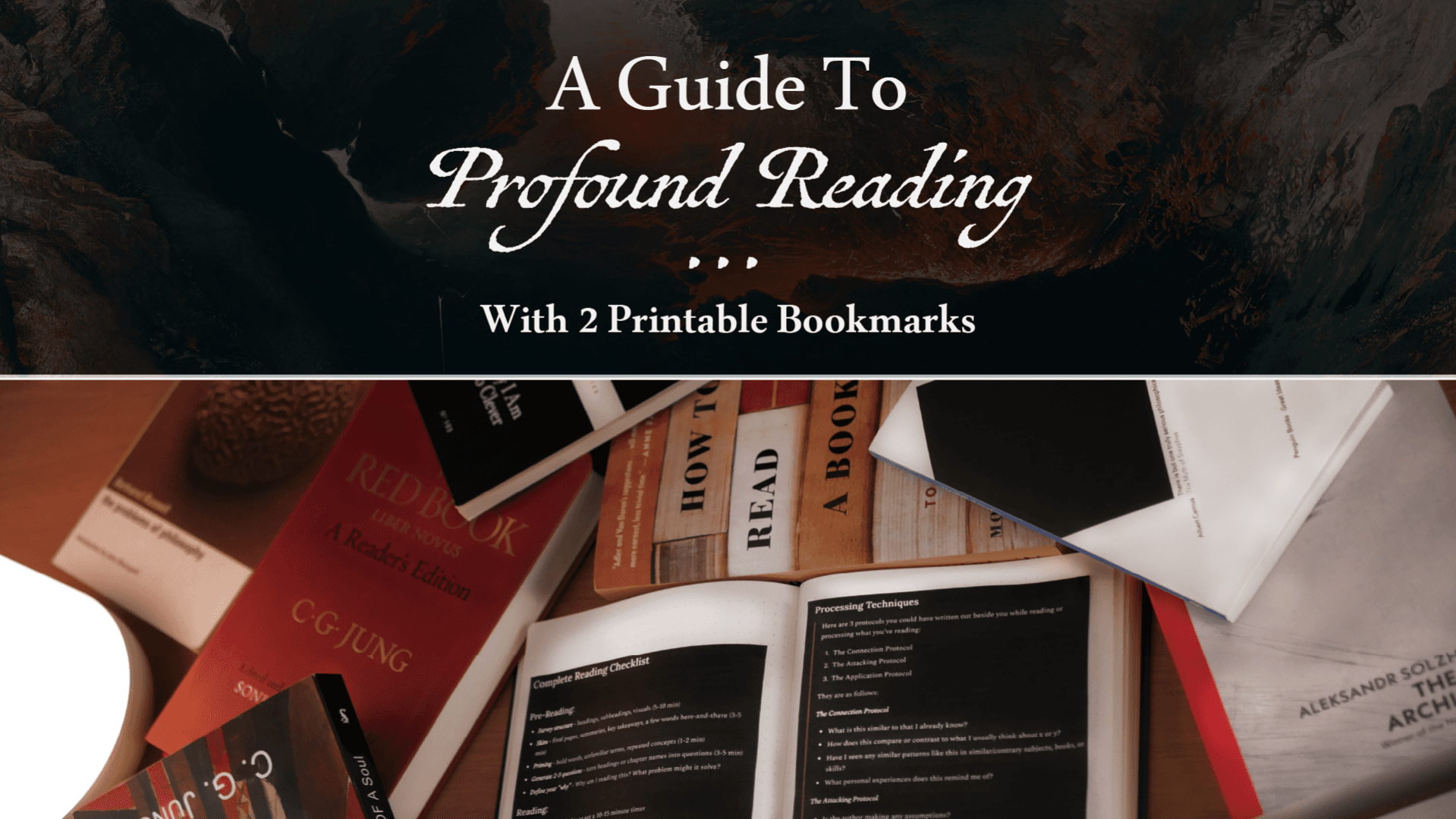
A Guide To Profound Reading
€4.99€9.99
A Framework to Remember & Retain Everything You Read
If you are anything like how I once was, you are doing the following things right now:
Watching every YouTube video with the same title of "How To Remember Everything You Read."
Skimming every article about speed reading.
Following tips about highlighting and note-taking and "building a second brain."
Maybe cramming, too...
Or maybe you're reading a 400-page book about how to read books.
And yet.
You can't remember everything that that book has told you to do.
Formal education only ever gives you tips on how to read.
They don't give you a system, or a specific way of thinking, to follow while consuming any source of information.
Let alone a system that leverages how your brain actually loves to learn based on real learning science.
Everything I listed up top.
None of those will help you learn how to read.
That is why I have built this very guide.
No no, your memory is not the issue
Your brain is hardwired to forget.
And it makes sense.
Forgetting is efficient.
Your mind aggressively deletes information it does not deem important for keeping you alive.
Survival.
And the way most people read amplifies this problem:
Passive consumption - eyes moving across the words, but the mind is disengaged
No mental scaffolding - new information has nothing to connect to
Cognitive overload - pushing through the pages when your brain has already shut down
Zero consolidation - no retrieval, no spacing, which means... that's right! No retention
School never taught you these solutions.
And most "reading advice" ignores it entirely.
Your mind isn't a vault for storing information. It's a garden for growing knowledge.
The profound difference is this word: connection
While most people try to cram isolated facts into their heads (which get forgotten easily), profound readers create webs of connected understanding that grow stronger with every new idea.
What is profound reading?
I used to attack dense books with pure determination.
It was actually cringy how determined I was to read these books. Seriously.
For example, I'd start The Myth of Sisyphus, get five pages in, and realize I had no idea what was actually being said.
I closed The Gulag Archipelago feeling overwhelmed and defeated (and didn't touch it again for two years).
The problem was rhat I was reading for hours but thinking for barely 5 minutes.
And my brain was punishing me for it.
By forgetting everything.
So I studied how the brain actually processes and retains information.
I tested techniques.
And I built a system myself.
And this is what happened instantly:
Instead of forgetting what I read within 24 hours, I could explain complex philosophical concepts weeks later
Instead of feeling overwhelmed by dense material, I felt energized by the connections I was making
Instead of reading for 3 hours with 5 minutes of thinking, I started reading for 30 minutes with deep comprehension that lasted days
Being informed is not the same as being enlightened, my friend.
The 3-step profound reading system
This system is built on one principle:
Your brain retains what it connects, and forgets what it isolates.
Step 1: Pre-Learning
Build mental scaffolding before you read.
Survey the structure, skim the end, prime vocabulary, generate questions.
When new information has something to attach to, it sticks.
Step 2: Reading (with Cognitive Load Management)
Read until you hit your limit; then stop and process.
Stay in the optimal zone where deep learning happens.
Because pushing through the wrong type of overwhelm means your brain retains nothing.
Step 3: Consolidation
Use retrieval practice and spaced intervals to encode knowledge to long-term memory.
The Feynman Technique (explaining concepts simply) is the ultimate test.
There's no much other theory inside this guide.
Since, it's a practical system you can use with your favorite book starting tonight.
Why this system works (the learning science, briefly)
Your brain has an optimal learning band:
Too little challenge → information marked as irrelevant → forgotten
Too much information → cognitive overload → nothing retained
Sweet spot → deep processing → long-term retention
The Connection Principle:
Isolated information gets deleted
Connected information gets kept
Your job: build a web of knowledge, not a storage box of facts
The Forgetting Curve is a feature, not a bug:
Your brain deletes information to conserve energy
Strategic repetition and active processing override this
Spaced consolidation makes knowledge permanent
Traditional reading tips fail because they treat your brain like a computer.
Which it isn't.
It's actually a garden, and a garden needs cultivation.
This guide is the watering pot.
Everything you will get
THE CORE SYSTEM
The Profound Reading Guide (5,000+ words)
The complete framework that transforms passive consumption into active knowledge creation.
You'll read it in full in about 30 minutes.
Which will set you up for how to use the 2 printable bookmarks perfectly.
The 3-Step Profound Reading System
Pre-Learning → Reading → Consolidation.
The exact sequence that aligns with how your brain actually processes and retains information.
Cognitive Load Management
Learn the three zones (underload, overload, optimal) and how to stay in the sweet spot where deep learning happens.
Know exactly when to stop reading and start processing.
The Connection Principle
Why isolated information gets forgotten and connected information gets retained, and how to build a web of knowledge instead of a storage box of facts.
THE TOOLS
Processing Techniques Bookmark (Printable #1)
Three protocols on a single bookmark:
The Connection Protocol - Questions to link new ideas to what you already know
The Attacking Protocol - Questions to think critically and challenge assumptions
The Application Protocol - Questions to turn knowledge into action
Complete Reading Checklist Bookmark (Printable #2)
The step-by-step system as a checklist:
- Pre-Reading
- Reading
- Post-Reading
Use with any book, any genre, any difficulty level.
Never wonder "what do I do next?" again.
Spaced Consolidation Schedule
The scientifically-backed review intervals:
1 day → 3 days → 1 week → 1 month
This will increase your knowledge retention in a way that feels illegal.
The Feynman Technique
How to explain complex concepts in simple terms; as if teaching a 12-year-old.
The most efficient test of true understanding.
If you can't teach it, you don't know it.
The Pre-Learning Protocol
The 4 steps to build mental scaffolding before you read:
1. Survey structure
2. Skim the end
3. Prime vocabulary
4. Generate questions
This alone can double your reading comprehension.
Guarantee
Test this guide out for 7 days.
If you don't retain more from your reading than you did before, email me and I will give you a full refund.
Yes, I'm being serious.
You keep the bookmarks and the guide either way.
So give it a go. You literally have nothing to lose.
FAQ
How long is the guide?
5,000+ words.
Most people read it in one sitting (about 30 minutes), then use the bookmarks with their next book immediately.
Who is this for?
Anyone who reads (fiction or non-fiction), and wants to actually retain what they read.
Students, self-learners, professionals, curious minds.
If you're a reader, this guide is for you.
Will this work for difficult books? (Philosophy, technical, etc.)
Yes.
I built this system specifically because I was struggling with dense material like Camus and Solzhenitsyn.
The Cognitive Load Management section addresses this directly.
What if I'm a slow reader?
Speed means nothing.
Reading is really about depth.
You'll likely read less but retain far more - which is the entire point.
I've tried other reading methods before.
Most reading advice gives you tips.
This gives you a full system to follow with very little friction at all.
And, it's built on how your brain actually processes information.
The two printable bookmarks make it as practical as humanely possible, not theoretical, and ready for immediate use no matter your current position.
What format is the guide?
You'll receive a PDF download of the guide, with printable bookmarks (also PDF format) you can download, print out, and use immediately with very little ink.
Ready to become a profound reader?
You can keep reading the way you always have.
Finishing books and forgetting them.
Collecting information that never becomes knowledge.
Always wondering why nothing sticks.
Or...
You can spend 30 minutes learning a system that changes how you read forever.
You can use the bookmarks with your next book tonight.
You can start building a web of knowledge that grows stronger with every page.
If you want to become a profound reader, this guide is for you.
If not, don't get it.
I originally offered lifetime Substack paid-tier access with this guide. I've since moved that bonus to The Profound Self-Education Guide, a more comprehensive system with an AI prompt that builds your personalized learning plan.
If you want the entire system and lifetime access, that's the one to get.
The Profound Self-Education Guide includes this reading guide for free.