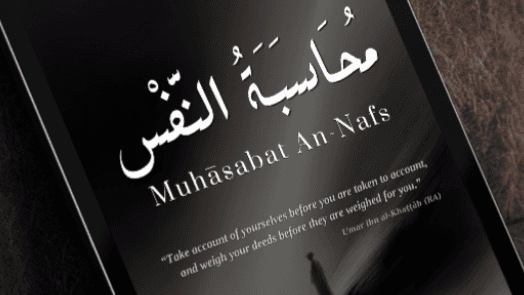
Muḥāsabat an-Nafs
$27$47
You pray. You fast. You are a muslim, Alhamdulilah! You think you're doing okay.
But praying and fasting on ramdan wearing hijab is the bare minimum. It is the floor, not the ceiling. And most of us have built our entire spiritual identity on that floor, quietly convinced we're better Muslims than the ones who don't pray or don't cover, while never once asking what is actually happening inside us.
We don't ask. Because if we asked honestly, we might not like the answer.
So here is the question: what is your actual level of iman right now? Not what people see. Not the version you post. Not the way you carry yourself in front of your family. The real one. Could you say?
Most of us couldn't. We have never been taught how to check.
Iman is not static. It rises and falls. Some days it is alive in your chest. Some days it is dying quietly while your body still goes through the motions of prayer and your soul is somewhere else entirely. The Prophet ﷺ taught this. The Companions feared it for themselves, they used to weep about hypocrisy in their own hearts, and these were the Companions, the best of this ummah. If they were checking themselves, what does it say about us that we have never done it once?
The most dangerous stage of being Muslim is not sinning. It is the stage where you have stopped noticing.
It happens slowly. You feed the nafs whatever it asks for. The gaze. The scroll. The gossip. The resentment. The petty hatred for someone who hurt you. The pride dressed as confidence. The riyā' when you're doing good deed, Each time you give in, it asks for more, and you give it more, and the part of you that used to flinch goes quieter. Until it stops flinching at all. Until every sin you used to fear feels normal. Until you feel nothing.
That is not peace. That is the soul's coma. And most of us are closer to it than we will admit, while still praying five times a day.
And here is the part the salaf (early generations of Muslims, particularly the Prophet Muhammad ﷺ's companions) could not sleep at night because of:
Death does not call ahead.
There is no warning. No countdown. No "you have three more years to fix this." The Prophet ﷺ said to live as a stranger or a traveler on the road, because you are. The next breath is not promised to you. And whatever iman is in your chest right now, in this moment, that is the iman you will be raised with if the moment is today.
So the question is no longer "will I get to it later?"
The question is: do I even know what is in there right now?
This journal exists to answer that.
It is forty days of the practice the salaf did nightly, muḥāsabat an-nafs. Self-accounting. The same way a scale tells you your weight. The same way bloodwork tells you what is happening in a body you cannot see inside of. This journal tells you what is actually happening in your soul.
It does it through questions. Specific ones. Direct ones. Uncomfortable ones. The kind that pull out what you have been pretending is not there. It walks you through every layer of yourself , your prayers, your tongue, your heart, your relationships, your eyes, your time, your money, your secret habits, and shows you, in your own handwriting, where the leaks are. Where the iman has thinned. Where the diseases of the heart have settled in without you knowing. Where the sins have quietly become normal.
You can pretend to your husband. To your parents. To your closest friends. You cannot pretend to your own handwriting. And once you have seen it on the page, you cannot unsee it. That is exactly the point. Because seeing is where the work starts. Until then, you were not lazy and you were not unwilling, you were blind. You cannot fix a soul you cannot see.
The version of you that walks out of these 40 days will not be perfect. She will not have it figured out. But she will know herself. She will know the actual level of her iman. She will know what stands between her and Allah. She will know, for the first time, in writing, what to actually do about it.
This is the basic self-awareness every Muslim should have. The kind nobody ever taught us. The kind no lecture, no reel, no halaqah was ever going to give us. The kind that only comes from sitting with yourself, honestly, with a pen in your hand and Allah as your witness.
What is inside
118 pages. Six phases that walk you through every layer of the self: the awakening of a numb heart, the rebuilding of the five pillars, the guarding of the tongue, the purification of the heart from its hidden diseases (riyā', kibr, ḥasad, ghaflah, ḥubb ad-dunyā), the rights you owe to the people in your life, and the realignment of how you spend your time, your body, your gaze, your money, your life.
Every day pairs a verse or ḥadīth, in Arabic, transliteration, and English, with questions you cannot answer with the polished spiritual-sounding version of yourself.
Also inside: a baseline self-assessment you fill out on Day 1 and again on Day 40, so you see your own growth in your own handwriting. A weekly "still point" review every seven days. A master inventory of 14 diseases of the heart. A master checklist of 30 major sins with restitution lines. A daily muḥāsabah template for the rest of your life after the 40 days end. A du'a collection for the journey. A signed lifetime pledge page where you commit, in writing, to three habits you will protect and three sins you are leaving behind, with Allah as your witness.
The 40 days end. The work does not.