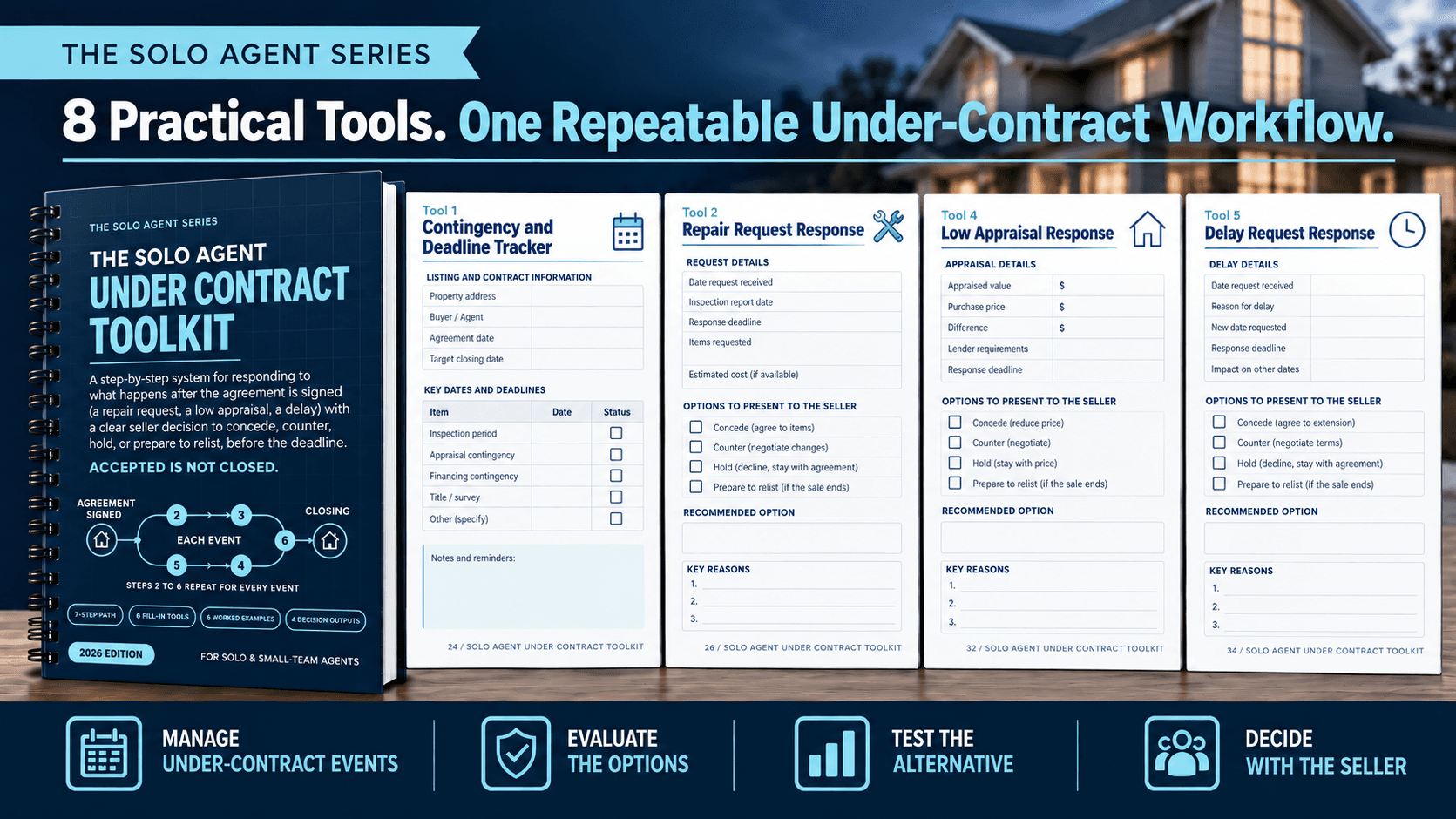
Get The Solo Agent Under Contract Toolkit Now!
$34.99$49.99
Accepted is not closed.
The Solo Agent Under Contract Toolkit is a practical, step-by-step system for handling what happens after a real estate agreement is signed and before the sale reaches closing.
When a repair request, low appraisal, financing issue, or delay changes the transaction, the agent has to quickly understand what changed, what it could cost the seller, what the agreement and local process allow, and what options are worth presenting.
This toolkit gives you a structured process for turning that event into a clear seller decision: CONCEDE, COUNTER, HOLD, or PREPARE TO RELIST.
WHAT YOU'LL GET
1. Under Contract Local Rules Card
A quick reference for recording the local requirements, brokerage policies, approved forms, and seller-approved processes you need to verify before responding to an event.
2. Contingency and Deadline Tracker
A central place to capture the agreement, key dates, seller standards, deadlines, agreed changes, and event history.
3. Repair Request Triage
A structured way to break a repair request into specific items, identify what is known and unknown, separate evidence from assumptions, and prepare the event for a decision.
4. Repair, Credit or Price Comparison
A side-by-side worksheet for comparing possible responses to a repair request and understanding how each option affects the seller's position.
5. Low Appraisal Response Options
A structured way to assess the appraisal gap, identify what is known, compare possible responses, and prepare the seller's decision.
6. Delay Response Planner
A practical worksheet for analyzing a threatened or requested delay, the affected dates, the seller's priorities, and the possible responses that need to be verified locally.
7. Walk-Away Assessment
A two-part assessment for evaluating the seller's position at an event and, when the sale may end, comparing the current sale with the possibility of starting over.
8. Seller Conversation Planner
A structured preparation tool for presenting the event, the facts, the options, the trade-offs, your recommendation, and the decision the seller needs to make.
9. Closing Handoff Checklist
A checklist for moving from clear-to-close through closing and file close, including an Under Contract Log for recording lessons across transactions.
THE 7-STEP UNDER CONTRACT PATH
The toolkit takes you through a repeatable process:
Set Up the Contract Clock
Capture the Event and Find the Clock
Work the Event
Test the Alternative
Present It and Decide
Respond, Record, Reset the Clock
Hand Off to Closing
The process is built around four possible decision outputs:
CONCEDE
Accept the requested change when the seller's position supports it.
COUNTER
Propose a different response when there is a plausible way to improve the seller's position.
HOLD
Keep the agreement as signed while the buyer chooses whether to proceed, when that is the seller's decision.
PREPARE TO RELIST
Prepare for the possibility that the sale will not close on terms the seller can accept.
VERIFY FIRST is the pause before a decision when information that matters is missing or unverified. It is not a fifth output.
THREE COMMON POST-ACCEPTANCE EVENTS
The toolkit is organized around three events that can require a structured response:
Repair requests
Low appraisals
Delays
Each event has its own guide, decision path, worksheets, and worked example.
OPTIONAL AI ASSIST
The toolkit includes three optional AI prompts for:
Sorting and organizing a repair request.
Checking a draft response for missing questions or unsupported assumptions.
Preparing a clear seller conversation outline.
The AI prompts are optional. The toolkit works without AI.
They are designed to work only from information you have verified and entered yourself. They do not interpret contract terms, calculate deadlines, estimate repair costs, write contract wording, or choose the response for you.
WHY IT MATTERS
Once an agreement is signed, the seller may feel that the hard part is over.
Then new information arrives.
A repair request can change the economics of the sale. An appraisal can create a gap between the contract price and the appraised value. A financing or scheduling problem can put the closing date at risk.
The agent needs to determine:
What actually changed.
What the agreement says.
What deadline is controlling.
What the seller has already agreed to.
What the event could cost.
What information is still missing.
What options are worth considering.
What the seller's alternatives look like.
What needs to be verified locally.
What decision the seller needs to make next.
This toolkit gives you a repeatable process to:
Capture the event and its deadline.
Separate facts from assumptions.
Assess the seller's current position.
Compare response options.
Prepare for repair requests, low appraisals, and delays.
Test what happens if the sale does not close.
Present the situation clearly to the seller.
Record the decision and reset the clock.
Carry the transaction through the closing handoff.
WHO IT'S FOR
Built for solo and small-team listing agents who carry their own listings from signed agreement to closing and need a practical structure for handling unexpected events without a transaction coordinator or second set of eyes.
It is also useful for newer agents on small teams who want a repeatable framework for post-acceptance decisions.
The toolkit is not a transaction-management system, legal guide, buyer-agent toolkit, or substitute for broker guidance and local forms.
WHAT'S INCLUDED
1 digital PDF toolkit, 58 pages, 2026 Edition.
Includes:
8 fill-in tools
7-step decision path
6 worked examples
3 event response guides
4 decision outputs
Under Contract Local Rules Card
Optional AI Assist prompts
Quick Reference Card
FAQ
Sources and Evidence Notes
Designed for practical use on paper or digitally. No additional software is required.
The toolkit is jurisdiction-neutral and designed to work alongside your brokerage policies, approved forms, local requirements, and professional judgment.