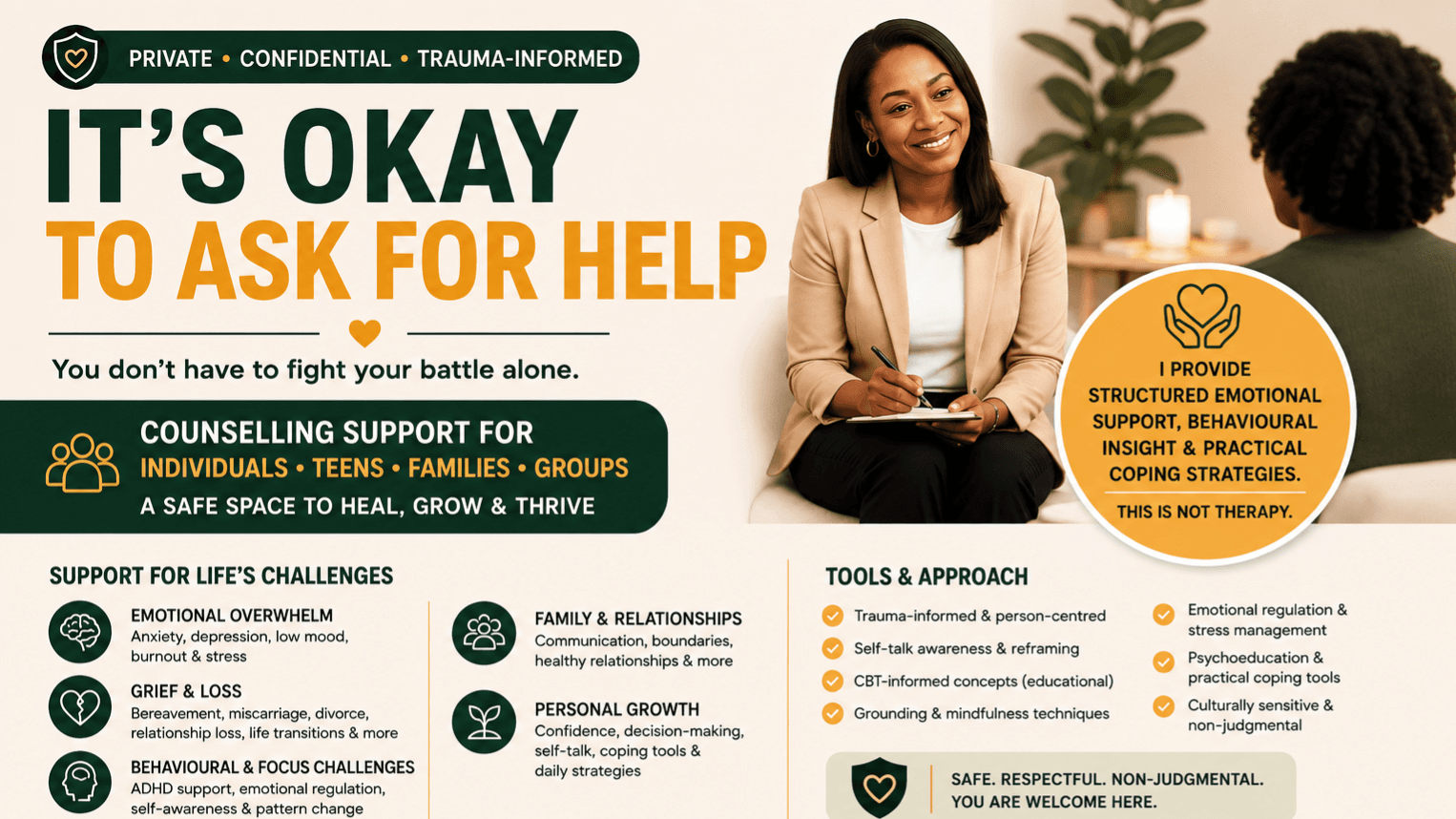
Private Counselling, Grief & Emotional Wellness
$100$150
Private Counselling, Grief & Emotional Wellness Support
Support that meets you where you are, without pressure, labels, shame, or judgment.
Sometimes you do not need someone to “fix” you.
You need somewhere safe to put down what you have been carrying.
You may be grieving someone you love. You may be overwhelmed by a life transition, struggling emotionally, experiencing burnout, trying to understand patterns that keep repeating, supporting a child or teenager through a difficult season, or simply realizing that you cannot continue carrying everything alone.
This counselling support service provides structured emotional support, behavioural insight, grief and bereavement support, and practical coping strategies within a safe, confidential, culturally responsive, person-centered, and trauma-informed environment.
Sessions are available for individuals, children, teenagers, families, and groups.
Please note: These sessions are not psychotherapy and do not provide clinical diagnosis or mental health treatment.
They are intentional, guided support conversations focused on self-awareness, grief support, emotional regulation, behavioural awareness, coping, resilience, personal growth, and practical strategies for navigating real-life challenges.
You do not have to be at breaking point before you ask for support.
Sometimes what you need is clarity. Sometimes you need tools. Sometimes you need someone to listen without rushing your story.
And sometimes, especially in grief, you simply need permission to feel what you feel without being told to “move on.”
Who This Support Is For
This service may be helpful for individuals, children, teenagers, families, or groups who:
Are navigating grief, bereavement, or significant loss
Are grieving the death of a loved one
Are adjusting after miscarriage, pregnancy loss, divorce, separation, friendship loss, relocation, job loss, health changes, caregiving changes, or another major life transition
Feel emotionally overwhelmed, mentally exhausted, or stuck in unhelpful patterns
Experience anxiety, low mood, emotional fatigue, overwhelm, difficulty focusing, or attention-related challenges
Feel burned out from constantly caring for, supporting, or showing up for everyone else
Are struggling to understand or communicate their emotions
Need grounding, accountability, perspective, or clarity during a stressful season
Want practical coping strategies without entering formal psychotherapy
Prefer a non-clinical, non-diagnostic, human-centered approach to emotional wellness
Want support that respects culture, autonomy, boundaries, faith, family dynamics, identity, and lived experience
Need a safe space to think, reflect, process, and identify their next steps
You do not need a diagnosis to deserve support.
Grief & Bereavement Support
Grief is not limited to death.
We grieve people, relationships, dreams, identities, opportunities, health, fertility journeys, marriages, friendships, homes, seasons of life, and versions of ourselves that no longer exist.
And grief does not always look like crying.
Sometimes grief looks like anger.
Sometimes it looks like numbness, exhaustion, irritability, withdrawal, difficulty concentrating, guilt, confusion, disrupted routines, or feeling as though everyone else has moved forward while your life has somehow stopped.
There is no single “correct” way to grieve.
During grief support sessions, you are given space to talk about your loss without being rushed, judged, spiritualized away, or pressured to recover according to someone else's timeline.
Support may focus on:
Making sense of emotions connected to loss
Understanding common grief responses
Navigating anniversaries, birthdays, holidays, and significant dates
Adjusting to life after loss
Managing emotional overwhelm
Coping with loneliness and changes in relationships
Processing guilt, regret, anger, confusion, or unanswered questions through supportive reflection
Developing grounding practices and healthy daily routines
Learning how to communicate your needs to family and friends
Supporting children and teenagers experiencing grief
Rebuilding routines after significant loss
Creating meaningful ways to remember and honour someone who has died
Finding ways to continue living while carrying the reality of what has been lost
The goal is not to erase grief.
The goal is to help you feel supported while learning how to carry it in a way that does not require you to abandon yourself.
Grief support offered through this service is supportive and educational in nature. It is not grief psychotherapy, trauma processing, diagnosis, or clinical treatment.
My Approach: Trauma-Informed & Person-Centered
Every session is guided through a trauma-informed and person-centered lens.
That means:
Emotional safety comes first
You are never pressured to disclose more than you are comfortable sharing
Your experiences are approached with curiosity rather than judgment
Language is respectful and non-pathologizing
Consent, choice, boundaries, dignity, and autonomy are honoured
Support is collaborative rather than controlling
Cultural and lived experiences are respected
Your strengths are recognized alongside your struggles
You remain an active participant in determining what support looks like for you
I believe that behaviour is often communication.
Instead of immediately asking, “What is wrong with you?” we can begin asking:
“What is happening underneath this behaviour?”
Because meaningful change often begins with understanding, not shame.
What We Can Focus On
Every person arrives with a different story, so sessions are individualized.
Support may include:
Grief and bereavement
Emotional overwhelm
Behavioural awareness and pattern recognition
Emotional regulation
Stress management
Burnout and emotional fatigue
Anxiety-related challenges
Low mood and emotional resilience
ADHD-related daily challenges such as focus, organization, overwhelm, and routines
Healthy self-talk
Cognitive reframing for everyday situations
Confidence and self-esteem
Boundary setting
People-pleasing and over-functioning
Decision-making
Relationship and family stress
Coping with major life changes
Parenting and family communication
Identity and personal growth
Building healthier daily routines
Understanding emotional triggers
Developing practical coping strategies
Reconnecting with yourself after difficult seasons
Support relating to anxiety, depression, ADHD, mood concerns, or other mental health conditions remains non-diagnostic and non-clinical and should not replace appropriate healthcare or treatment.
Tools Used
Non-Therapeutic, Skill-Based & Evidence-Informed Support
Although these sessions are not psychotherapy, I may gently incorporate practical and evidence-informed wellness strategies for education, reflection, and everyday coping.
These may include:
Self-talk awareness and reframing
CBT-informed concepts for education and self-reflection only
Grounding techniques
Mindfulness and present-moment awareness
Emotional check-ins
Reflective questioning
Psychoeducation about emotions, stress, grief, and behaviour
Behavioural pattern awareness
Journaling prompts
Values clarification
Practical stress-management strategies
Emotional vocabulary building
Routine and organization strategies
Strengths-based reflection
Coping plans for everyday stressors
These tools are used for education, self-awareness, personal development, coping, and empowerment.
They are not used to diagnose or treat mental illness.
Support for Children & Teenagers
Children and teenagers experience emotions and grief differently from adults.
A child may not always say, “I am grieving,” “I am anxious,” or “I feel overwhelmed.”
Instead, their emotions may appear through:
Behavioural changes
Withdrawal
Anger or irritability
Difficulty concentrating
Changes in school engagement
Fear or worry
Difficulty communicating emotions
Changes in routines
Family conflict
Difficulty adjusting after loss or major life changes
Sessions can provide age-appropriate opportunities for young people to build emotional awareness, identify coping strategies, communicate what they are experiencing, and feel heard.
For minors, appropriate parent or legal guardian consent will be required before services begin, while respecting the young person's dignity, privacy, developmental needs, and applicable confidentiality requirements.
This service does not provide psychological assessment, diagnosis, psychotherapy, or treatment for children or adolescents.
Individual, Family & Group Sessions
1:1 Counselling Support
Personalized, confidential support tailored to your current concerns, goals, circumstances, and lived experience.
Family Support
Guided conversations designed to strengthen emotional understanding, communication, boundaries, and healthier family interactions.
Group Support
Facilitated spaces focused on shared learning, emotional wellness, grief, coping skills, psychoeducation, and respectful discussion.
Group participation does not require anyone to disclose personal information they are uncomfortable sharing.
All sessions are designed to foster emotional safety, dignity, clarity, respect, and growth.
What This Service Is NOT
Professional and ethical boundaries matter.
Please understand that this service:
Is not psychotherapy
Is not counselling psychology
Does not provide psychological or psychiatric services
Does not provide clinical diagnosis
Does not provide psychological assessments
Does not provide formal treatment plans
Does not provide trauma-processing psychotherapy
Does not replace medical or psychiatric care
Does not replace treatment from a regulated mental health professional when clinical care is needed
Does not provide crisis intervention
Does not provide emergency mental health services
If, during our work together, your needs appear to require care outside the scope of this service, you may be encouraged to connect with an appropriate regulated healthcare or mental health professional.
Your wellbeing comes before keeping you in a service that is not appropriate for your needs.
Why Work With Me?
I am an experienced mental health, wellness, harm-reduction, and trauma-informed service provider offering structured emotional and behavioural support rooted in compassion, integrity, cultural awareness, dignity, and lived-experience understanding.
My approach integrates:
Emotional literacy
Trauma-informed practice
Person-centered support
Afrocentric and culturally responsive awareness
Anti-racist and anti-oppressive practice
Intersectional and inclusive perspectives
Behavioural insight
Nervous-system awareness
Grief-sensitive support
Strengths-based reflection
Empowerment rather than dependency
Practical tools that can actually be applied to everyday life
You are more than a label.
You are more than the hardest thing that has happened to you.
And you deserve support that recognizes your humanity before your struggle.
What You May Gain From These Sessions
Every person's journey is different, and no specific outcome can be guaranteed.
However, sessions are designed to support you toward:
Greater emotional clarity
Increased self-awareness
Improved coping strategies
Better understanding of behavioural patterns
Stronger emotional vocabulary
Increased confidence
Improved boundaries
Healthier thought patterns
Reduced feelings of overwhelm
Greater understanding of grief responses
More intentional decision-making
Improved ability to communicate emotional needs
Practical tools for navigating stressful situations
Feeling heard, supported, and less alone
Growth is not rushed here.
It is supported.
Terms & Conditions
By booking a session, you acknowledge the following:
Sessions must be booked in advance and are subject to availability.
Cancellations or rescheduling must follow the notice period stated at booking.
Missed appointments without appropriate notice are non-refundable unless otherwise stated.
Participation is voluntary.
You may pause or discontinue support at any time.
Sessions are intended for emotional wellness, psychoeducation, personal development, grief support, and skill building.
Appropriate consent is required for services involving minors.
Confidentiality is respected within applicable ethical and legal limits.
Information may need to be disclosed where required by law or where applicable safeguarding obligations arise.
This service is not intended for emergencies or acute mental health crises.
Important Disclaimer
Please read carefully before booking.
This counselling and emotional wellness support service is not psychotherapy, counselling psychology, psychiatry, psychological treatment, or medical care.
No clinical diagnosis, psychological assessment, psychotherapy, psychiatric treatment, or medical treatment is provided through these sessions.
Grief and bereavement support offered through this service is non-clinical supportive care and does not constitute grief psychotherapy or treatment for complicated or prolonged grief-related mental health conditions.
Information, guidance, psychoeducation, reflective conversations, and practical tools shared during sessions are intended for emotional support, wellness education, coping, self-awareness, grief support, and personal development purposes.
This service should not be used as a substitute for professional medical, psychiatric, psychological, or psychotherapeutic care when such care is required.
If you are experiencing a mental health emergency, thoughts of suicide or self-harm, risk of harming another person, severe psychological distress, or another immediate safety concern, please contact your local emergency service, crisis service, or an appropriate regulated healthcare professional immediately.
By completing your booking, you confirm that you have read, understood, and accepted the scope and limitations of this service.
Frequently Asked Questions
Is this therapy or clinical counselling?
No.
These sessions are not psychotherapy, counselling psychology, or clinical mental health treatment.
There is no diagnosis, psychotherapy, or clinical treatment provided.
This is structured emotional, behavioural, grief, wellness, and coping support designed to help you gain insight, develop practical skills, and navigate life more intentionally.
Then how is this different from therapy?
Psychotherapy and other forms of clinical mental health treatment involve regulated clinical practices designed to assess and treat psychological concerns.
This service focuses on support, self-awareness, grief, coping, emotional regulation, behavioural insight, psychoeducation, accountability, and practical life strategies without providing clinical treatment.
Think of it as guided emotional support and skill building rather than mental health treatment.
Do you provide grief counselling?
I provide non-clinical grief and bereavement support.
This means you can receive a compassionate space to talk about loss, understand grief responses, identify coping strategies, navigate difficult dates and transitions, communicate your needs, and adjust to life after significant loss.
I do not provide grief psychotherapy, clinical trauma processing, diagnosis, or treatment.
Does grief support only apply when someone dies?
No.
Grief may follow many forms of loss.
This can include:
Death of a loved one
Miscarriage or pregnancy loss
Divorce or separation
Relationship or friendship loss
Job or career loss
Immigration or relocation
Loss of health or physical ability
Fertility challenges
Caregiving transitions
Retirement
Empty nesting
Loss of identity
Major life transitions
The loss of a dream, expectation, or future you imagined
If something mattered to you, losing it can create grief.
Can this support help me if I experience anxiety, depression, ADHD, or mood challenges?
Potentially, with an important distinction.
Sessions can support day-to-day coping, organization, emotional awareness, stress reduction, grounding, self-reflection, and behavioural understanding.
Support may incorporate educational and wellness approaches such as:
Self-talk awareness
CBT-informed educational concepts
Grounding
Mindfulness
Behavioural reflection
Emotional regulation strategies
Practical coping tools
However, this service does not diagnose or treat anxiety disorders, depressive disorders, ADHD, mood disorders, or other mental health conditions.
If clinical treatment is required, working with an appropriate regulated healthcare professional is important.
Can I use this service alongside therapy or medication?
Yes.
Some people use emotional wellness support alongside psychotherapy, medical care, psychiatric care, medication management, or other professional services.
This service does not replace those providers and will not advise you to discontinue prescribed medication or clinical treatment.
Do I need a diagnosis to book?
No.
You do not need a diagnosis to need support.
You can book because life feels heavy.
You can book because you are grieving.
You can book because you feel overwhelmed.
You can book because you want better coping strategies.
You can book because you are tired of repeating the same patterns.
Or you can simply book because you need a safe place to think out loud and gain perspective.
What happens during a session?
Sessions are conversational, structured, collaborative, and supportive.
Depending on your needs, we may:
Talk through what you are currently experiencing
Explore behavioural or emotional patterns
Identify stressors and triggers
Talk about grief or significant loss
Explore the impact of a major life transition
Practice grounding or mindfulness strategies
Identify healthier coping responses
Explore boundaries
Develop practical next steps
Build emotional vocabulary
Examine self-talk
Identify strengths and available support systems
You set the pace.
You are never required to share something you are not ready or comfortable discussing.
Are sessions confidential?
Your privacy is respected and sessions are conducted within a confidential environment.
However, confidentiality has limits and may be subject to applicable legal, safeguarding, or reporting obligations.
These limits will be explained where appropriate.
Can children and teenagers book?
Support may be available for children and teenagers where the service is appropriate for their needs.
A parent or legal guardian will generally need to provide appropriate consent before services begin.
If a young person's needs require psychological assessment, psychotherapy, psychiatric support, crisis intervention, or another specialized service, referral to an appropriate professional may be recommended.
Is this suitable for families and groups?
Yes.
Family and group sessions can focus on emotional awareness, communication, coping, grief, boundaries, psychoeducation, and shared learning.
Sessions are facilitated with a trauma-informed approach, and participants are not forced to disclose personal information.
Who is this service NOT suitable for?
This service may not be appropriate if you:
Require psychological assessment
Require a mental health diagnosis
Require psychotherapy
Need psychiatric treatment
Are experiencing an acute mental health crisis
Require emergency intervention
Require intensive trauma treatment
Require specialized clinical treatment beyond the scope of emotional wellness support
In these circumstances, connecting with an appropriate regulated mental health or healthcare professional is strongly recommended.
What results should I expect?
There is no guaranteed outcome and this is not a quick fix.
The purpose of the sessions is to provide a supportive environment in which you can develop greater awareness, coping strategies, perspective, emotional clarity, and practical tools.
Your progress will depend on many factors, including your individual circumstances, participation, consistency, readiness, support system, and needs.
Why should I choose personalized support when there are free resources online?
Because sometimes information is not the missing piece.
You may already have watched the videos.
Saved the posts.
Read the books.
Listened to the podcasts.
You may even know exactly what you “should” be doing.
But human support provides something information alone cannot always provide: connection, reflection, accountability, personalized guidance, and a space where your story can actually be heard.
You are not simply receiving information.
You are being supported in understanding how that information applies to your life.
Is your approach culturally sensitive and trauma-informed?
Yes.
Sessions are approached with awareness of culture, lived experience, race, identity, family systems, power dynamics, boundaries, dignity, and emotional safety.
There is no one-size-fits-all formula.
Your story matters.
Your context matters.
And your voice matters.
Ready to Begin?
You do not have to wait until everything falls apart before you ask for support.
Whether you are navigating grief, overwhelm, burnout, emotional challenges, behavioural patterns, family concerns, or a major life transition, you deserve a space where you can be heard without judgment.
Come as you are.
We can begin from there.
Book Your Private Support Session
Choose your preferred session option through this page. Once your booking is confirmed, you will receive the next steps and session information.
Support that meets you where you are.
Tools for where you are going.