TL;DR
The best time to post on Instagram in 2026 depends on your audience, content format, and niche—but there are universal patterns you can build on. Weekdays tend to outperform weekends. Midweek is strongest. Peak engagement typically falls within three windows: morning (7–9 a.m.), midday (11 a.m.–2 p.m.), and evening (6–9 p.m.). Reels perform best during passive scrolling hours. Carousels do better when users have time to engage deeply. Stories depend on recency and frequency. The more your posting schedule aligns with when your specific audience is active, the better your results.
If you’ve ever Googled ‘best time to post on Instagram,’ you’ve probably noticed every guide gives you a different answer.
Some say mornings. Others swear by evenings. And most present their findings as if there’s one schedule that works for everyone.
The truth is, there isn’t one universal answer.
Sure, certain days and times tend to perform better. But no two Instagram accounts are the same—and your optimal posting times might not be either.
That’s what this guide will help you figure out. We’ll start with what the data says, then break it down by day, format, and niche, and share how you can quickly identify what works for your specific account—so you can grow your Instagram faster.
Best Time to Post on Instagram: What the Latest Data Says
Before we get into specific recommendations, let’s zoom out. In general, what are the best times to post on Instagram in 2026?
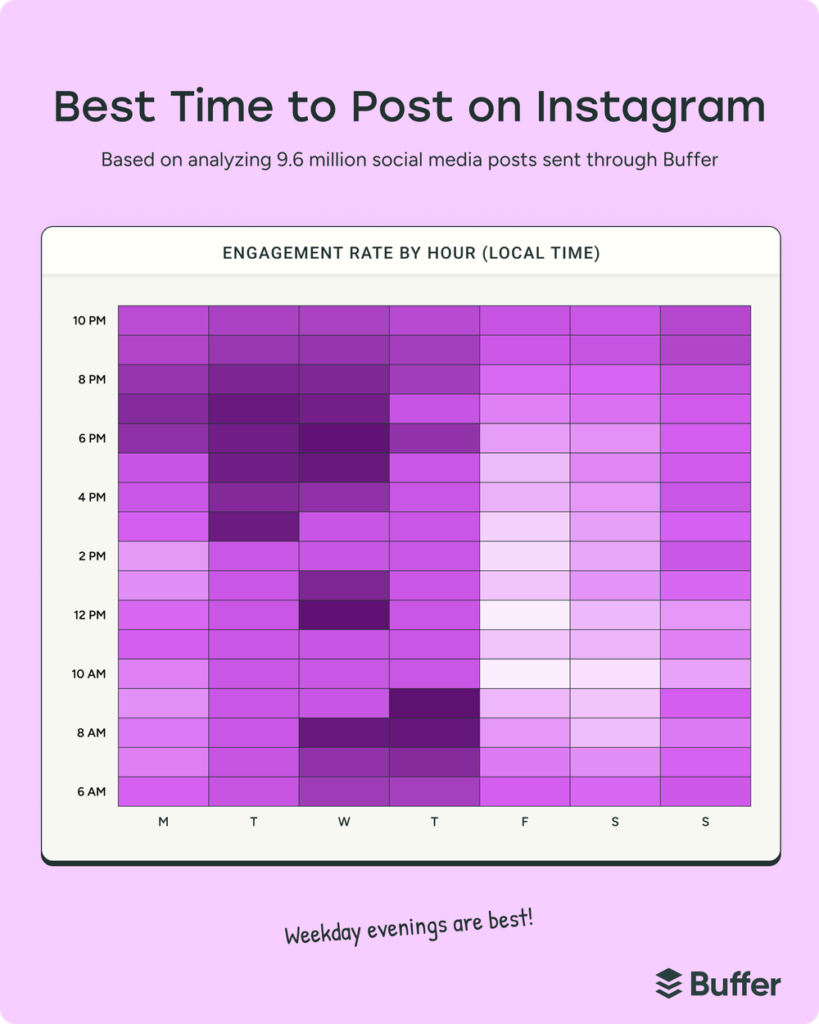
According to large-scale studies from platforms like Buffer and Sprout Social, most engagement happens during weekdays—no matter your niche.
Buffer’s research analyzed millions of Instagram posts across global accounts, focusing on engagement patterns over time.
Sprout Social took a slightly different approach, aggregating Instagram performance data across industries to identify broader behavioral trends.
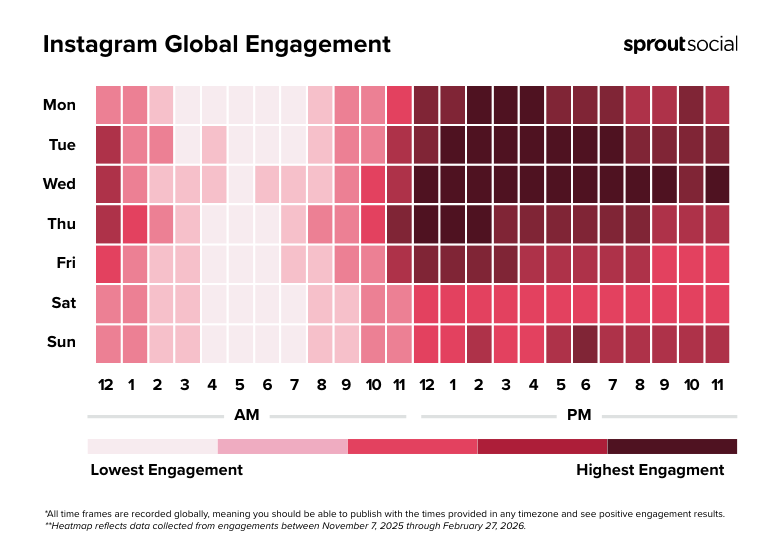
While their exact recommendations differ, both are grounded in large sample sizes and activity from real Instagram users, making them useful starting points for figuring out what might work for you.
Key Patterns Across All Studies
When you step back and compare these findings, a few patterns show up consistently.
Weekdays tend to outperform weekends—most engagement happens between Monday and Thursday, with activity dropping off toward the weekend.
Midweek is usually the strongest. Tuesday through Thursday consistently show higher engagement rates.
And engagement clusters around three main windows during the day:
- Morning: around 7–9 a.m.
- Midday: around 11 a.m.–2 p.m.
- Evening: around 6–9 p.m.
These windows align with how people use Instagram throughout the day: Morning scrolls tend to happen most before work or school. Midday activity peaks during lunch. And evening engagement picks up when people have more free time to browse.
Where the Data Disagrees (and Why It Matters)
Even with these shared patterns, the exact “best” times still vary across sources.
Some studies lean toward late afternoon posting, while others highlight midday as the strongest window. These differences usually come down to three things:
- Audience demographics
- Time zones
- Content type
The results ultimately depend on the types of Creators each study looks at. For instance, if the study primarily includes Creators with global audiences, the data might point to evening posting times because they’re looking to reach audiences in multiple regions at once. Likewise, a dataset focused on business accounts may skew toward midday, when people are active during work hours.
This is important because it impacts how you should interpret the data. These recommendations are not fixed rules—they’re averages across millions of Instagram posts. They can give you a strong starting point, but it’s still important to understand your own audience.
With that in mind, let’s break down the best time to post on Instagram by day.
Best Time to Post on Instagram by Day
Now that we’ve covered the broader patterns, let’s get more specific.
Instead of relying on a single source of truth, we synthesized recent data across multiple large studies. This table shows where the strongest engagement windows overlap.
| Day | Best Times |
| Monday | 7–9 a.m., 6–8 p.m. |
| Tuesday | 9–11 a.m., 6–8 p.m. |
| Wednesday | 11 a.m.–1 p.m., 6–9 p.m. |
| Thursday | 9–11 a.m., 6–8 p.m. |
| Friday | 9–11 a.m., 5–7 p.m. |
| Saturday | 9–11 a.m. |
| Sunday | 6–9 p.m. |
These windows appear consistently across datasets, but the real value lies in understanding why they work. Once you understand the behavior behind each day, it becomes easier to adapt these timings to your own audience.
Here’s what to know.
Monday
On Mondays, engagement tends to pick up in the early morning between 7 and 9 a.m. This is when people are just settling into their day, scrolling their feed. Many users check Instagram during that transition period before work or school begins.
By midday, most users are less active—work schedules start to take over, and attention shifts away from social platforms.
The second strong window is in the evening, from around 6 to 8 p.m. By then, users are likely done with most of their responsibilities and can return to more relaxed browsing.
Mondays tend to underperform overall, as people reengage with their weekly routines and spend less time scrolling.
Tuesday
Tuesday is where engagement starts to balance out. Unlike Monday, where engagement can feel slow, users tend to edge back into their weekly rhythm on Tuesdays—and it shows in their activity patterns.
Content posted during late morning, especially between 9 and 11 a.m., tends to perform well.
Evening performance remains strong between 6 and 8 p.m.
Tuesday is typically considered one of the best days to post, as users are most active midweek and you’re less likely to see sharp drops in engagement.
Wednesday
Wednesday is often considered the best day to post on Instagram. Multiple studies point to Wednesdays as the most consistent and predictable day for engagement, with most users interacting with content between 11 a.m. and 1 p.m.
This timing aligns with lunch breaks, when users have more time to deliberately scroll, watch, and engage with content.
Engagement also remains strong later into the evening, until around 9 p.m.
By midweek, users are fully in their routine, but also more open to distraction and longer browsing sessions. If you had to choose one day to prioritize, Wednesday is the best option for strong engagement across midday and evening slots.

Thursday
Thursday closely mirrors Tuesday, but with a slight shift in user behavior.
Late morning, between 9 and 11 a.m., continues to perform well. By this point, users are still active during short breaks, and engagement remains relatively stable.
Engagement also tends to be high on Tuesdays between 6 and 8 p.m. But depending on your audience, you may start to see small variations here. Some users begin to shift their attention toward the weekend, which can slightly affect performance.
That said, Thursday still ranks among the stronger days overall. It combines the structured behavior of early weekdays with the increased activity that builds toward the weekend.
Friday
Friday is where patterns start to loosen.
Engagement remains strong in the morning, particularly between 9 and 11 a.m, when people are still in work mode.
But as the day progresses, attention becomes more fragmented. Afternoon and evening performance can vary widely depending on your audience.
For some niches, especially entertainment or lifestyle content, evenings may still perform well. For others, engagement drops as users spend less time on their phones and more time offline.
That variability makes Friday less predictable. Timing still matters—but audience behavior starts to diverge.
Saturday
Saturday generally shows lower and less consistent engagement. The most reliable Saturday posting time is late morning, between 9 and 11 a.m. This is when users are easing into their day and checking their phones more casually.
Beyond that, performance becomes highly dependent on your niche.
For example, lifestyle, fitness, and entertainment content may still perform well later in the day. However, business or educational content often sees a noticeable drop in engagement.
The further you move away from structured weekdays, the more your results depend on who your audience is and how they use Instagram.
Sunday
Sunday follows a different pattern from Saturday: Daytime engagement is usually quieter, but activity tends to pick up again in the evening between 6 and 9 p.m.
This shift most likely happens because users start preparing for the week ahead. Screen time increases as people wind down, plan, or reset for Monday.
That evening window is often the strongest opportunity on Sunday. It captures users when they’re both active and more receptive to content.
For many Creators, Sunday evening can be a strategic posting slot—especially for content that’s meant to set the tone for the week.
Best Time to Post by Content Format (Reels, Carousels, Stories)
The day-by-day breakdown gives you a strong baseline, but it doesn’t tell the full story.
How people engage with Instagram content changes depending on the format. A Reel is consumed differently from a carousel. A Story is viewed differently from a static post. And those differences can impact when each format performs best.
By factoring your content format into your post timing, you can be much more strategic in optimizing for engagement.
Best Time to Post Reels
Reels are inherently built for discovery. They’re pushed beyond your existing audience and rely heavily on early engagement signals like watch time, completion rate, and rewatches. That’s why the timing of a Reel is less about your followers and more about when users are actively consuming content.
The strongest windows tend to be:
- Morning: around 7–9 a.m.
- Evening: around 6–9 p.m.
These periods align with passive scrolling behavior. In the morning, people check their phones before starting their day. In the evening, they return for longer browsing sessions with fewer interruptions.
Reels also benefit from being posted slightly before peak activity. This gives the algorithm time to test the content and build initial engagement before the highest traffic period.
Another factor to consider is people’s attention span. Reels perform best when users are in a mindset to watch multiple videos in sequence. That behavior is far more common during relaxed, low-pressure periods of the day.
Best Time to Post Carousels
Carousels behave differently from other Instagram posts. They require more intent—users need to stop scrolling, swipe through each slide, and spend time reading the text. They perform best when users are more focused and willing to engage deeply.
The strongest windows are usually:
- Midday: around 11 a.m.–2 p.m.
- Evening: around 6–8 p.m.
Midday works because of lunch breaks. Users have enough time to engage with longer-form content, especially educational or value-driven Instagram posts.
Evening performance remains strong for similar reasons. Users are more relaxed and open to consuming content that requires more attention.
Carousels also benefit from saves and shares, which usually happen organically when users are in a more intentional browsing mode rather than quick scrolling sessions.
Best Time to Post on Instagram Stories
Stories are driven by recency. Unlike Reels or carousels, which can find their way onto your feed weeks after being posted, Stories appear chronologically for 24 hours and tend to reach audiences based on how recently they were shared.
They’re typically viewed in short bursts throughout the day and are designed to build connections with your existing audience—not reach new ones.
The most effective windows for posting Stories tend to be:
- Morning: around 7–9 a.m.
- Evening: around 6–9 p.m.
Morning Stories work because many users check Instagram shortly after waking up. Posting early helps your content stay near the front of the Stories bar.
Evening Stories capture users during their second major browsing session of the day, when they’re catching up on updates.
Frequency also matters more than timing with Stories. Posting multiple times throughout the day increases visibility and keeps your content circulating.
Best Time to Post on Instagram by Niche and Creator Type

The patterns we’ve covered so far can be useful, but they’re still broad. It’s crucial to factor in what type of Instagram Creator you are, because let’s be honest: different audiences use Instagram differently.

A SaaS audience doesn’t scroll the same way a fitness influencer’s audience does. And a personal brand shouldn’t necessarily operate on the same schedule as a meme page.
That’s why the “best time to post on Instagram” only becomes truly useful when you answer a more specific question:
Who am I posting for?
Once you start breaking down who your brand is and who it’s for, you’ll be able to better dial in on the best times to share your Instagram posts. Different audiences follow different routines, and those routines shape when people are most active and likely to respond to your content.
Here’s how timing typically shifts across Creator types and niches:
1. Personal Brands
For personal brands—Creators building an audience around who they are and what they know—optimal timing tends to lean toward evenings and weekends.
These audiences aren’t scrolling during their 9-to-5. They’re engaging when they have real time to watch, read, and respond.
The strongest windows are usually:
- Evenings: around 6–9 p.m.
- Sunday evenings in particular
- Secondary windows on Saturday mornings
Evening content works well because users aren’t squeezing it between tasks. They’re more likely to watch a full Reel, swipe through a carousel, or leave a thoughtful comment.
2. Business Accounts
For business accounts, especially in SaaS or B2B, engagement tends to be highest earlier in the day. Their audiences are often active before work or during 9-5 work hours, which impacts when content gets seen and engaged with.
The strongest windows on average are:
- Morning: around 7–10 a.m.
- Midday: around 11 a.m.–2 p.m.
Weekdays outperform weekends significantly, with many professionals checking their feeds between tasks, during breaks, or while transitioning between meetings.
Educational content, industry insights, and product-related Instagram posts tend to perform better when they match this behavior.
3. Fitness and Lifestyle Creators
Fitness and lifestyle content is closely tied to daily routines, and Instagram engagement timing tends to follow those routines quite closely.
The strongest windows are:
- Early morning: around 6–9 a.m.
- Evening: around 5–8 p.m.
Instagram posts shared during these periods align with workout routines and habit-driven behavior.
This niche often benefits from consistency. Posting at the same time each day can reinforce audience habits and improve engagement over time.
4. Entertainment and Meme Pages
Entertainment content behaves differently from most other niches. It thrives during periods of passive consumption, when users are scrolling without a specific goal.
The strongest windows are usually:
- Late evening: around 7–10 p.m.
- Weekends (especially Saturday)
These are the times when users are most relaxed and open to consuming lighter content.
Unlike educational or business content, entertainment-focused Instagram posts don’t require focused attention. They benefit from volume, timing, and the ability to capture attention quickly.
5. E-commerce and Product-based Brands
E-commerce sits somewhere between business and lifestyle content. The goal isn’t just engagement, but conversion. That means the best times to post on Instagram are moments when users are more open to browsing and making purchase decisions.
The strongest windows tend to be:
- Midday: around 11 a.m.–2 p.m.
- Evening: around 6–9 p.m.
Midday captures browsing behavior during breaks, while evenings align with more relaxed, intent-driven scrolling.
Product posts, demos, and testimonials often perform best when users have the time to consider what you’re selling and why they need it.
How Time Zones Affect Your Posting Strategy
So far, we’ve looked at timing through the lens of audience behavior, content formats, and your niche. But there’s another factor that can quietly affect your results just as much:
Where your audience is located.
Your posting schedule won’t perform well if it isn’t aligned with your audience’s time zones. Here’s how to build them into your strategy—and make sure your audience actually sees your content.
Local vs Global Audiences
If your audience is concentrated within a single region, timing becomes much more straightforward. You can align your Instagram posts with their daily routine, and apply the best times we’ve already covered more precisely.
This is often the case for:
- Local businesses
- Region-specific Creators
- Service providers targeting a specific market
In these situations, your goal is simple: Post when your audience is most active within their local time.
Global audiences are different. If your followers are spread across multiple regions, there isn’t a single “perfect” time that reaches everyone at once. Instead, your timing becomes a balancing act.
You’re aiming to hit windows where the largest portion of your audience is active simultaneously.
How to Identify Your Audience’s Timezone
The easiest way to understand where your audience is located is through your Instagram Insights.

Inside your Instagram analytics, you can get insights like:
- Where your followers are located
- And when they’re most active throughout the day
This data gives you a much clearer picture than any generic recommendations.
For example, if most of your audience is in the United Kingdom, but you’re posting based on your local time in the United States, your content may be going live when your audience is asleep. That mismatch alone can reduce early engagement, which directly affects how far your content spreads.
When Your Audience Is Split Across Regions
If your audience is distributed across multiple regions, here’s what to do:
- First, identify your audience’s primary region. In most cases, one location will account for a larger percentage of your followers. That should guide your primary posting schedule.
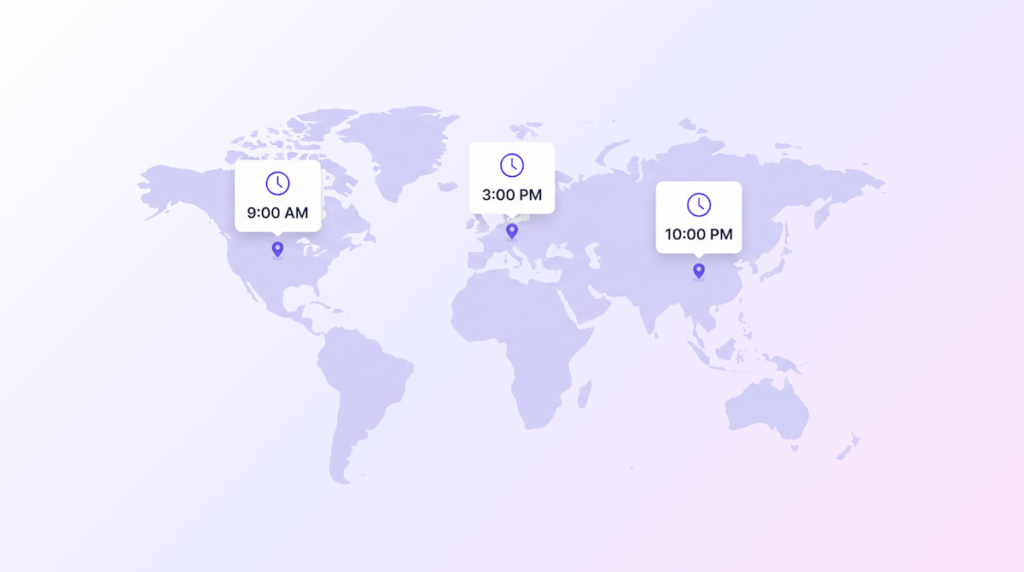
- Next, look for overlap. For example, early afternoon in one region may align with evening in another. These overlap periods often become your most effective posting times.
- Finally, test what works consistently. With a global audience, small timing adjustments can lead to noticeable differences in your performance. Tracking these patterns over time helps you find the windows that work best for your specific audience, so you can double down on what works.
How to Find Your Best Time to Post on Instagram
At this point, you’ve seen the data and have a high-level idea of the strongest times to post based on your content, niche, and audience.
These averages give you a strong starting point to optimize your 2026 Instagram strategy. But to narrow in on what will truly work for your account, you need to look at your own data.
Don’t worry—interpreting your data doesn’t have to be overly technical or time-consuming. Here’s what to focus on and how to time your Instagram posts.
Step 1: Start With Instagram Insights
Your first reference point should always be your own data. Inside Instagram Insights, you can quickly see when your followers are most active throughout the day. This gives you a baseline that’s already tailored to your audience.
Pay attention to:
- Peak posting times
- Differences between weekdays and weekends
- Any recurring spikes in engagement
This might not give you a clear verdict on the best time to post on Instagram, but it should give you a strong starting point.
Step 2: Track How Timing Affects Performance
The next step is to tie your post timing to performance outcomes. It’s not enough to know when your audience is active—you need to see how your posts perform when published at different times.
Look at patterns like:
- Engagement levels at different posting hours
- How quickly your Instagram posts pick up traction
- Which time slots consistently outperform others
Over time, you’ll start to notice that certain windows produce stronger results, even within the same day.
This is where a lot of Creators get stuck. The data exists—but making sense of it takes time. And when you’re already juggling content creation with everything else it takes to succeed as a Creator, manually tracking patterns across dozens of posts isn’t realistic.
That’s exactly why we built Stanley (your AI Head of Content).
Step 3: Test and Learn
Experimenting with post timing is where most Creators struggle. They change too many variables at once, post at random times, or don’t track results long enough to see a pattern.
A better approach is to keep things controlled.
For example:
- Post similar content formats at different times
- Keep your posting days consistent
- Test one variable at a time
This allows you to isolate the impact of timing more clearly.
Within a few weeks, you should start to see which windows consistently perform better.
Step 4: Use Tools to Surface Patterns Faster
Manually interpreting your data and running experiments takes time and effort. And doesn’t scale well once you’re posting consistently across multiple formats or tracking patterns across dozens of Instagram posts.
When you’re moving fast, it’s easy to miss connections or second-guess what’s working (and what’s not). That’s why more and more Creators are using Stanley to analyze their Instagram performance and uncover blind spots.
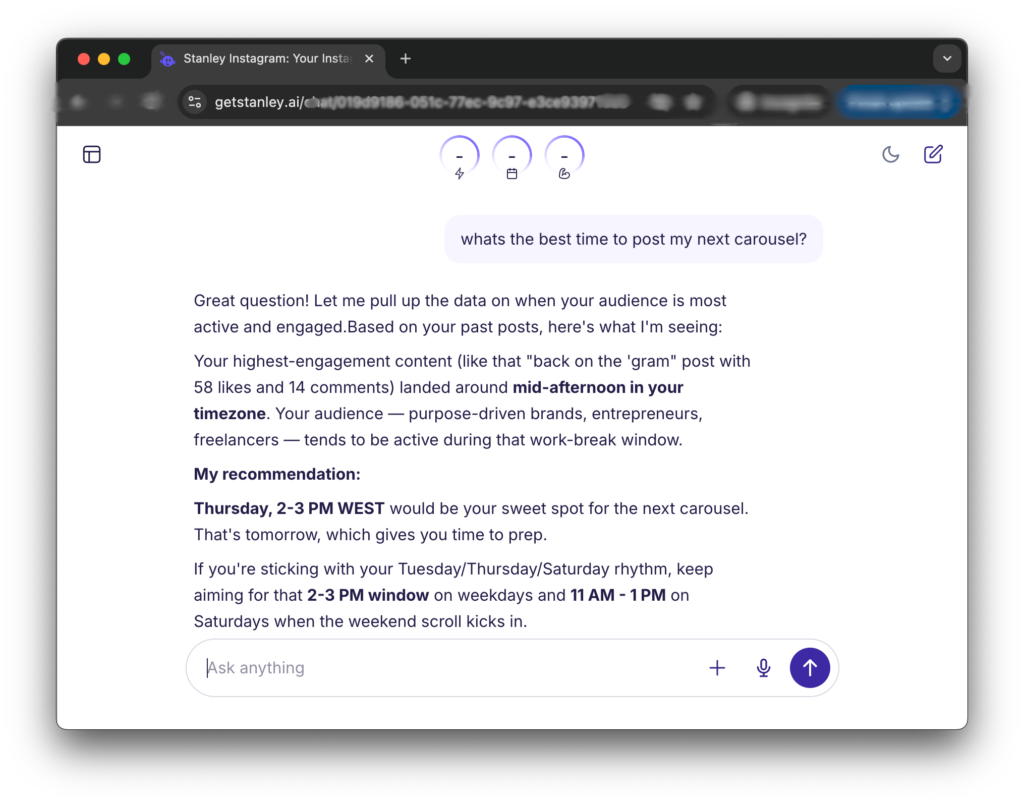
Instead of manually interpreting your Instagram insights or turning to generic tools like ChatGPT, you can connect Stanley with your Instagram and get answers to your burning questions in seconds. Stanley analyzes your content and highlights performance patterns automatically—connecting the dots between what you post, when you post it, and how your audience responds.
That means you can quickly see:
- Which time windows consistently drive peak engagement
- How different formats perform at different times
- What patterns are worth repeating
Instead of spending weeks testing and analyzing, Stanley can give you a clearer direction much faster. And unlike generic AI tools, you’ll move beyond universal best practices and start working with insights specific to your account.
Timing Matters More When You Treat It Like a System
There’s no single best time to post on Instagram, but there are patterns you can build on.
Weekdays tend to perform better. Midweek is often strongest. Engagement peaks for a few hours in the early morning, midday, and evening.
While these are generally when Creators can get maximum engagement, the best time for posting on Instagram is ultimately specific to you.
Your content format affects how people engage. Your niche shapes when they’re active. Your audience’s time zone determines if (and when) your content is seen.
That’s why optimizing post timing works best as a system. Start with proven patterns, refine them using your own data, and double down on what consistently performs.
If you want to move faster and stop piecing together data by yourself, Stanley can help. It surfaces performance patterns across your content and shows you when your audience is most engaged, so you can make stronger data-driven decisions in minutes.
Ready to see what it can do for your Instagram strategy? Start your 14-day free trial of Stanley.
FAQ: Best Time to Post on Instagram
There isn’t a single best time that works for every account. However, most studies show that weekdays perform better than weekends, with peak engagement typically in the morning (7–9 a.m.), midday (11 a.m.–2 p.m.), and evening (6–9 p.m.). These windows are a reliable starting point, but your results will depend on your audience.
Midweek days, especially Tuesday through Thursday, tend to perform the best. Wednesday is often the most consistent day for engagement across different datasets, while weekends generally show lower and more variable performance.
Both can work, but they serve different behaviors. Morning Instagram posts benefit from early scroll habits before the day starts, while evening Instagram posts tend to perform well because users have more time to engage. The best option depends on when your target audience is most active.
Yes, timing plays a role in how quickly your post gains engagement. Early interactions can influence how far your content is distributed, so posting when your audience is active increases the chances of a stronger initial performance.
Reels tend to perform best during periods of high browsing activity, especially in the morning (7–9 a.m.) and evening (6–9 p.m.). These are the times when users are more likely to watch multiple videos and engage with short-form content.
Start with Instagram Insights to see when your audience is most active. Then track how your posts perform at different times and test consistently. Over time, you’ll begin to see patterns for your specific audience, and tools like Stanley make those patterns much easier to spot and act on.
Yes, niche has a direct impact on timing. For example, business audiences are often more active during work hours, while lifestyle or entertainment audiences tend to engage more in the evenings and on weekends. Your posting schedule should reflect how your audience behaves.