
TL;DR: Faceless accounts work because they turn content into a system. When you remove the pressure to show up on camera, consistency becomes easier, formats become repeatable, and growth becomes more predictable on Instagram and TikTok. The most successful faceless accounts focus on one clear niche, run a simple content system, improve using performance data, and monetize through aligned offers like affiliates, digital products, UGC deals, and platform rewards. If you approach a faceless account as an asset you build methodically, not a shortcut you rush, it can grow, compound, and earn without being tied to your identity.
Most “faceless account” advice on the internet is recycled.
At Stan took a different route. Instead of guessing what works, our team built a brand-new faceless Instagram account from scratch and documented the entire process from day one.
Here’s what happened:
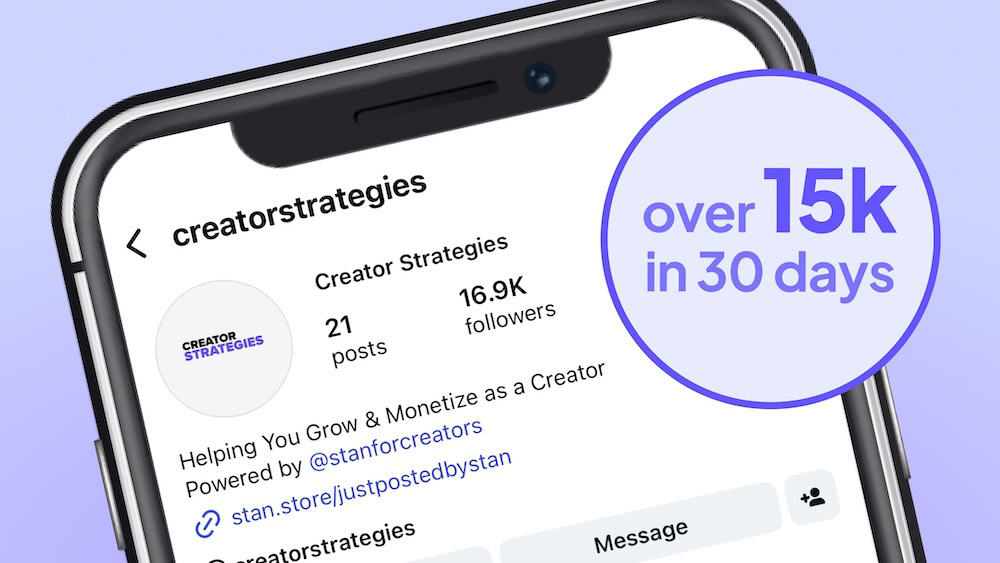
- In 30 days, the account crossed 15,000 followers
- In its first week, it gained 2,000 followers and 125,000 total views
- The first video alone reached nearly 100,000 views
And the growth has not slowed down. It has continued to compound week after week.
What made the experiment valuable was not just the speed, but the structure behind it. There was no personal brand, no on-camera presence, and no borrowed audience. Growth came from a simple, repeatable content system and constant iteration based on performance data.
That is the core insight behind faceless accounts. When identity is removed, consistency improves. When consistency improves, distribution follows.
This guide builds on those same principles. You will learn how faceless accounts work on Instagram and TikTok today, the formats that perform best, and how creators turn them into scalable, monetizable assets.
Let’s start with the fundamentals.
Table of Contents
- What Is a Faceless Account? (And Why They’re Everywhere)
- Why Faceless Accounts Work So Well on Instagram and TikTok
- 5 Popular Types of Faceless Accounts That Perform Best
- How to Create a Faceless Account (Step-by-Step)
- How to Grow a Faceless Account on Instagram and TikTok
- How Faceless Accounts Make Money (Beginner to Advanced)
- Tools and AI Workflow for Running a Faceless Account Efficiently
- Common Challenges With Faceless Accounts (And How to Beat Them)
What Is a Faceless Account? (And Why They’re Everywhere)
A faceless account is a social account built without tying the content to a visible person.
No talking head. No personality-led branding. No requirement to show your face on camera.
Instead, the content carries the message. Voiceovers, on-screen text, clips, B-roll, screen recordings, or hands-only visuals do the work, while the creator stays behind the scenes.
Stan’s Creator Strategies Instagram page is a clear example of what a faceless account looks like in practice.
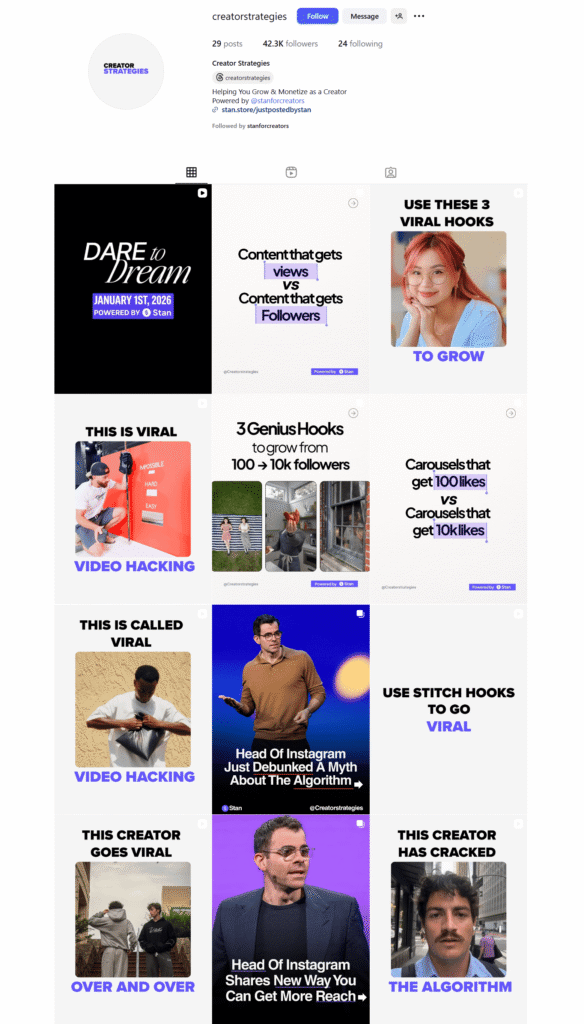
The grid is built around consistent visual structure, bold text, clips, and simple storytelling. There is no central personality anchoring the content. Each post stands on its own, designed to deliver one idea quickly and keep viewers engaged.
That is the defining trait of a faceless account.
The account is not built around who is speaking. It is built around what is being said and how clearly it is delivered.
This model works especially well on Instagram and TikTok because both platforms are now distribution-first. Content is pushed based on performance signals like watch time, retention, saves, and replays, not whether a recognizable face is attached to the post. If a piece of content holds attention, it spreads.
That shift explains why faceless accounts are suddenly everywhere.
Creators are realizing they do not need to become public figures to grow. Brands are realizing they can build pages that behave like media assets instead of personal profiles. And solo creators are discovering that removing the pressure to be on camera makes consistency much easier to maintain.
Why Faceless Accounts Work So Well on Instagram and TikTok
Faceless accounts are not working by accident. They are working because they align almost perfectly with how Instagram and TikTok distribute content today.
Both platforms are built around short-form discovery. Content is pushed to people who do not follow you yet, then scaled based on how that content performs. If viewers watch, rewatch, save, or share, distribution expands. If they swipe away quickly, it stops.
Notice what is missing from that equation: who you are.
On Instagram and TikTok, the algorithm does not need a face. It needs signals.
Faceless content often performs well because it is designed around those signals from the start. Text-led hooks make the value clear immediately. Voiceovers remove visual friction. Clips and B-roll keep attention moving. The viewer understands what they are getting within the first second, which improves retention.
There is also less distraction.
When a face is present, viewers subconsciously judge appearance, delivery, confidence, and tone. When the face is removed, the focus shifts entirely to the idea. The message either lands or it does not. That clarity makes content easier to test, refine, and repeat.
Another reason faceless accounts work is consistency.
Showing up on camera takes energy. Lighting, confidence, mood, and environment all become variables. Faceless formats remove most of that friction. Creators can batch content, reuse templates, and publish more frequently without burnout. Over time, consistency compounds faster than charisma ever could.
Finally, faceless accounts fit how people consume content now. Viewers scroll with sound off. They skim. They watch in public. Text overlays, captions, and visual storytelling make content accessible in any context. That accessibility increases watch time and shareability.
Put simply, faceless accounts work because they are built for the feed.
They prioritize clarity over personality, systems over spontaneity, and repeatability over performance. On platforms that reward retention and consistency above all else, that is a powerful advantage.
5 Popular Types of Faceless Accounts That Perform Best
Not all faceless accounts perform the same.
Some formats struggle because they are vague or hard to sustain. Others work consistently because they are easy to repeat, easy to understand, and naturally fit how people consume short-form content on Instagram and TikTok.
The faceless accounts that grow fastest tend to share a few traits. They communicate value immediately, rely on simple visual structures, and can be produced at scale without creative burnout.
Below are the faceless account types that are performing best right now, and why they work so well.
1. Clipping Accounts
Clipping accounts are built around short, high-signal moments taken from longer content. Podcasts, interviews, livestreams, talks, or creator videos are broken down into tight clips that deliver one clear idea in under a minute.
For example, the TikTok page @foundvice often shares short clips pulled from long-form founder conversations. Videos open immediately on a strong insight, use clear on-screen captions to reinforce the message, and end before attention drops.
There is no intro, no creator context, and no personality-led branding. The clip stands on its own because the idea is clear and relevant.
What makes this format powerful is leverage. The hard work has already been done in the original content. Your role is to identify moments with strong emotional pull, clear insight, or tension, then package them for short-form discovery.
These accounts perform well because they are dense. There is no filler. Viewers get value immediately, which improves retention and sharing. When done right, clipping accounts can post frequently without creative fatigue, making them ideal for consistent growth.
2. Hands-Only Tutorials & How-To Demos
Hands-only accounts remove the face but keep the action. The camera focuses on the task itself: writing, cooking, editing, organizing, assembling, or demonstrating a process step by step.
These accounts work because they are practical. Viewers immediately understand what they are watching and what they will learn. There is also a natural sense of progress, which keeps people watching until the end.
Hands-only tutorials perform especially well in skill-based niches where clarity matters more than personality. They are also highly repeatable, making them ideal for creators who want structure without being on camera.
3. Quote & Affirmation Pages
Quote and affirmation pages are built around short, emotionally resonant statements paired with simple visuals. The goal is not long watch time, but saves, shares, and repeat exposure in feeds and Stories.
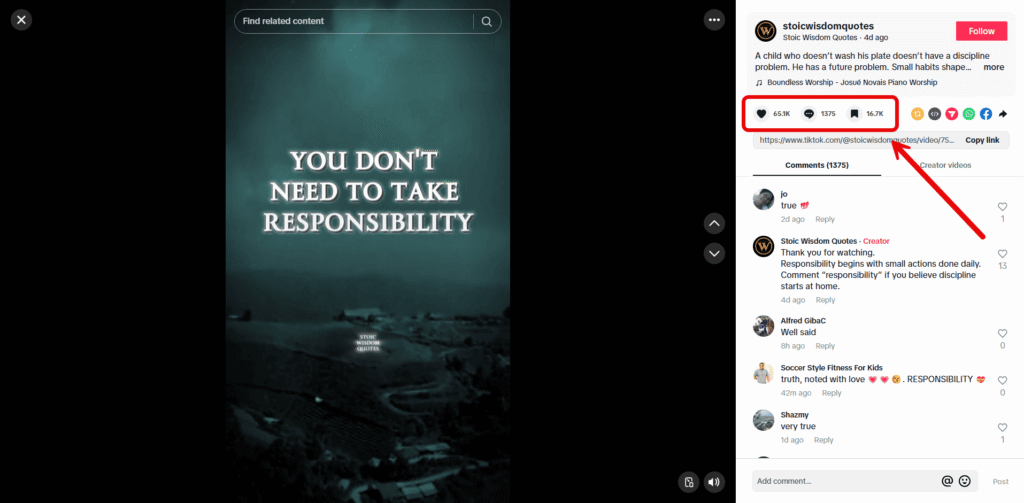
For example, the TikTok page @stoicwisdomquotes consistently posts short stoic quotes over minimal visuals.
Each video communicates one clear idea, often tied to discipline, patience, or self-control. The message is immediately understandable, which makes the content easy to consume and easy to reshare.
What makes this format effective is emotional alignment. Viewers either agree with the quote or see themselves in it. When that happens, the content gets saved, shared, or reposted, which signals value to the algorithm even without long watch times.
Quote pages perform best when they stick to a tight theme. Random quotes struggle. Focused philosophies like stoicism, confidence, or self-mastery build recognition and trust over time.
4. B-Roll Storytelling Accounts
B-roll storytelling accounts use visuals to carry the narrative. Clips, stock footage, archival video, or abstract visuals are paired with text or voiceover to tell a story, explain an idea, or frame a message.
This format works because it feels cinematic without being complex. Movement keeps attention, while the story gives viewers a reason to stay. When paired with strong hooks and pacing, B-roll storytelling can achieve high retention even without a visible creator.
These accounts perform best when the storytelling is tight. One idea per post. One clear takeaway. No unnecessary scenes. The cleaner the narrative, the better the performance.
5. Voiceover Explainers
Voiceover explainer accounts teach, break down ideas, or tell short stories using narration instead of an on-camera presence. Visuals are usually secondary. Stock footage, abstract clips, simple animations, or background videos support the message while the voice carries the structure.
For example, the TikTok page @mind.over.matter98 uses short voiceovers paired with minimal visuals to deliver ideas around mindset, discipline, and personal growth.
The account does not rely on facial expression or personality. Each video is built around one clear message, spoken calmly and supported by simple text on screen.
What makes this format work is focus. The voice guides attention, while the visuals prevent boredom without competing for it. Viewers can listen passively, watch without sound, or do both, which makes the content accessible in almost any context.
Voiceover explainers perform best when they stay tight. One idea per video. Clear pacing. No unnecessary storytelling. When structured properly, this format is easy to template and scale without burnout.
How to Create a Faceless Account (Step-by-Step)
Creating a faceless account that grows comes down to setup.
Most accounts struggle because they start posting before the niche, format, and system are clear. When those pieces are missing, consistency breaks and growth stalls.
In this section, we focus on getting the foundation right first, so consistency and iteration can actually compound.
Let’s walk through each step in order.
Step 1: Choose Your Faceless Niche
The niche you choose determines almost everything that comes after.
It affects how easy content is to create, how clearly the algorithm understands your account, and how monetization eventually works. Most faceless accounts do not fail because the format is wrong. They fail because the niche is too broad, too vague, or poorly defined from the start.
A reliable way to think about niche selection is to look at the overlap between three things.
Your experience, your interests, and your audience’s needs.
The strongest faceless niches sit in the middle of that overlap.
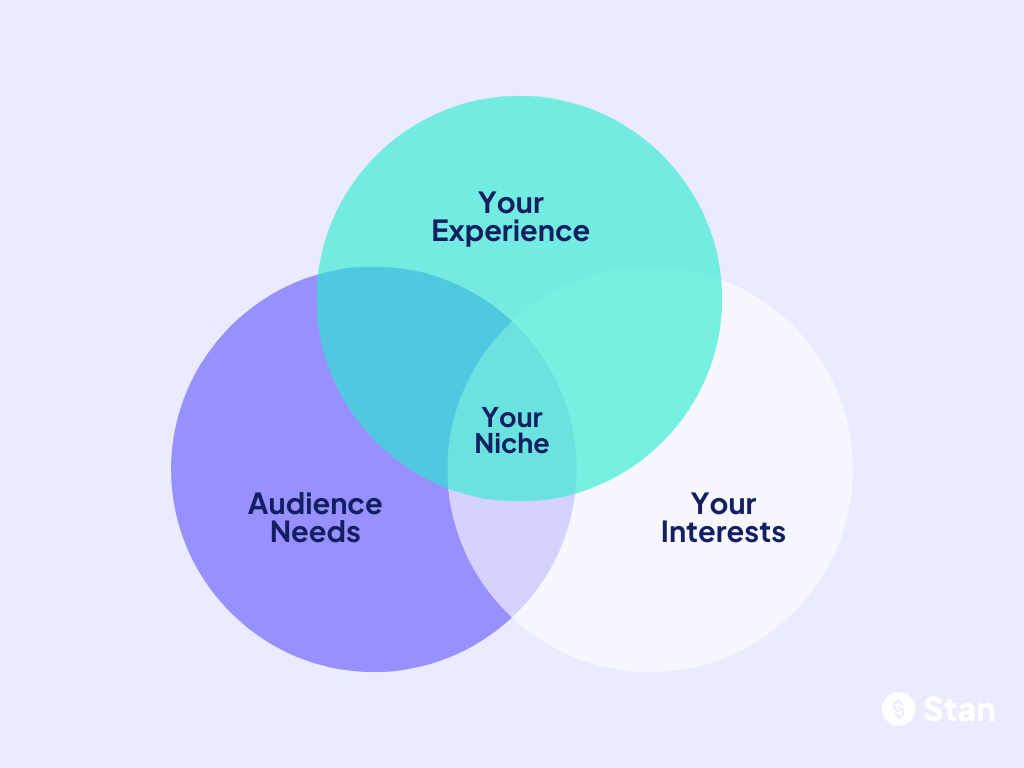
Your experience does not need to be expert-level. It can be familiarity, curiosity, or something you are actively learning. Your interests matter because faceless accounts still require consistency, and interest is what makes repetition sustainable. Audience needs are what make the account worth following in the first place.
When all three align, content ideas come naturally and performance becomes easier to improve over time.
A strong faceless niche also has a few clear traits.
First, it is specific. “Motivation” is vague. “Short reminders for people rebuilding discipline” gives the algorithm context and gives viewers a reason to follow.
Second, it has repeatable problems or themes. You should be able to list 30 to 50 post ideas without forcing it. If ideas dry up quickly, the niche is too thin.
Third, it fits faceless delivery. Some niches rely heavily on personal presence and trust built through visibility. Others work perfectly with text, voice, clips, or visuals. Focus on spaces where clarity matters more than who is speaking.
A simple validation check is to scan your feed. If you already see multiple faceless accounts performing well in that space, that is usually a signal the niche supports the format.
Step 2: Protect Your Identity Properly
If you are building a faceless account, anonymity should be intentional, not accidental.
Many creators say they want to stay faceless, but then leak signals without realizing it. Over time, those small details add up and defeat the purpose of the model. Setting things up correctly from the start prevents that problem.
Begin with separation.
Use a fresh email address that is not tied to your personal accounts. Avoid syncing contacts or linking the account to existing profiles. On Instagram and TikTok, skip suggested connections and disable any settings that automatically recommend your account to people you know.
Next, be deliberate about your profile details.
Your username should not reference your real name. Your bio should describe the value of the account, not the person behind it. Profile images work best when they are simple: logos, symbols, text-based visuals, or abstract imagery that fits the niche.
Pay attention to content details as well.
Do not include reflections, background audio, watermarks, or metadata that could accidentally reveal your identity. If you use voiceovers, keep delivery consistent and neutral. If you want an extra layer of separation, text-to-speech or AI voice tools can help maintain anonymity without hurting clarity.
Finally, decide how faceless you actually want to be.
Some creators stay completely anonymous. Others are comfortable revealing their identity later, once the account is established. Either approach is fine, but the decision should be made early so your setup matches your long-term plan.
Step 3: Create Your Repeatable Faceless Content System
Successful faceless accounts are not powered by constant creativity. They are powered by systems. A clear, repeatable content system removes guesswork, speeds up production, and makes consistency realistic.
Start by choosing one primary format.
That might be short clips with captions, voiceover explainers with B-roll, text-led Reels, or hands-only demos. Resist the urge to mix formats early. One format gives the algorithm a clear signal and helps you learn faster.
Next, standardize the structure.
Every post should follow a familiar flow:
- A clear hook in the first second
- One core idea or takeaway
- A clean ending that resolves the thought
Once the structure is set, turn it into templates.
Create reusable layouts for visuals. Write hook formulas you can swap words into. Decide how long your posts usually run. Pick fonts, colors, and caption styles you can reuse without thinking. The less friction there is, the more likely you are to post consistently.
Then build a small content bank.
Before publishing anything, aim to have 10–20 ideas outlined. Not fully produced. Just clearly defined. This prevents burnout and keeps you from scrambling for ideas after every post.
Finally, accept that repetition is a feature, not a flaw.
Faceless accounts grow by repeating what works, not by reinventing the wheel every time. Viewers do not see your content the way you do. Familiarity builds recognition, and recognition builds trust.
Step 4: Prime Your Account
Priming your account is one of the most overlooked steps in building a faceless account, yet it has a direct impact on early distribution.
Before you publish anything, the platform needs context. It needs signals that help it understand what your account is about and who your content should be shown to. If you skip this step and start posting immediately, you leave that decision entirely to chance.
Start with your profile.
Complete every field. Add your bio, profile image, and any highlights or pinned elements that reinforce your niche. Keep everything aligned. When someone lands on your page, they should immediately understand the theme and value of the account.
Next, train your interest graph.
Follow a small number of accounts in your niche. Engage lightly with their content. Watch, like, and save posts similar to the ones you plan to create. These actions send early signals about the category your account belongs to.
You can also use this stage to study what already works. Pay attention to hooks, pacing, text placement, and post length. This gives you reference points before you publish your own content.
Priming does not take long, but it matters.
When you finally start posting, the algorithm already has a frame of reference. Your content is more likely to be tested with the right audience instead of being scattered randomly.
Step 5: Build Your First 9–12 Posts (Instagram) or First 5–7 TikToks
Before you worry about growth, focus on coverage.
Your first batch of posts is not about going viral. It is about giving the platform enough data to understand your account and giving yourself enough runway to stay consistent without pressure.
For Instagram, aim to prepare 9–12 posts before publishing anything. This fills your grid, makes the page look intentional, and allows viewers to understand the theme of the account at a glance. For TikTok, 5–7 posts is enough to start collecting early signals without overcommitting.
At this stage, variety should be limited. Stick to the same format, pacing, and visual style. The goal is not to test everything. It is to test one system multiple times. Small variations are fine, but the structure should remain familiar across posts.
Each post should focus on a single idea. Avoid cramming too much into one video. One message, one angle, one takeaway. This improves retention and makes it easier to spot what is working once data comes in.
Do not over-polish. Clean beats perfect. Your early posts are learning tools. Publishing them quickly is more valuable than waiting until everything feels flawless. Momentum matters more than aesthetics at this point.
Step 6: Publish Consistently Using a Simple Weekly Cadence
Consistency is where most faceless accounts either break through or fade out.
Not because creators do not understand its importance, but because they overcomplicate it. Posting schedules become unrealistic, motivation drops, and content creation starts to feel heavy. Faceless accounts work best when consistency is designed into the system, not forced through willpower.
Start with a cadence you can maintain. Three to five posts per week is enough on both Instagram and TikTok. Daily posting is not required. What matters is showing up on a predictable rhythm so the platform can learn how to distribute your content and your audience knows what to expect.
Batch your content. Create multiple posts in one sitting and schedule them in advance. This removes daily pressure and keeps quality stable. When content is batched, you are less likely to skip days or rush posts.
Stick to your core format. This is not the stage to experiment wildly. Repetition helps the algorithm connect the dots between your posts. The clearer the pattern, the faster distribution stabilizes.
Expect uneven results at first. Some posts will outperform others for reasons that are not always obvious. Do not react emotionally. Consistency works over time, not in single uploads.
The goal of this step is simple: keep publishing long enough for patterns to emerge. Once they do, you can start improving with intent.
Step 7: Improve Fast With Analytics
This is where faceless accounts start to separate themselves.
Once you are publishing consistently, data becomes your biggest advantage. You no longer need to guess what works. The platform tells you, if you know what to look for.
Focus on a small set of signals. Watch time and retention matter most. If people stay, distribution increases. Pay attention to where viewers drop off and which posts hold attention longer than others. Those patterns are not random.
Look at saves, shares, and follows. Saves and shares indicate value. Follows indicate clarity. When a post drives follows, it usually means viewers understood what the account is about and wanted more of it.
Compare posts, not days. Do not judge performance based on a single upload. Look across multiple posts and identify common elements in your best performers. It might be the hook style, pacing, caption structure, or topic angle.
Then double down.
Create more content that mirrors what is already working. Do not chase novelty. Refinement beats reinvention. Small improvements repeated over time compound faster than constant experimentation.
How to Grow a Faceless Account on Instagram and TikTok
The difference between faceless accounts that stall and those that scale usually comes down to a small set of repeatable actions. The points below cover the levers that consistently drive reach and retention on Instagram and TikTok.
1. Lead With a Clear, Text-Based Hook
Your hook does the heavy lifting.
Faceless content performs best when the value is obvious in the first second. Text on screen should clearly state the idea, problem, or payoff. If viewers have to guess what the video is about, they scroll.
Strong hooks are specific, outcome-driven, or curiosity-led. Weak hooks are vague, generic, or purely aesthetic.
2. Optimize for Retention, Not Likes
Likes are easy. Retention is what drives distribution.
Short-form algorithms reward content that keeps people watching. That means tight pacing, no long pauses, and no unnecessary scenes. Every second should earn its place.
If people consistently watch past the halfway point, reach tends to scale naturally.
3. Repeat Formats That Already Work
Growth accelerates when patterns emerge.
If a format performs well once, repeat it. Change the idea, not the structure. Familiarity helps the algorithm understand your account and helps viewers recognize your content in the feed.
4. Design Content People Want to Save or Share
Faceless accounts often grow through saves and shares more than likes.
Educational tips, short explanations, reminders, and practical breakdowns give viewers a reason to keep the content or send it to someone else. Those actions signal lasting value, which boosts distribution.
If your content disappears after one watch, growth slows.
5. Keep Visuals Simple and Readable
Complex visuals hurt faceless content more than they help.
Clear text, strong contrast, and minimal clutter make content easier to consume quickly. Many viewers watch with sound off or while distracted. Design for skimming.
When visuals are easy to process, retention improves.
6. Post on a Predictable Rhythm
Consistency builds trust with the algorithm.
Posting three to five times per week on a steady schedule is enough. What matters is predictability, not volume. Irregular posting makes performance harder to read and slows learning.
A simple cadence sustained over time outperforms short bursts of daily posting.
7. Use Trends Selectively
TikTok and Instagram trends are tools. When a trend fits your format, adapt it. When it does not, skip it.
Faceless accounts grow faster when trends support an existing system instead of constantly reshaping it. Trend-chasing without structure creates noise, not growth.
How Faceless Accounts Make Money (Beginner to Advanced)
Faceless accounts make money the same way any strong account does: by attracting the right audience and giving them something valuable to act on. The monetization methods themselves are simple. What matters is how well they align with the content and the expectations you’ve set.
Below are the most common ways faceless accounts monetize today, starting with the easiest to implement and moving toward more scalable options.
1. Affiliate Marketing
Affiliate marketing is often the easiest entry point for faceless accounts.
It works best when the product naturally fits the content. Educational pages can recommend tools. Clip pages can link to longer-form content or resources. Tutorial accounts can point to software, templates, or products viewers already want to use.
The key is relevance.
When the recommendation feels like a logical next step, conversions follow. When it feels forced, trust drops quickly. Faceless accounts rely on clarity and usefulness, so the offer should solve the same problem the content addresses.
Start simple. One primary affiliate offer is enough in the beginning.
2. Brand Deals
Brand deals become viable once an account shows consistent reach and audience alignment.
Faceless accounts are especially attractive to brands that care more about distribution than personality. What matters is whether your content reaches the right people and performs reliably, not whether a creator appears on camera.
The strongest deals come when the brand fits seamlessly into the format. A product mentioned in a voiceover, shown in a hands-only demo, or integrated into a clip performs better than a hard sell.
Consistency and niche clarity matter more here than follower count.
3. Digital Products
Digital products are where faceless accounts become real assets.
Templates, guides, checklists, mini-courses, and simple resources work especially well because they scale without adding ongoing workload. Once created, the same product can be sold repeatedly to new viewers discovering your content.
This is where faceless accounts benefit from a clear link-in-bio setup. Instead of relying on DMs or manual follow-ups, creators can send traffic to a single destination where their offer lives.
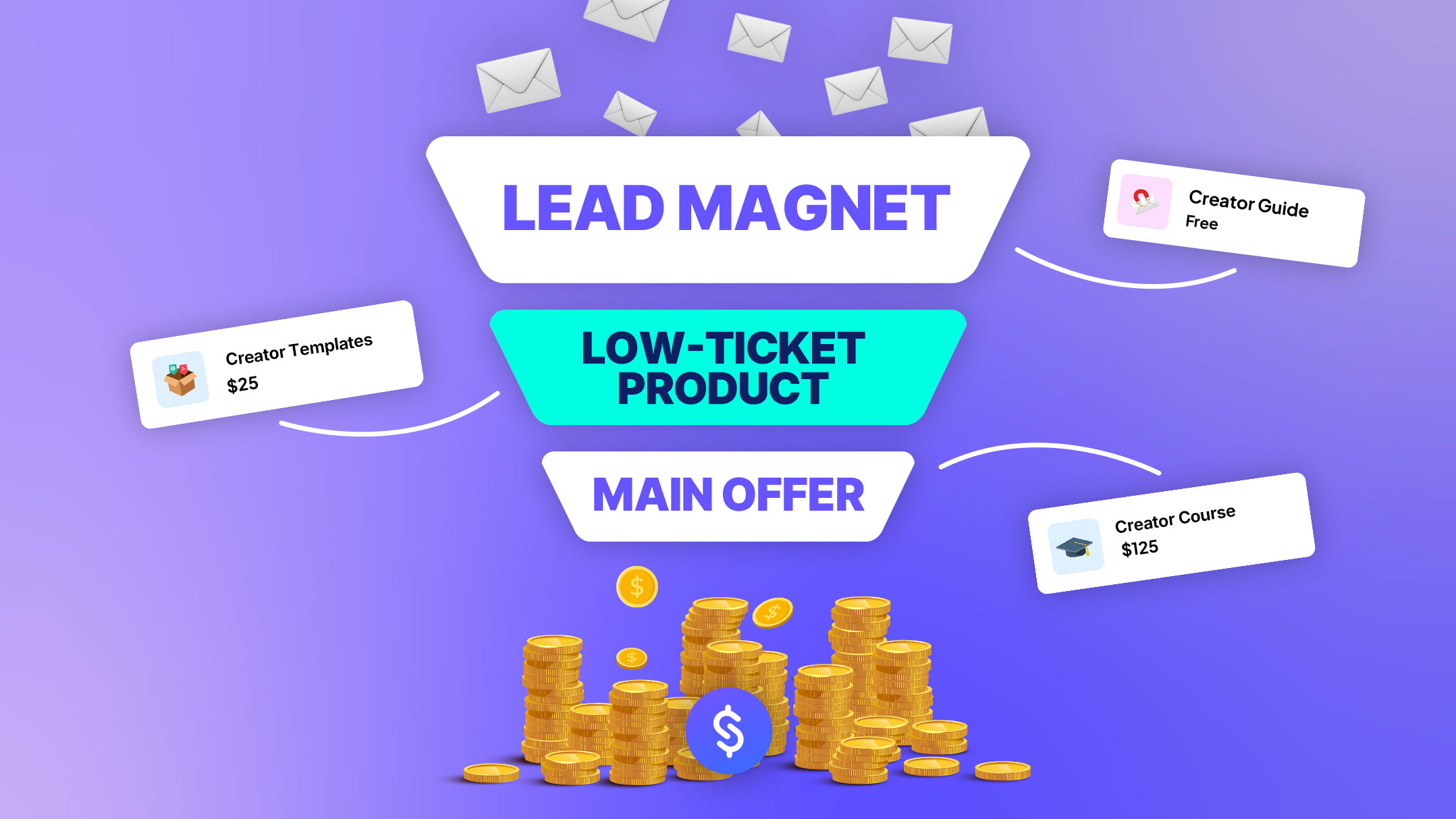
Platforms like Stan make this especially effective by letting creators host digital products, lead magnets, and subscriptions in one place without complicating the funnel.
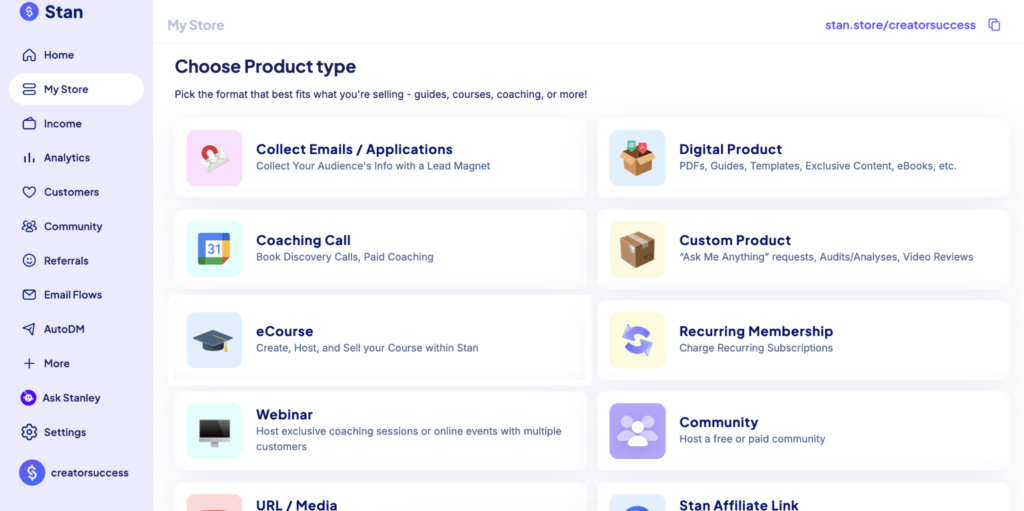
The strongest results come when the product solves one specific problem the content already addresses. The posts create awareness and trust. The product becomes the logical next step.
For creators who want control, simplicity, and long-term leverage, digital products are often the most sustainable monetization path.
4. UGC Deals
User-generated content deals are a strong fit for faceless accounts because they focus on content quality, not personal branding.
Brands often need short-form videos they can run as ads or post on their own pages. As long as your content demonstrates the product clearly and performs well, a visible creator is not required. Voiceovers, text-led videos, and hands-only demos are all commonly accepted.
What matters is proof.
When your page consistently produces engaging content in a specific niche, it becomes easier to pitch brands or get inbound requests. Even smaller faceless accounts can land UGC deals if their content style matches what brands already use in ads.
5. Subscriptions + Bonuses
Subscriptions and bonus-style monetization work best once an account has a clear value promise.
Instead of selling access to a personality, faceless accounts sell access to more utility. This might include deeper explanations, exclusive resources, curated content, or behind-the-scenes workflows.
Because the account is system-driven, subscribers know what they are paying for. The value feels structured rather than personal, which increases retention.
This model works especially well when the free content solves surface-level problems and the paid content delivers implementation.
6. TikTok Creator Rewards and Instagram Subscriptions
Platform-native monetization adds another layer of income once reach becomes consistent.
TikTok rewards creators for high-performing content, while Instagram subscriptions allow audiences to pay for exclusive posts. These programs are performance-based, meaning distribution and retention matter more than personality.
Faceless accounts that already optimize for watch time and clarity are well-positioned to benefit from these features. They are not the most reliable income source on their own, but they can meaningfully supplement other monetization paths.
Tools and AI Workflow for Running a Faceless Account Efficiently
Faceless accounts scale when production stays simple.
The biggest advantage of not showing your face is that content no longer depends on mood, energy, or environment. To fully benefit from that advantage, you need a workflow that is fast, repeatable, and easy to maintain over time.
This section breaks down the tools and systems that help faceless creators publish consistently.
Editing Tools
Your editing setup should prioritize speed over perfection.
Mobile-first editors like CapCut and InShot are more than enough for most faceless formats. They handle text overlays, quick cuts, captions, and basic effects without friction.
For creators who prefer desktop workflows, tools like Premiere Pro or Final Cut offer more control, but they are not required to grow.
The goal is not cinematic quality. It is clean pacing, readable text, and tight cuts that keep viewers watching.
AI Voice and AI Visuals
Voiceovers are one of the most effective tools for faceless accounts, and AI makes them easier to deploy at scale.
Text-to-speech tools such as ElevenLabs, Play.ht, or Murf allow you to turn scripts into consistent narration without recording your own voice. This helps maintain anonymity and removes another production barrier.
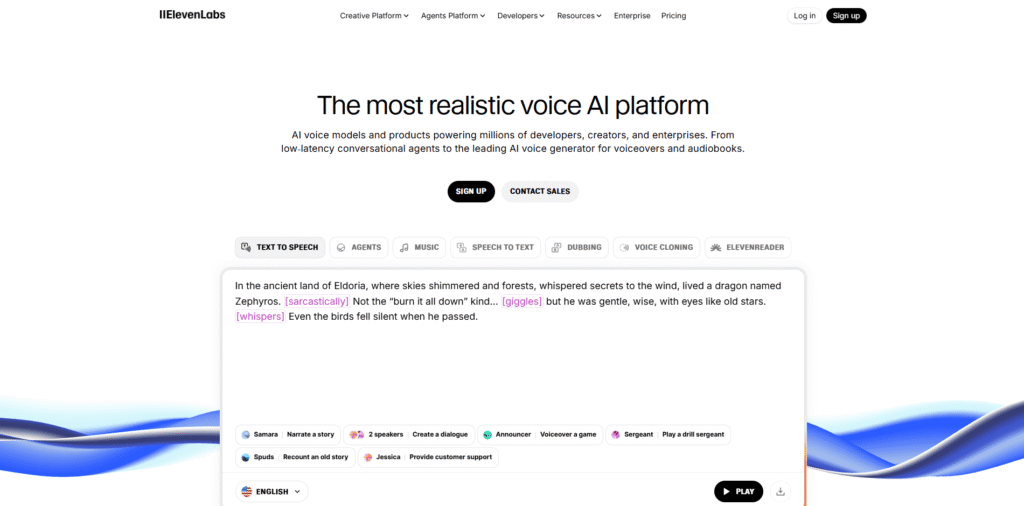
When paired with stock footage, B-roll, or screen recordings, voiceovers create a polished experience without complexity.
AI visuals can also support ideation and variation. Tools like Pexels, Pixabay, or AI image generators can provide simple background footage, abstract visuals, or motion elements that add context without distracting from the message.
Used correctly, AI does not replace creativity. It removes friction.
Scheduling and Publishing
Consistency improves when publishing is automated.
Scheduling tools like Meta’s native scheduler allow you to batch content and release it on a fixed cadence. This is especially helpful for faceless accounts, where multiple posts can be produced in one sitting using the same templates.
Scheduling also removes the emotional component of posting. Content goes out whether or not you feel inspired that day, which is exactly how systems are supposed to work.
Analytics and Performance Tracking
Analytics guide improvement, not validation.
Built-in insights from Instagram and TikTok are enough to spot patterns. Watch time, retention, saves, and follows tell you what resonates. Tracking these metrics weekly instead of daily keeps you focused on trends rather than noise.
The most effective faceless accounts treat analytics as feedback. Posts are adjusted, not overanalyzed.
Templates and Repeatable Assets
Templates are where efficiency compounds.
Reusable layouts for captions, hooks, text overlays, and endings remove decision fatigue. When each post follows a familiar structure, production becomes faster and quality stays consistent.
Over time, templates also help your account develop a recognizable look and feel, which improves recall in the feed.
Stan Store Integrations
Once monetization enters the picture, tools matter even more.
Stan allows faceless creators to centralize links, sell digital products, manage subscriptions, and route traffic without building complex funnels. Because faceless accounts rely on clarity and simplicity, having one clean destination for offers keeps conversion friction low.
This setup works especially well for creators who want to test monetization without overcommitting. With a 14-day free trial, you can set up your store, connect your content, and see how your audience responds before locking anything in.
Instead of juggling multiple tools, creators can focus on publishing consistently and improving performance, while the system handles delivery in the background.
Common Challenges With Faceless Accounts (And How to Beat Them)
Faceless accounts are powerful, but they are not effortless. Like any creator model, they come with trade-offs. The difference is that most of these challenges are structural, not personal, which makes them easier to solve once you understand them.
Let’s explore the common ones.
1. Low Trust
One of the most common concerns with faceless accounts is trust. Viewers are used to associating credibility with a visible person, so anonymous content can feel distant at first.
The solution is consistency and clarity. When your content delivers the same type of value repeatedly, trust shifts from the creator to the format.
Clear messaging, accurate information, and predictable quality do more to build credibility than showing your face ever could. Over time, viewers learn what your account stands for, and that reliability becomes the trust signal.
2. Repetitive Content
Faceless formats often rely on repetition, which can feel limiting to the creator.
The mistake is assuming repetition means stagnation. In reality, repetition creates recognition. Small variations in hooks, pacing, visuals, or angles are enough to keep content fresh while maintaining a familiar structure. The audience experiences the content as reliable, not boring, because they encounter each post individually, not as a creator does during production.
3. Burnout
Burnout still happens with faceless accounts, just in different ways.
It usually comes from overproduction or overthinking. Posting too often, experimenting constantly, or rebuilding formats every week creates unnecessary pressure.
The fix is to simplify. Reduce the number of formats, batch content, and let templates do more of the work. When creation feels mechanical instead of emotional, sustainability improves.
4. Copyright and Content Ownership
Clipping and curated content introduce copyright risks if handled carelessly.
The safest approach is transformation. Add commentary, context, voiceover, or educational framing so the content becomes something new. Avoid reposting raw clips without value added.
Understanding platform guidelines and fair use principles protects your account and keeps monetization options open.
5. Algorithm Volatility
Reach can fluctuate, especially on short-form platforms.
The mistake is reacting emotionally to short-term drops. Algorithms change, but the fundamentals do not. Accounts built around clear ideas, strong retention, and consistent publishing tend to recover faster because they align with how content is distributed at a core level.
Short-term dips are feedback, not failure.
Why Now Is the Best Time to Build a Faceless Account
Faceless accounts are not a workaround. They are a direct response to how Instagram and TikTok operate today.
Both platforms reward clarity, retention, and consistency more than personality. When content is built around repeatable formats instead of personal presence, it becomes easier to publish, easier to refine, and easier to scale across niches.
Faceless accounts remove friction. They reduce the pressure to perform and shift focus toward execution. For many creators, that shift is what makes consistency sustainable in the first place.
When treated as a system rather than a shortcut, a faceless account becomes a real asset. One that can grow without being tied to your face, your mood, or your availability.
FAQ About Faceless Accounts
1. Can you really make money with a faceless account?
Yes. Faceless accounts earn by turning attention into aligned offers, just like visible creator accounts. Affiliate products, digital products, UGC deals, brand partnerships, and platform payouts all work without a visible creator, as long as the content consistently delivers value to a defined audience.
2. How long does it take to grow a faceless Instagram or TikTok account?
There is no fixed timeline, but early traction often appears within a few weeks once the platform understands your niche and format. Consistent posting and refinement over time lead to more stable, compounding growth.
3. Do faceless accounts get lower engagement than normal creator accounts?
No. Engagement depends on clarity and retention, not showing your face. Many faceless formats perform well because they remove distractions and communicate value immediately.
4. What kind of faceless content performs best right now?
Simple, repeatable formats perform best. Short clips, voiceover explainers, hands-only demos, quote-based posts designed for saves, and clean B-roll storytelling all work when the value is clear from the first second.
5. Can a faceless account get verified?
Yes, in some cases. Verification depends on notability and platform criteria, not whether a creator shows their face. Faceless brand and media-style pages are more likely to qualify than anonymous individuals.