
TL;DR: YouTube doesn’t pay Creators a fixed amount per view. What you earn depends on your RPM—your revenue per thousand views—which varies by niche, audience location, watch time, and ad engagement. Most Creators earn between $1 and $10 per 1,000 views, translating to anywhere from $1,000 to $20,000 per million views depending on content type. Long-form videos still pay significantly more than Shorts, which average $30 to $200 per million views. Beyond AdSense, many Creators build additional income through sponsorships, affiliate marketing, memberships, and digital products.
If you’ve ever thought about starting a YouTube channel or you’ve already posted a few videos, you’ve probably wondered if it can pay off.
How much does YouTube pay for a view? For a thousand? For a million?
It’s one of the biggest questions new and aspiring Creators ask. Because before you commit your time, effort, and gear, you want to know if YouTube income is realistic.
The tricky part is that there’s no single answer. Some Creators make a few dollars per thousand views, while others earn thousands from the same traffic. The difference often comes down to niche, audience, and the way you set up your income streams.
This guide clears the fog. You’ll see what Creators actually earn, what affects those numbers, and how you can build a path to consistent YouTube income no matter your current audience size.
Let’s get into it.
Table of Contents
- How YouTube Monetization Works
- How Much YouTube Pays Per View and Per 1,000 Views
- How Much YouTube Pays for 1 Million Views
- How Much YouTube Shorts Pay
- How Much YouTube Pays for Subscribers and Engagement Metrics
- Other Ways Creators Earn on YouTube
- How to Increase Your YouTube Earnings
How YouTube Monetization Works
Before you can estimate how much YouTube pays, you need to understand where that money comes from. YouTube doesn’t pay you for uploading videos. It pays you for helping advertisers reach people who are likely to care about their products.
That’s the foundation of the YouTube Partner Program (YPP), the system that allows Creators to earn from the ads shown on their videos, plus a few other revenue streams.

What YouTube Pays For
Once you’re accepted into the YouTube Partner Program, you can start earning through several built-in revenue features.
Here’s what YouTube currently pays Creators for:
- Advertising Revenue: Earn money from ads shown on your Watch Page videos and within the Shorts feed. This includes pre-roll, mid-roll, and display ads.
- Shopping: Tag products in your videos or Shorts and earn commissions through the YouTube Shopping affiliate program. Fans can also buy directly from your store.
- YouTube Premium Revenue: Earn a share of the subscription fees from YouTube Premium members who watch your videos.
- Channel Memberships: Viewers can pay a recurring monthly fee in exchange for exclusive perks like badges, emojis, or members-only videos.
- Super Chat and Super Stickers: During livestreams, fans can pay to highlight their messages or send animated stickers in the chat.
- Super Thanks: Fans can tip you directly on videos or Shorts, and their comments appear highlighted with an animation.
Each feature has its own eligibility requirements and payout structure, but together they make up your total YouTube income inside AdSense.
CPM vs RPM: The Metrics That Define Your Income
These two acronyms determine how much you earn:
- CPM (Cost Per Mille): What advertisers pay YouTube per 1,000 ad views.
- RPM (Revenue Per Mille): What you earn per 1,000 views after YouTube’s share and other factors.
In most cases, YouTube keeps 45% of ad revenue, leaving Creators with about 55%.
Here’s a quick comparison:
| Metric | Represents | Who It Benefits | Typical Range |
| CPM | Amount advertisers pay per 1,000 ad impressions | YouTube and Creator | $1–$30+ depending on niche |
| RPM | Creator’s actual earnings per 1,000 video views | Creator | $0.50–$10+ average |
Keep in mind: A common misconception is that every view counts equally. It doesn’t. You only earn from monetized views when a viewer sees or interacts with an ad. Skipped ads, ad blockers, or audiences in countries with lower ad demand can all reduce your RPM.
YouTube Monetization Requirements
You can’t start earning right away. To join the YouTube Partner Program, you must first meet the minimum eligibility thresholds:
- 1,000 subscribers
- 4,000 public watch hours in the past 12 months
- or 10 million Shorts views in the past 90 days
Once you qualify, YouTube reviews your channel to ensure it follows monetization policies such as avoiding reused content, spam, or violations.
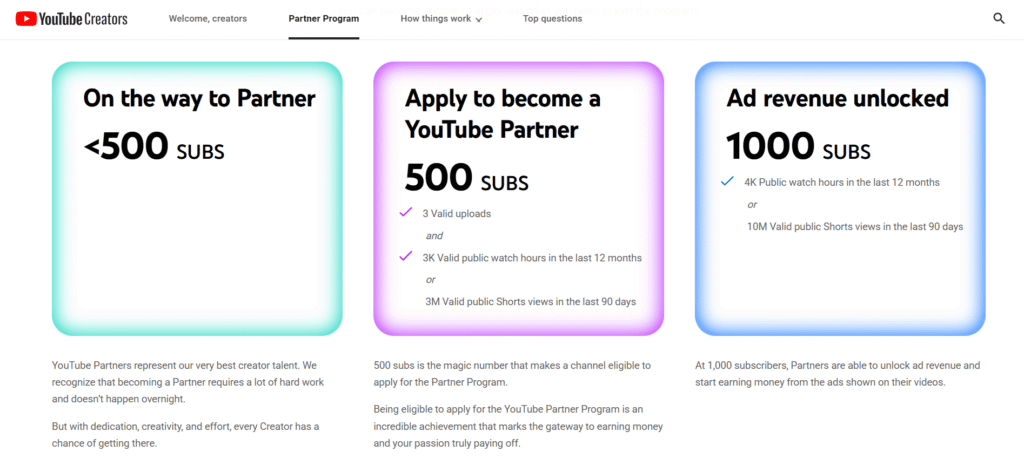
Meeting these requirements is proof that you’ve built a baseline audience and consistency. Reaching it early helps you start collecting real data—your RPM, traffic sources, and top-performing videos—all of which guide how much you can grow over time.
How Much YouTube Pays Per View and Per 1,000 Views
YouTube does not pay a flat rate per view. Your payout depends on ad demand, viewer location, video topic, watch time, and the percentage of your views that are monetized.
The simplest way to understand it is through RPM.
Here’s the core formula:
Estimated Earnings = RPM × (Total Views ÷ 1,000)
RPM already accounts for YouTube’s share, unmonetized views, and ad types combined. That makes it the most reliable number to compare across channels.
Average CPM and RPM in 2025
These are the typical ranges Creators see for long-form videos:
| Niche | Typical CPM | Typical RPM |
| Personal Finance | $12–$40 | $4–$20 |
| Tech & Productivity | $8–$30 | $3–$12 |
| Business & Marketing | $10–$35 | $4–$15 |
| Education/How-to | $6–$20 | $2–$8 |
| Fitness & Wellness | $5–$18 | $2–$7 |
| Beauty & Fashion | $4–$15 | $1.50–$6 |
| Entertainment & Vlogs | $2–$10 | $0.50–$4 |
| Gaming | $2–$8 | $0.50–$3 |
RPM is always lower than CPM because not every view shows an ad, some viewers skip, some regions pay less, and YouTube keeps a platform share.
How to Estimate Your YouTube Earnings
Use a realistic RPM based on your niche and audience, then apply the same formula every time to stay consistent.
Here’s how to do it:
Step 1: Pick an RPM
Choose a conservative number within your niche range. If you are new, start on the lower end.
Step 2: Plug in views
Apply the number of views from a single video or your total monthly traffic.
Step 3: Calculate
Earnings = RPM × (Views ÷ 1,000)
Examples
- 1,000 views at $3 RPM: Earnings = $3 × (1,000 ÷ 1,000) = $3
- 100,000 views at $3 RPM: Earnings = $3 × (100,000 ÷ 1,000) = $300
- 1,000,000 views at $3 RPM: Earnings = $3 × (1,000,000 ÷ 1,000) = $3,000
If you only know your CPM, you can estimate RPM by multiplying CPM by your monetized playback rate and then by the creator share. A simple rule of thumb is RPM equals about 25% to 50% of CPM, depending on niche and audience.
Why Earnings Vary Between Creators
The same view count can pay very different amounts depending on these five factors:
- Audience country: Views from the United States, Canada, Australia, the UK, and Western Europe often have higher CPMs than views from regions with lower advertiser demand.
- Niche and advertiser intent: Topics tied to money or business decisions attract higher ad bids. Finance, tech, and education channels often outperform lifestyle or entertainment.
- Watch time and ad inventory: Longer videos allow more mid-roll ads without hurting viewer experience. Higher retention also improves ad fill rates and RPM.
- Traffic sources: Suggested and search traffic usually monetize better than external embeds or shorts. Kids content and limited-ad categories also earn differently due to stricter policies.
- Seasonality: RPMs often rise in Q4 when advertisers increase budgets and dip in January when ad spend resets.
If you are just starting, choose a niche with strong advertiser demand, aim for longer average view duration, and focus on audiences in higher-CPM regions when possible. These small choices can significantly raise your RPM over time.
How Much YouTube Pays for 1 Million Views
There’s no fixed payout for a million views. What matters is your RPM. Multiply your RPM by 1,000 to estimate how much a video with one million views could earn:
Earnings for 1M views = RPM × 1,000
Most Creators see long-form RPMs ranging from $1 to $10+ depending on niche, audience, and engagement. That’s why one creator might earn $3,000 for a viral YouTube video while another makes $15,000 from the same number of views.
Modeled Payouts by Niche (1,000,000 Views)
| Niche | Conservative RPM | Mid RPM | High RPM | Earnings Range |
| Entertainment and Vlogs | $1.00 | $2.50 | $3.00 | $1,000–$3,000 |
| Gaming | $0.80 | $2.00 | $3.00 | $800–$3,000 |
| Beauty and Fashion | $1.50 | $3.00 | $6.00 | $1,500–$6,000 |
| Fitness and Wellness | $2.00 | $4.00 | $7.00 | $2,000–$7,000 |
| Education and How-to | $2.00 | $5.00 | $8.00 | $2,000–$8,000 |
| Tech and Productivity | $3.00 | $6.00 | $12.00 | $3,000–$12,000 |
| Business and Marketing | $4.00 | $8.00 | $15.00 | $4,000–$15,000 |
| Personal Finance | $5.00 | $10.00 | $20.00 | $5,000–$20,000 |
These ranges reflect what Creators commonly report across different industries. Tech, business, and finance channels tend to earn more because advertisers are willing to pay higher rates to reach their audiences.
Entertainment and gaming channels usually sit on the lower end due to broad audiences and lower advertiser intent.
How Much YouTube Shorts Pay
When YouTube first launched Shorts, Creators could only earn through the Shorts Fund.
That changed in 2023 when Shorts became part of the YouTube Partner Program. Today, you can monetize Shorts directly, but the system still works differently from long-form videos.
YouTube Shorts Monetization Basics
Shorts revenue comes from ads shown between Shorts in the feed, not before or during individual videos. Those ad earnings are pooled together each month and then distributed to Creators based on the number of views they contribute to the total pool.
Here’s the simplified breakdown:
- Ad revenue pool: YouTube collects ad revenue from all Shorts watched globally.
- Music usage: A percentage of that pool goes to music rights holders for Shorts that use licensed songs.
- Creator share: The remaining revenue is split between YouTube and Creators.
Unlike long-form videos, where you earn per ad shown on your content, Shorts payouts are tied to total engagement across the platform. This means your RPM can fluctuate more widely depending on the month, music use, and region of your audience.
How Much YouTube Shorts Pay for 1 Million Views
Shorts monetization is still developing, but by 2025, clearer patterns have emerged. Based on creator reports and platform data, the average payout for 1 million Shorts views ranges between $30 and $200.
This might seem low, but keep in mind:
- Shorts are often under 30 seconds long, meaning fewer ad opportunities per view.
- Many viewers scroll quickly, lowering ad impressions.
- Music rights reduce the total pool before the creator split.
Here’s a quick breakdown using realistic RPM ranges:
| Estimated RPM | Earnings for 1M Shorts Views |
| $0.03 | $30 |
| $0.10 | $100 |
| $0.20 | $200 |
| $0.50 (exceptional case) | $500 |
Some niches, like tech, finance, or language learning, occasionally see higher rates, especially when Shorts drive strong watch time or attract high-value advertisers. But for most Creators, Shorts should be viewed as a discovery and growth tool, not the primary income stream.
Still, Shorts can indirectly boost revenue by helping new viewers find your channel, subscribe, and later watch your long-form content, which pays much more.
How Much YouTube Pays for Subscribers and Engagement Metrics
One of the biggest misconceptions new Creators have is that YouTube pays directly for subscribers or likes. It doesn’t.
YouTube’s payouts come from ad revenue, not audience milestones. But subscribers and engagement still matter because they influence how often your videos get recommended, how long people watch, and ultimately how much you earn.
How Subscribers Affect Revenue
Subscribers are the backbone of consistent income. They don’t generate revenue just by clicking “Subscribe,” but they increase the likelihood of repeat views, which leads to more monetized impressions and higher RPM over time.
Here’s how subscribers indirectly increase your revenue potential:
- Higher view consistency: Subscribers are more likely to watch new uploads soon after release, helping your videos perform better in recommendations.
- Improved watch time: Loyal viewers stay longer, which improves overall retention and allows more mid-roll ads.
- Better channel data for advertisers: YouTube’s algorithm learns your audience profile, allowing it to place more relevant (and often higher-paying) ads.
Think of subscribers as your predictable view base. A creator with 10,000 loyal subscribers who regularly watch new uploads may earn more than someone with 100,000 casual followers who rarely return.
A good example is MrBeast, the most-subscribed YouTuber in the world. With a broad and highly engaged audience, his videos regularly hit millions of views within hours of upload.
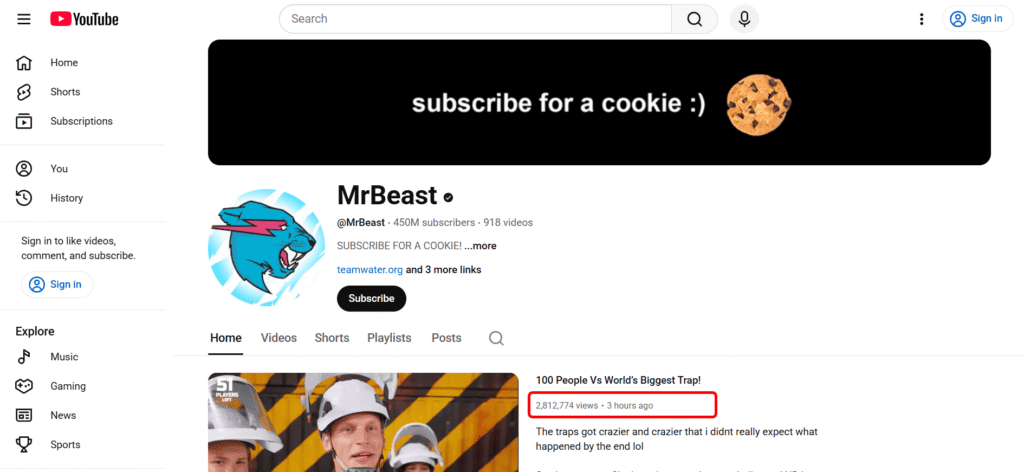
That early surge tells YouTube’s algorithm that his content will perform well, which attracts more ad inventory and higher CPMs. The scale of his subscriber base guarantees views and amplifies revenue potential with every release.
Do Likes and Comments Affect Pay?
Likes, comments, and shares don’t directly add money to your account, but they significantly affect your visibility, which affects revenue.
The more people engage with your video, the more signals YouTube gets that it’s worth promoting. That means:
- More impressions in the algorithm = more monetized views
- Longer session time = more ad inventory
- Better audience retention = higher CPM potential
For example, a 10-minute video with strong engagement and high retention can serve two or three ad breaks without annoying viewers, while a low-engagement video might not even hold attention through the first ad.
So, while a “like” doesn’t put money in your pocket, engagement fuels discoverability, which directly impacts your future payouts.
Bottom Line: Subscribers and engagement don’t earn you money on their own, but they set the stage for everything else that does. Build a loyal audience that watches, comments, and returns often, and your ad revenue, RPM, and brand opportunities naturally grow alongside it.
Other Ways Creators Earn on YouTube
AdSense is where most Creators start, but it’s rarely where they stay. The highest-earning YouTubers treat ads as one part of a bigger system—a foundation for visibility that supports several income streams.
Once you have consistent traffic, even at a small scale, you can stack multiple monetization methods to create stable income.
Here are the main ones worth building into your channel:
Brand Deals and Sponsorships
Once you build a niche audience, brands start to notice. Sponsorships are when a company pays you to feature or mention their product in your content.
Rates depend on your niche, engagement, and video type, but here’s a quick guide for ballpark numbers:
| Average Views per Video | Typical Sponsorship Range |
| 10,000–25,000 | $300–$1,000 |
| 25,000–100,000 | $1,000–$5,000 |
| 100,000–500,000 | $5,000–$15,000 |
| 500,000+ | $15,000+ |
Some Creators earn more per deal if they have a clearly defined audience and integrate the product naturally into their content (for example, finance Creators promoting software or fitness Creators promoting supplements).
If you want to learn how to pitch brands, set your rates, and land your first sponsorship, read our full guide on how to land your first brand deal.
Affiliate Marketing and Product Links
Affiliate marketing is one of the easiest ways to start earning beyond AdSense, even if you have a small channel. You promote products using custom tracking links and earn a commission every time someone buys through your link.
For instance:
- A tech creator might link to cameras or software.
- A finance creator could link to budgeting tools or investment platforms.
- A fitness creator might link to gym gear or nutrition programs.
Many Creators earn between $50 and $1,000+ per month from affiliate sales once their channel grows to a few thousand subscribers. The key is trust—recommending only products you use or genuinely like.
You can integrate affiliate links in your video description, pinned comments, or a Stan store page for an organized, trackable setup.
Channel Memberships and Super Chats
Once your audience becomes loyal, memberships can create recurring income. Viewers pay a monthly fee—often between $2.99 and $9.99—for perks like exclusive content, badges, or early video access.
Meanwhile, Super Chats and Super Stickers let your viewers donate during livestreams. When you go live consistently, these can add up quickly. Some streamers earn thousands per month purely from fan contributions.
Digital Products or Services
The smartest Creators don’t stop at ad revenue or sponsors. They build offers their audiences can buy directly.
You can use Stan to set up your own:
- Digital products (eBooks, Notion templates, checklists, or mini courses)
- Online programs or coaching sessions
- Exclusive content bundles or paid webinars
With Stan, you can add your store link directly to your video descriptions or channel bio, letting viewers go from “watching your content” to “buying your offer” in one click.
Ready to start selling your own offers? Create your Stan account today and try it free for 14 days.
How to Increase Your YouTube Earnings
You can’t control everything about YouTube’s algorithm, but you can control the factors that increase your RPM and overall income. Whether you’re just starting out or already monetized, these are the levers that move the needle most:
Pick a High-CPM Niche
Every topic has a different ceiling for what advertisers will pay. A creator posting comedy skits and a creator teaching personal finance might both hit 100,000 views, but the finance video could earn 10 times more.
Advertisers pay higher rates when the audience is close to making a purchase or business decision. That’s why CPMs tend to be strongest in:
- Personal finance and investing
- Business, marketing, and entrepreneurship
- Tech and software tutorials
- Productivity and career development
- Education and professional skills
If you haven’t picked a niche yet, start with something you know well that also aligns with advertiser interest. The goal is to find a topic that balances passion and profitability—content you can sustain and that brands are already spending to reach.
Improve Watch Time and Retention
Watch time is the hidden currency of YouTube. The longer viewers stay on your video, the more ad inventory YouTube can sell, and the more you earn.
Here’s how to raise it:
- Start strong. Your first 15 seconds decide whether someone stays or scrolls.
- Cut filler. Trim pauses, intros, and repeated points.
- Use pattern breaks. Change visuals, camera angles, or pacing to re-hook attention.
- Add clear structure. Outline points early so viewers know what’s coming.
- Encourage end-to-end viewing. Use timestamps, chapters, and teasers for your next upload.
Even a small bump in average view duration can lift your RPM over time because it boosts audience satisfaction and makes your content more ad-friendly.
Upload Consistently and Track Performance
Consistency trains both the algorithm and your audience to expect new content. It doesn’t have to mean daily uploads; it means reliable output.
Use YouTube Analytics to identify patterns:
- Which videos earn the highest RPM?
- Where do viewers drop off?
- Which thumbnails or titles drive the best click-through rate?
Adjust around what works. A clear pattern of engagement, retention, and watch time signals to YouTube that your channel deserves more reach, which often translates into higher revenue opportunities and better CPMs.
Building a Foundation for Long-Term YouTube Success
YouTube’s pay structure can seem unpredictable at first. One creator earns thousands from a single upload, while another makes only a few dollars for the same number of views. But once you understand how monetization works—CPM, RPM, niche, and audience—it stops feeling like luck and starts feeling like strategy.
Focus on what matters most: not chasing viral moments, but creating content that attracts loyal viewers, keeps them watching, and gives advertisers a reason to invest in your space.
If you’re just starting out, build that foundation. Pick a niche with potential, publish consistently, and pay attention to the story your data is telling you. Every video teaches you something about what works, what pays, and where to go next.
YouTube Pay FAQs
1. How much does YouTube pay for 100K views?
For most Creators, 100,000 views earns between $100 and $1,000 depending on niche, audience, and RPM. Entertainment or lifestyle channels may land near the lower end, while finance, tech, and education channels often reach the higher end.
2. How much does YouTube pay for 1 million views?
Earnings for 1 million views typically range from $1,000 to $20,000. The difference comes down to audience geography, ad engagement, and niche CPM rates. For example, Creators in finance or tech can easily see RPMs of $10–$20, while general entertainment averages around $2–$4.
3. How much does YouTube pay for 10 million views?
With an RPM of $2–$10, 10 million views can bring in anywhere from $20,000 to $100,000. Most Creators only reach this level through consistent uploads and a strong back catalog that keeps earning passively.
4. How much does YouTube Shorts pay for 1 million views?
Shorts generally pay much less than long-form content—around $30 to $200 for 1 million views, though some niches with high advertiser demand can exceed that. Shorts work best as a way to grow your audience and funnel traffic to long-form videos that pay more.
5. How much does YouTube pay per subscriber?
YouTube doesn’t pay directly for subscribers. However, more subscribers mean higher retention, better watch time, and stronger monetization potential. Loyal subscribers who watch every upload are what push your RPM higher over time.
6. How much does YouTube pay for 1,000 views?
On average, Creators earn $1 to $10 per 1,000 views (RPM). A channel’s RPM depends on niche, audience location, ad engagement, and video length.
7. How much does YouTube pay per video?
It depends entirely on the number of monetized views and your RPM. A 10-minute educational video with a $5 RPM and 100,000 views would earn around $500, while a 3-minute comedy video might make closer to $100 for the same view count.