TL;DR
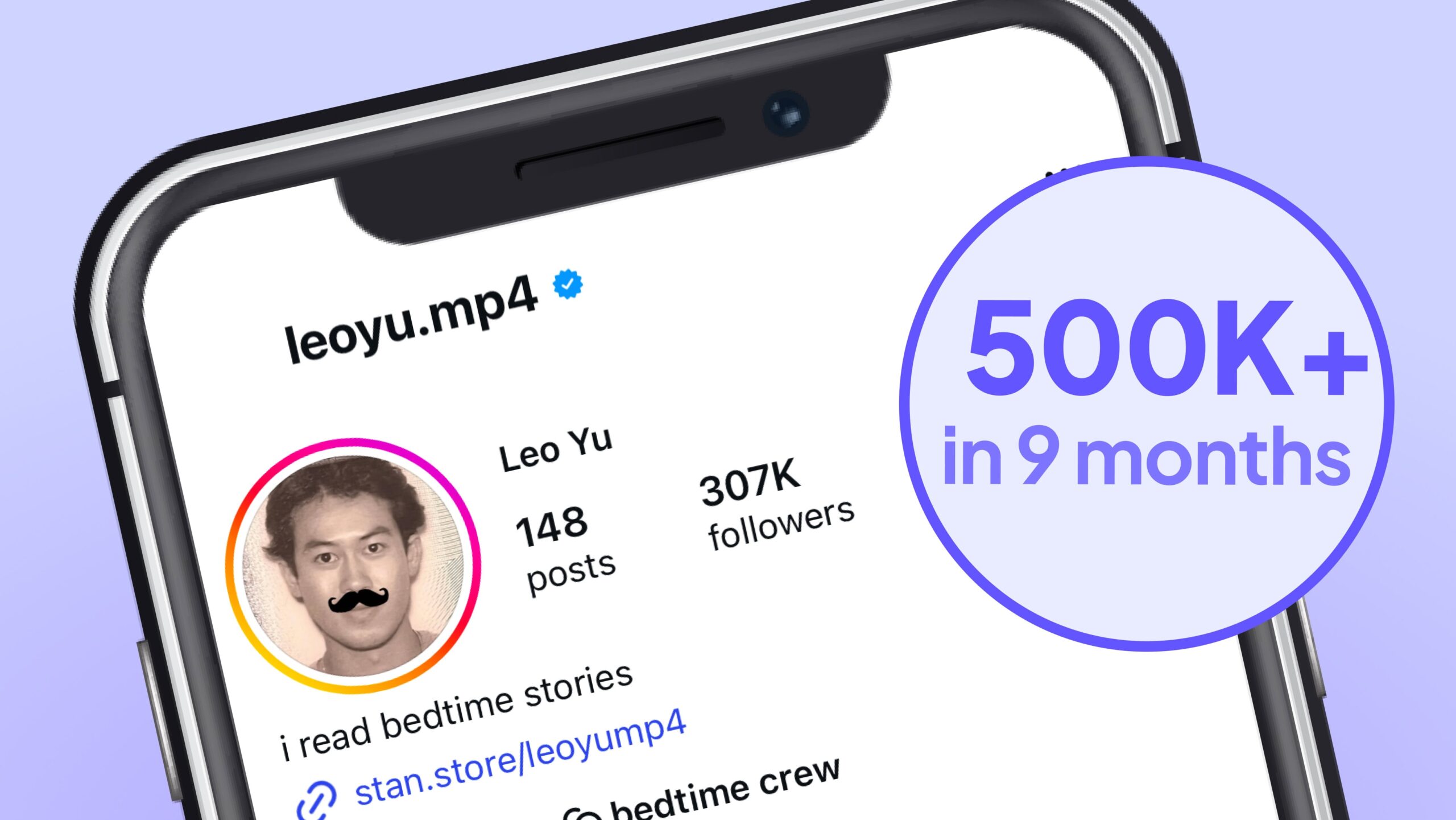
Leo posted every day for 30 days and barely reached 250 followers. Then a single video of him reading a children’s book hit a million views overnight. Nine months later, he’s built an audience of 500K+ by turning one idea into a repeatable format. Here’s exactly how he did it and the playbook he’d follow if he were starting over.
Nine months ago, I had 250 followers. Today, over 500,000 people follow me across Instagram, TikTok, and YouTube. My entire content strategy is reading children’s books on camera… which sounds weird, I know.
I’ll explain. But first, an intro. I’m Leo—a Creator and Stan Store’s Creator Partnerships Manager 👋 I spent over a decade hiding behind two smaller faceless accounts before building this one.
Growing this account from zero gave me a whole new perspective on what it takes to be successful as a Creator and the opportunities it can unlock (like landing my job at Stan).
I didn’t know what I was doing when I started, but 31 days in, one line changed my life. Here’s how I grew from 0 → 500K+ followers in nine months and what I’d do again if I were starting today.
I Spent A Decade Hiding From The Camera
I’ve loved making things on the internet since I was 13, when I watched Casey Neistat and started filming my friends riding bikes around the neighborhood. I was convinced that time lapses and fun music were my ticket to YouTube fame. Spoiler alert: They weren’t.
I kept creating throughout high school and college, but I was terrified of being judged by people I knew. So I went faceless and built a meme page to 25,000 followers on TikTok and a personal finance page to 15,000 followers.
I eventually let both accounts die, because when nobody knows a page is yours, walking away costs you nothing. It’s weirdly easy to abandon something you’re hiding behind.
What finally moved me to show my face was hearing Creators I respected, like Mino Lee and John Hu, talk openly about the exact thing keeping me anonymous: the cringe of putting your face on camera.
The reframe that got me was stupid simple: It’s cringe until it’s not. You don’t get to skip the awkward phase. You just go through it, get better, and one day you stop caring.
So in November 2025, as I watched talking head videos take over Instagram, I said, “F*ck it, I’m going to take this seriously.”
The plan was to post every day for 30 days and see what happens. I had no idea just how much it would.
My First 30 Days Of Posting
I posted my first talking head video a few hours after getting home from a job I hated. I filmed it in my apartment, edited it way too many times, and hesitated before hitting publish.
It was awkward and got almost no views, but it felt good to put my name on something finally.
I committed to posting once a day, every day, for one month. The first two weeks of posting were so uncomfortable I wanted to quit, but by week three things started to come together.
Day 14: The Midpoint
After two weeks of posting, I’d built a routine: work 9-5, come home, come up with an idea, film it, edit it, post it, sleep, repeat.
I was testing three niches at once:
- Career content about my jobs, college, and businesses.
- Personal finance.
- And comedy—just me trying to be funny on camera.
I was learning the platform’s rules as I went, too. Instagram only pushes videos under 3 minutes out to new audiences, so I tried keeping mine under 2.5 minutes.
Every night, I’d check one number to see what was working: my 3-second retention rate (the percentage of viewers who make it past the first three seconds of my videos). It’s the closest thing you get to a report card on your hook.
My first two weeks of content weren’t working. My videos were barely getting 1,000 views, people were dropping off within the first few seconds, and engagement was weak.
But with every post, the hooks were getting better.

Day 21: Keeping The Streak
By the fourth week, I hit a wall. Some nights I had nothing to post. No fresh ideas to edit together or a creative angle to try. But I refused to break the streak, so I’d post B-roll with text and music.
Those were my worst-performing videos, because they offered no real value or entertainment. They existed so I could tell myself I posted. That’s it.
It taught me that consistency just for the sake of it is worth nothing. A posting streak only matters if there’s something in the video for the person watching.
So going forward, I no longer held myself to a consistency standard. I held myself to a quality standard. I’d ask myself ”Would I personally watch this video if someone else made it?“
Day 30: A Foundation To Build On
By Day 30, I’d built an audience of 250 followers—which didn’t match the montage version of every Creator growth story I’d seen. But I realized I’d actually gained something way more valuable than followers: I had 30 tested hooks, 30 data points, and instincts that were a month sharper than when I started.
That gave me a lot to build on that I didn’t have before, and the confidence to do it. So I kept posting.
The Children’s Book That Changed Everything
On day 31, I picked up The Very Hungry Caterpillar, pointed the camera at myself, and opened with, “If you’re seeing this video, your attention span is extremely cooked.”
That video got one million views overnight, and my account jumped from 250 followers to over 1,000. I sat in my apartment watching the numbers climb, and thought, “How do I recreate this?”
The answer came down to a few things I started doing on repeat.
Doubling Down On What Works
When you hit a pot of gold (or in my case, a winning format), you keep digging. So for my next video, I read another children’s book using the same structure and grabby hook. It worked again.
That’s when I knew day 31 wasn’t a random viral moment. It was a proven format.
Once I had a format that worked, I started stretching it further. Doubling down didn’t just mean making new videos in the format—it meant re-running the winners. That’s where Trial Reels came in.
I’d take a video that already performed well, throw new captions on it, swap a single scene, or re-film the hook with a different background. Instagram would treat it like a new video, shown to people who don’t follow me.
If it flopped, that was a data point I could learn from. If it hit, it doubled the reach of my existing content. A video that gets a million views on my main page can do another million as a trial.
Turning A Winning Format Into a System
Having a clear format made it easier to develop a system rather than scrambling to come up with a new idea every day. I’d film a week of content in one sitting, edit everything in one standalone session, and plan it all out in a content calendar.
I also started squeezing more out of each idea, turning a talking head video into carousels. And the more I did it, the faster I got.
That system is the difference between this account and the two faceless accounts that I let die: Those ran on motivation. This one runs on process. Motivation is easier to lose, but a process? That keeps running.

Compounding Consistency
Growing on social media is a lot like investing. It’s slow, then it’s fast. I kept my daily posting streak for months, and at first the returns were small.
250 followers in month one. 1,000 in month two. But by month three, compounding started kicking in.
10,000 followers on January 14.
20,000 on January 21.
30,000 on January 27.
40,000 on January 30.
I was hitting a new milestone once a week, then every few days. Nothing about my video format changed. I just kept using the same system.
On March 10, four months after I started, I hit 100,000 followers.
And now, nine months into posting and more than 80 storybooks later, I have over 500,000 followers across Instagram, TikTok, and YouTube.
Finding Purpose In Posting
When I started posting videos, I had no idea who would watch them. I read children’s books on the internet, so you’d probably guess my audience is parents or teachers. The reality is, most of my followers are 18 to 25 years old. Teens, college kids, young adults.
My videos give them a blast of nostalgia in the middle of their doom scroll, and my DMs revealed something even deeper. For people who didn’t have a good childhood or never had someone read to them growing up, my videos fill a gap.
A few messages have stopped me cold:
“I’m 14, and my mom used to read this to me as a little kid. She passed away this year, so I quite literally SOBBED listening to this. It reminded me of the music box I have from her that plays the same lullaby.”
“I don’t remember anyone ever telling me a bedtime story as a child, so I didn’t even know what I was missing out on. But hearing you read a story is really calming, and I hope I see your videos more often.”
“I had a rough go at life and am currently working on re-parenting myself, and your stories are a huge help for me. I truly appreciate them and wish you all the best.”
People constantly tell me my videos helped them through a rough patch or are helping them heal. I save those messages. They’re content ideas, they’re testimonials, and most of all, they’re proof that what I’m building has an impact beyond the numbers.
👉 That’s been my greatest lesson from this experience: You don’t get to pick what your brand means to someone. The people watching do.
That was a humbling thing to learn.
Steal My Playbook: How to Grow From 0→500K Followers In Less Than A Year
Here’s the exact playbook I’d follow if I were starting an account today from zero.
1. Post as often as you can
Posting consistently isn’t just an algorithm play. It helps you get better at creating and get over the fear of being seen.
You should post often enough that your results start to compound, and try to make every video 1% better than the last.
At first, I was scared of people I knew seeing my content and thinking, “What are you doing? This is weird.” But once I started posting consistently, my friends and family said,”It took you long enough.”
Taking action is what got me to stop dwelling on what everyone else might think.
2. Double down on your winning formats
The Very Hungry Caterpillar video could have been a one-off post. Instead, I paid attention to the data, treated it like a formula, and read 80+ books with the same structure.

Most Creators find something that works and get bored of it long before their audience does. But when you find something people respond to, that’s your signal to keep trying it.
3. Use Trial Reels
If you have access to Instagram’s Trial Reels feature and you’re not using it, you should be. It’ll put your content in front of people who don’t follow you and help you learn what works. Just take an existing video and swap out a single scene, caption, or hook.
Worst case, it flops, and you get data back to inform your next move. And if it lands, you can double the reach of your best content.
4. Create a batching system
Trust me—batching content will save you time and help you stick to your streak. Film a week’s worth of content in one sitting, edit in one session, and schedule it all in advance.
5. Use 3-second retention rate as training wheels
For my first 30 videos, I graded every hook against this number, which helped make them sharper. And it strengthened my instincts.
Over time, I stopped obsessively checking every data point because I knew what to look for. The nitty-gritty numbers that made me better in month one would have slowed me down in month six.
Now, I just focus on getting good content out using a framework that I know will perform with similar results every single time.
6. Repurpose videos into carousels
Turning a talking head video into a carousel is the easiest repurposing tactic there is. Make your content go further by squeezing every format out of an idea.
I’ve talked to over 100 Creators in the past year, and the ones growing the fastest all say some version of the same thing: most of their content is remixed from something that already worked.
Different format, different platform, different angle, same core idea.
7. Leverage your DMs as a content pipeline
Instead of constantly brainstorming fresh content ideas, listen to your audience. Create the content they’ve told you they want to see.
For example, my inbox is usually filled with book requests. Each one gives me a pre-validated video idea someone wants to watch. I’ve turned those DMs into a pipeline of content that makes my audience feel heard.
Turning My Audience Into A Business
Until now, I’ve been focused on building an audience and figuring out my format. The one thing I haven’t done yet is monetize it. That’s what I’m excited to explore next.
At Stan, we’ve helped Creators make over $600M by turning their audience into a business, and now I’m doing that with mine. I’ve already got a few offers live on my Stan Store, with more coming this year.
The only reason I got here is that I spent months showing up. A year ago, putting my face on camera felt impossible. I’d let every faceless page I built before this one die. Even the first 30 days of posting on this account felt like they were going nowhere.
Then my 31st video reached a million people overnight—which wouldn’t have happened if I’d stopped at day 30.
So if you’re posting into the void and wondering if it’s worth it, keep doing it. You’ll only get better. And stop caring what anyone else thinks.
It’s cringe until it’s not.