TL;DR
In 14 days, our founders went from zero experience building AI agents to launching Stanley—a $1M+ LinkedIn AI agent. They built it in public, iterated fast, listened obsessively to Creators, and let the organic flywheel do the rest. We’re breaking down exactly how they did it, and why building distribution beats ads every time. Ready to build your own LinkedIn audience? Try Stanley for free.
We recently launched an AI agent for LinkedIn that hit $1M+ in revenue in just a few weeks. But the craziest part is that it only took our founders, John and Vitalii, 14 days to build it.
They documented the entire process, starting from day one when they arrived in London with absolutely no idea how to build an AI agent, all the way to launching a product that generated $200K ARR in a single day.
And now, we’re unpacking exactly how they did it—what worked, what broke, and how building in public turned a 14-day sprint into a $1M+ product.
Why We Built Stanley: Your LinkedIn Coach
Our Creator-Founders, John and Vitalii, are both active LinkedIn Creators known for building in public. Even though they were posting 1–2 times per week on LinkedIn, they still wished they could create more. So they decided to build a tool that would solve that for themselves and other Creators.
They’d already built a successful $30 million business called Stan Store—the easiest way for anyone to start their own online business. But they saw an even bigger opportunity to help people not just monetize, but build the audience that makes monetization possible.
They created Stanley to democratize access to personal branding, and they’re constantly making it better so more people can build real distribution on LinkedIn.
How We Built A $1M+ AI Agent In Just 14 Days
Day 1: London
John and Vitalii arrived in London with a general idea—but no real game plan for bringing it to life. They knew they wanted to create an agent-first tool for Creators, but neither of them had ever built an AI agent before.
And with just 14 days to launch, that was terrifying.
They set themselves a strict deadline: five days to figure out how to build the agent, or they’d never finish in time.
Day 1’s challenges and breakthroughs:
- Challenge: They had absolutely no idea how to build an AI agent.
- Breakthrough: Vitalii began “vibe coding.” He decided to build the entire backend of the product without writing a single line of code himself, using natural language to program the agent.
Day 2: The Gameplan
It didn’t take long for them to realize that building a complex, all-encompassing tool was impossible in 14 days. To ship an MVP, they needed to narrow their focus on a specific type of customer and problem.
The customer? LinkedIn Creators with 2K+ followers.
The core problem? Growing an audience takes consistent, quality content.
They chose this niche because:
- They were the customer
- They deeply understood the problem
- The market was large enough to monetize
At Stan, they’d already built a customer base of 70,000+ Creators focused on monetization. But the piece that comes before monetization? Having an audience.
Because audience = distribution. And distribution is where all the money comes from.
With their idea locked in, they mapped out a realistic scope and action plan. They also devised a plan to start acquiring customers by sending very comprehensive analysis emails to Creators from Stanley.
Day 2’s challenges and breakthroughs:
- Challenge: They had to admit they fundamentally couldn’t build something overly complex in such a short timeframe.
- Breakthrough: After scoping the problem down to a two-week MVP scope focused on LinkedIn text posts, which could help validate their bigger vision, Vitalii figured out how to scrape LinkedIn’s history of posts. He also built a foundational AI agent and a prompt to build on.
Day 3: Breaking Past Content Fluff
By day 3, they had a prototype. But honestly? It was bad.

The agent kept giving generic, unhelpful advice like “Share a journey story.” Not the specific, strategic guidance Creators actually need to grow.
They spent the entire day trying to get the AI to stop sounding like a robot and start sounding like a strategist.
After hours of work, Stanley finally began generating actionable ideas rooted in each Creator’s unique story, voice, and background.
Day 3’s challenges and breakthroughs:
- Challenge: The agent’s output was too broad. It was suggesting high-level fluff that no one would actually want to post.
- Breakthrough: By the end of the day, they moved from generic suggestions to visceral, specific ideas. The agent started saying things like, “John, share your tactical playbook of how you scaled Stan from 0 to $10 million,” which was infinitely more valuable.
Day 4: Zooming Out
On day 4, they hit another wall. While the content ideas were getting better, the agent couldn’t hold a conversation or answer the questions being asked. And they were just 24 hours away from launching Alpha
They’d been so focused on solving one part of the problem that they’d ignored the user experience.
To fix it, they zoomed out and rethought Stanley at a systems level—rewriting foundational prompts that shaped not just the content ideas, but the conversational experience itself.
Vitalii asked the agent to analyze its own flaws and generate the prompts to fix them.
Day 4’s challenges and breakthroughs:
- Challenge: Stanley struggled to answer the questions being asked, often forcing unrelated content ideas down users’ throats.
- Breakthrough: They realized the value of an AI agent isn’t just in the features or outcomes, but in the conversational experience of working with the agent. By asking Stanley to analyze its own faults and generate prompts to improve its performance, they resolved most of the issues.
Day 5: Cold Emailing Top Creators
John and Vitalii didn’t wait for perfection before trying to get customers. They tested Stanley’s value proposition before the product was even finished.
Using their vibe-coded prototype, they analyzed the top posts of five massive LinkedIn Creators—including Justin Welsh, Lara Acosta, and Steven Bartlett—then sent them a hyper-personalized cold email explaining exactly why their content worked.
They were willing to bet that if Stanley provided meaningful data upfront, these high-profile Creators would feel compelled to respond.
Day 5’s challenges and breakthroughs:
- Challenge: The fear of failing in public was real. They had been hyping this journey for days, and sending cold emails to industry giants felt like a high-stakes gamble where silence would mean failure.
- Breakthrough: They realized that acquisition doesn’t require money—it requires hustle and ingenuity. By leading with a comprehensive in-depth analysis as a hook, they flipped the dynamic from begging for attention to offering immense value.
Day 6: Product Testing
The feedback came in—and it wasn’t good.
Users said the output felt stiff, safe, and like a worse version of ChatGPT. That hurt. But it was exactly what they needed to hear.
John and Vitalii realized they were solving the wrong problem. Training the AI on past posts created a content loop of recycled ideas.
They needed to build something that didn’t just reflect Creators’ voices, but challenged them with forward-looking ideas.
Day 6’s challenges and breakthroughs:
- Challenge: Creators told them Stanley’s content was too surface-level to be useful (a real blow to the ego).
- Breakthrough: They pivoted the product’s core logic: Stanley wouldn’t just mirror you—it would surface ideas that stretch your thinking and push your performance. They realized they weren’t just building a copywriter, they were building a creative partner.
Day 7: The Midpoint
They’d hit the halfway mark of their 14-day sprint and had come a long way.
In 7 days, they had:
✅ Built a web app
✅ Hacked their way to get all the LinkedIn data
✅ Shipped a working MVP in 5 days
✅ Trained Stanley on live Creator data
✅ 100 people on the Alpha waitlist
✅ Launched Alpha with 10 users
✅ Interviewed 10+ users
✅ Learned they were solving the wrong problem
✅ Pivoted
But walking through London that night, they faced a bigger realization: this couldn’t stay a side project.
To fully capture the opportunity, they had to loosen their grip on their existing $30M business and pivot the company toward an AI-first future.

Day 7’s challenges and breakthroughs:
- Challenge: The fear of the unknown. Every problem solved seems to come with a new and scarier one behind it.
- Breakthrough: Embracing the idea that the path makes itself as you start walking. They committed to using Stan’s resources to fund this new future, trusting that if they started before they were ready, they’d eventually figure it out.
Day 8: The Tesla Breakthrough
They spent days refining the prompts, and by day 8, they finally saw magic. John tried to confuse the bot by asking about cars—a topic completely unrelated to their business.
Instead of getting distracted or refusing to answer, Stanley connected the concept of cars to their business strategy, suggesting a post about “The Tesla approach to building my AI agent.” It even recalled a year-old story about Vitalii’s Uber rating.
Day 8’s challenges and breakthroughs:
- Challenge: Testing the agent’s ability to handle distractions and maintain context without breaking character.
- Breakthrough: The agent wasn’t just answering—it was context-matching. It successfully linked Tesla’s approach to their MVP launch, proving it could mimic high-level creative thinking.
Day 9: Switching Models
Day 9 was pure chaos. They’d over-engineered the product by giving the agent too many conflicting instructions—telling it to be friendly, data-driven, casual, smart, and professional all at once.
And then Stanley broke down.
That’s when it hit them: great prompt engineering isn’t in the code, but in the exact instructions and words you give the agent.
Day 9’s challenges and breakthroughs:
- Challenge: They had to blow up the entire agent and switch models from ChatGPT to Claude, which felt like taking a massive step backward with the clock ticking.
- Breakthrough: They learned that less is more. They stripped back conflicting instructions to focus on the core value, realizing the innovation wasn’t in the code—it was in the prompt.
Day 10: The Breakthrough
They spent the day at Steven Bartlett’s office to get his feedback on Stanley after switching models. This is also the day they noticed a major friction point: Stanley took up to 20 seconds to “think” of a response, so users were stuck blankly staring at a loading dot.
They didn’t have time to make the backend faster, so they vibe-coded a solution live. Instead of a loading dot, they programmed Stanley to show dynamic text with exactly what it was doing—reading your recent post, analyzing data, crunching numbers.
Day 10’s challenges and breakthroughs:
- Challenge: Users were dropping off because they didn’t know if the AI was working or just frozen.
- Breakthrough: Landed the first 2 paying customers! And Steven got really excited about a feature where Stanley finds the highest-performing posts in your niche and rewrites them with your unique voice and perspective. His excitement gave John and Vitalii massive conviction to keep going.
Day 11: The Crash
After regaining momentum, they secured their first real customer interview with creator Lara Acosta. She loved the tool, validating that their “personalized to you” framing was a winning hook.
High on that success, they headed to a Creator event hoping to find more users. But reality hit them like a truck—after 10 days of non-stop hustle, they were too exhausted to talk with people and had to leave early.
Day 11’s challenges and breakthroughs:
- • Challenge: Hitting their limits physically. They were so exhausted from the sprint that they couldn’t even function at a networking event surrounded by potential customers.
- • Breakthrough: Lara Acosta validated their cold outreach strategy, confirming that phrases like “I spent the last 3 days analyzing your competitors” are the specific psychological hooks that get users to open emails and engage with the product.
Day 12: Product Market Fit
With just 2 days left of their sprint, they spent day 12 sending out their first batch of Stanley-generated cold emails to top Creators. They also conducted interviews with Creators to better understand the current pain points in their content creation workflow and tell them about Stanley (which helped secure the first beta customers!).
The early signals were promising. They watched users live—one person spent over 45 minutes in a single session!
Their next step was to figure out why users kept coming back and double down on those features.
Day 12’s challenges and breakthroughs:
- Challenge: Watching a user live was nerve-wracking—especially seeing the product break in real-time.
- Breakthrough: Despite the bugs, users were copying and pasting Stanley’s ideas directly into LinkedIn. They had proof of value and early signs of product-market fit, because users were coming back on weekends to use the tool.
Day 13: Dinner with Justin Welsh

At this point, everyone who had tried Stanley was coming back to it daily and spending at least 30 minutes within the app without being prompted to. John and Vitalii were feeling good about where the product was at—now it was time to put it to the ultimate test.
They’d secured a dinner with Justin Welsh, the “Michael Jordan of LinkedIn.” If he didn’t like it, they knew they had a problem. They showed him Stanley, and he asked it to analyze his profile.
Day 13’s challenges and breakthroughs:
- Challenge: Impressing the most knowledgeable person in the LinkedIn Creator space.
- Breakthrough: Stanley analyzed Justin’s profile so accurately that he admitted, “This knows me a lot better than Claude or Chat GPT does.” He validated that the tool cut down his prep time significantly.
Day 14: The Launch
Then came the moment of truth: Launch day.
John and Vitalii had been building in public for two weeks, sharing every failure and success. When they posted that Stanley was live, the reaction was instant.
They’d started this journey with nothing but a napkin sketch of an idea. And now, they were leaving London with a validated product: an AI agent that will transform how people show up on LinkedIn.
In just two weeks, they’d hit:
✅ 200+ hours of coding
✅ 10+ customer interviews
✅ 500+ beta applications
✅ 200+ paying customers
Day 14’s challenges and breakthroughs:
- Challenge: The fear of failing after hyping the journey for 14 days.
- Breakthrough: They generated over 2,000 comments on the launch post and $200K from that single announcement. In just two weeks, they went from zero to a $1M business.
From Launch to $1M+: Stanley Today
John and Vitalii had built hype around Stanley by building in public, sharing every up and down of the journey on social media. So when Stanley went live, we generated $200K from that post alone—but that was just the beginning.
In the months since, we’ve continued to make Stanley even better at creating great content while rolling out features like voice-to-text, image generation, in-depth analytics, and more.
It’s not just John and Vitalii building anymore—our team is making Stanley better every day.
And now, seven months later, we’re at $1M+ ARR.
Our growth hasn’t come from paid ads or crazy marketing schemes. It came from the organic flywheel we built.
The Flywheel That Built a $1M+ AI Agent
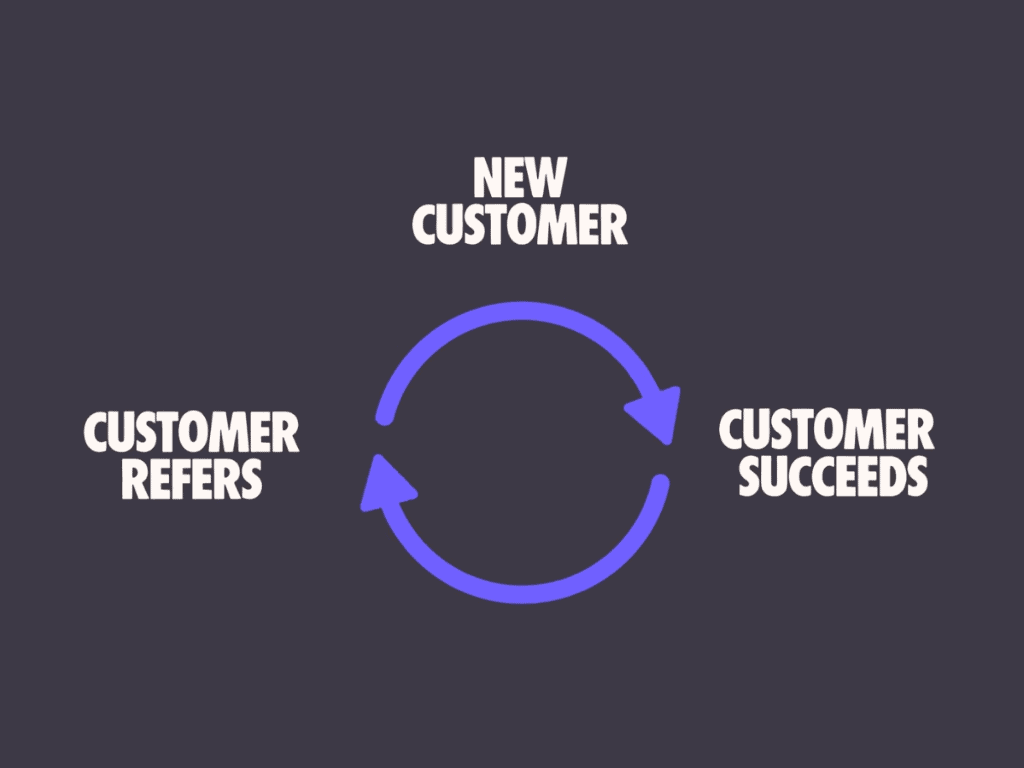
We didn’t have to spend money on ads to scale Stanley to $1M+ ARR. All we had to do was build our organic flywheel.
When you build in public, you don’t have to beg people to try your product. Instead, you attract people who are excited about what you’re building and want not only to try it but to play an active role in making it better.
That’s how you get your first customers.
Once you have customers, listen to them and iterate based on their feedback. You’ll end up building a better product and customer experience.
So many people from our Beta cohort shared that Stanley doubled their engagement and cut their content creation time in half. We even had one early customer tell John that he could already attribute $200K in contract lead value to using Stanley!
When our users started seeing results, they told the world.
Your customers are your best salespeople. That’s how you grow.
The more you improve the percentage of people who succeed with your product, the faster this flywheel gains momentum. And suddenly, growth gets easier.
That’s the real takeaway from this 14-day sprint:
Stanley didn’t scale to $1M+ ARR because we ran ads.
It scaled because we built it in public.
Refined in the comments. Stress-tested by real Creators. Torn apart, rebuilt, and improved again.
Every feature, every improvement, every breakthrough. With Creators at the center.
And now, it’s your turn to experience it.
Create top 1% LinkedIn posts, cut your content creation time in half, and build distribution. Try Stanley free for 14 days.