Link-in-Bio Storefront vs Website: Which is Best?
A traditional website is no longer required to build a booming online business.
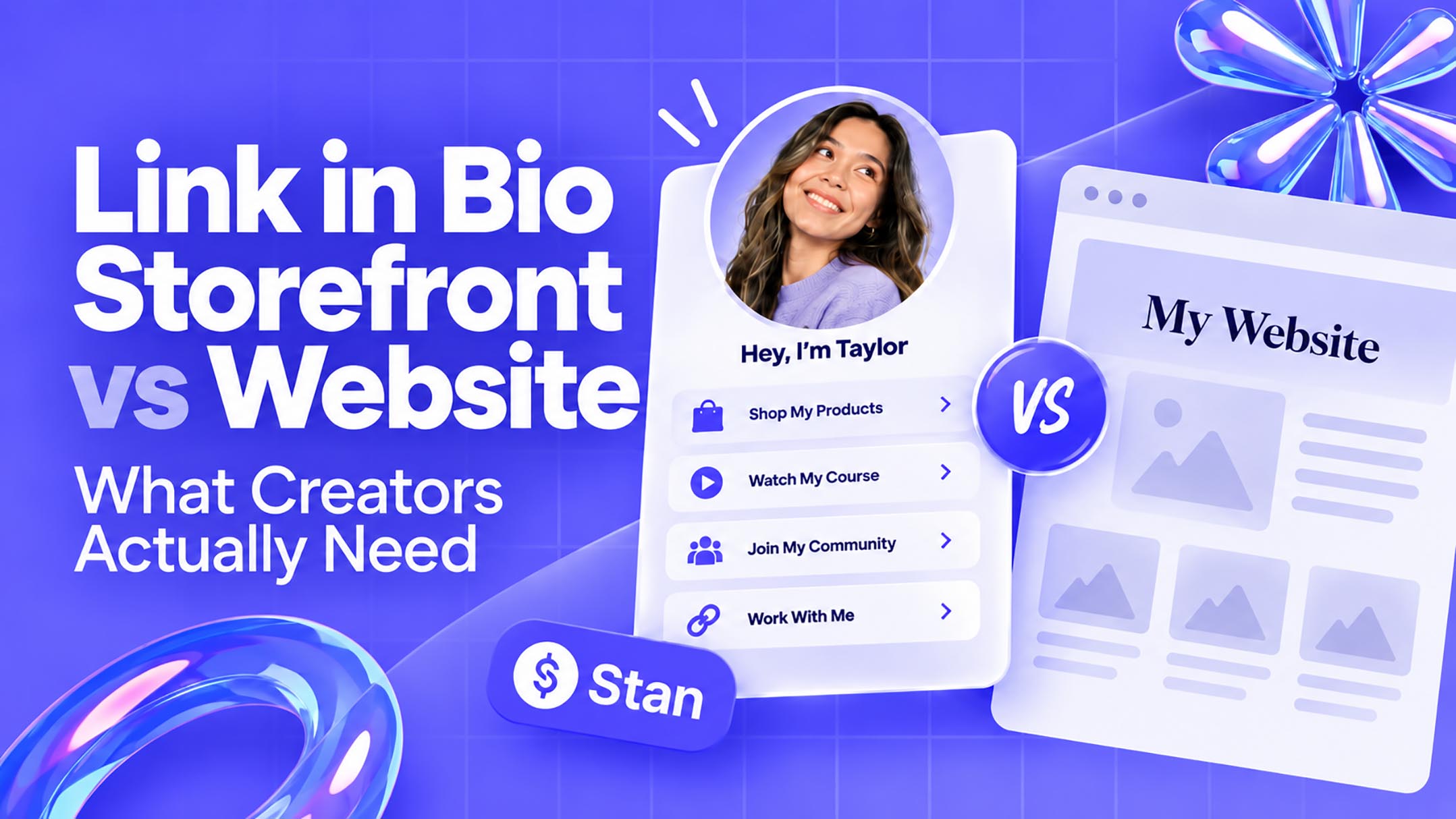
For Creators, platforms like Stan have changed what a link-in-bio storefront can do. It can still sit behind a bio link, but the platform itself goes much further, giving you tools to sell, capture leads, manage customers, and run more of the business without having to build and maintain an entire site.
Don’t get us wrong. Traditional websites still make sense when you need total control, more content, or more room to grow through search. For many Creators, a storefront platform offers a lower-cost way to launch, with built-in tools that can support the business well beyond its early stages.
That’s what makes the link-in-bio storefront vs. website comparison worth looking at. They can overlap, but they’re built around different priorities.
What Is a Link-in-Bio Storefront?
A link-in-bio storefront is a mobile-first destination designed to turn the attention you’re already earning on social media into a clear next step.
Unlike a basic link-in-bio page, which only directs people to your website, shop, booking page, email sign-up, or other third parties, a storefront keeps the overall experience more cohesive. Someone can arrive from Instagram, TikTok, or another social platform and interact with your business without clicking through a list of links, each leading to a different place.
With Stan, the storefront is the customer-facing side of a much broader Creator platform. It gives your audience an easy place to see what you offer and take action.
That matters because social traffic behaves differently from search traffic. Someone tapping your bio link already has context. They usually don’t need a grand tour of your business; they need an obvious path to whatever made them click in the first place.

Simple is good when simple matches the intention.
What Does a Traditional Website Do Better?
A traditional website gives you more room to build in terms of content and control. You also have much more freedom to optimize individual pages for search.
That makes a website especially valuable when Google is part of your growth plan. If you want to publish regularly, target a wider range of search terms, or build an organic traffic channel over time, a full website gives you a bit more space to do it.
The trade-off is that all that flexibility comes with more to manage. Hosting, templates, forms, analytics, ecommerce tools, and regular updates can add up quickly, especially if all you needed was a straightforward place for people to buy from you.
Link-in-Bio Storefront vs Website: The Main Differences
Here’s where the two options differ most clearly:
What Creators Care About Most
When Creators talk about the platforms they use, the conversation quickly shifts from feature lists to what makes running the business easier.
Rebecca Portsmouth, who has spent more than a decade selling online, puts the trade-off pretty plainly in her Stan Store review:
She also raises an even more compelling point:
Her reasoning is practical. WordPress and WooCommerce offer enormous flexibility, but that flexibility can also mean more decisions, setup, and ongoing management. A platform that gets you up and running quickly with the functionality you genuinely need leaves more time for the work that grows the business.

That same sentiment shows up in Stan’s own Creator stories, just from different angles.
Ellie Frazier didn’t want to build a complicated setup before she could start selling:
For Jessica Carter, the appeal was being able to look professional while still keeping the business manageable:
Zee Slingsby takes that simplicity seriously enough that she tells new clients to start with Stan:
None of these Creators are arguing that websites have no value. What they are pointing to is something more practical: the best setup is the one that gives you enough capability to run the business without making the platform itself another project.

So, Do You Need a Link-in-Bio or a Website?
To echo our Creators, the smartest setup is the one that fits your business at its current stage and gives you room to grow when you need it.
If social media is already doing the work of introducing people to your business, a link-in-bio storefront is often the more natural fit. By the time someone taps your bio link, they usually have some context and a reason for being there.
For many Creators, that means a shorter customer journey, a lower-cost way to launch, and the tools to run and grow the business behind the storefront. With Stan, more of that journey can stay connected in one place.
The journey is short because it should be.
A traditional website makes more sense when it needs to play a bigger role in how people discover and understand your business.
If visitors are finding you through Google, comparing options, exploring a larger catalog, reviewing your work, or simply needing more information before they’re ready to take action, a website gives them the space to do that.
It also gives you more room to build an organic search presence, publish content, and create different paths for different types of visitors.
As the discovery process becomes more complex, a traditional website becomes more valuable.
That’s not a criticism of storefronts. It’s just a different job.
For some businesses, the answer will inevitably be both: a website that helps new people discover and understand the business, and a storefront that gives an established audience a clear place to take action.
What matters is choosing the setup that best supports how your business works now. If a storefront gets people where they need to go and gives you the tools to run the business behind it, that’s not a temporary workaround. That’s optimization.