
Loading the
Elevenlabs Text to Speech
AudioNative Player…
TL;DR
Caleb Hammer is a personal finance YouTuber who turned budgeting into must-watch content with Financial Audit—a show where real people break down their income, debt, and spending while he delivers tough-love accountability. Since launching in May 2020, he’s grown to a combined audience of 7.6M+ across YouTube, Instagram, and TikTok, and built a diversified Creator business spanning a podcast, memberships (Hammer Elite), and his own budgeting app (DollarWise).
Caleb Hammer didn’t make personal finance louder—he made it impossible not to watch. By turning budgeting and debt into structured, high-stakes conversations, he built Financial Audit, a format that feels closer to a reality show than a traditional money lesson. Real people, real numbers, and real accountability became his hook.
That approach was shaped by Caleb’s own experience navigating debt after high school. Instead of positioning himself as a distant expert, he built trust by leading with transparency and tough love. The result was a repeatable show with a clear promise: clarity over comfort.
Since launching his YouTube channel in 2020, Caleb has grown Financial Audit into a multi-platform Creator business spanning long-form YouTube, a weekly podcast, short-form discovery clips, memberships, and Creator-owned products. Today, his content reaches millions—proving that educational content can scale when it’s built around story, structure, and systems.
In this Creator bio, we’ll break down how Caleb Hammer became a Creator, the pivotal moments that mattered, the growth mechanics behind Financial Audit, how he monetized responsibly, and what other Creators can learn from his path.
Caleb Hammer: Complete Bio Stats
| Category | Details |
| Full Name | Caleb Hammer |
| Age | 31 years old |
| Birthday | February 14, 1995 |
| Birthplace | Kalamazoo, Michigan, U.S. |
| Location | Austin, Texas |
| Nationality | American |
| Education | Studied music composition at Western Michigan University (did not complete degree) |
| Occupation | YouTuber, Personal Finance Creator, Media Personality |
| YouTube Channel Launch | May 20, 2020 |
| YouTube Subscribers | ~3.25M+ |
| Instagram Followers | 1M+ |
| TikTok Followers | 3.4M+ |
| Content Niche | Personal Finance Education, Financial Audits |
| Primary Show | Financial Audit |
| Podcast/Audio | Financial Audit (YouTube/Podcast) |
| Products/Services | YouTube Membership (Hammer Elite), Budgeting App (DollarWise), Courses & Tools |
| Estimated Net Worth | Mid seven figures |
| Known For | Financial Audit format, Money education, Tough-love accountability |
How Caleb Hammer Found His Creator Niche
Caleb Hammer’s path into content creation didn’t start with a camera or a growth plan—it started with personal financial pressure.
After high school, he found himself dealing with debt and money decisions that felt overwhelming and opaque. Instead of ignoring the problem, he leaned into learning: budgeting frameworks, credit behavior, and the mechanics behind why people stay stuck financially. That process reshaped how he thought about money and, eventually, how he talked about it.
What made Caleb’s perspective different early on was proximity. He wasn’t teaching finance from a distance or from theory alone. He was working through the same mistakes his future audience would recognize immediately. That lived experience became the backbone of his voice: direct, structured, and unapologetically honest.
Before Financial Audit became a show, Caleb experimented with posting finance-related content on YouTube, testing how to explain money concepts clearly without dumbing them down. Those early videos revealed an important insight: people didn’t just want tips—they wanted context, accountability, and examples that felt real. Numbers alone weren’t enough. Story mattered.
That realization pushed him toward a more interview-driven format. Instead of talking at viewers, Caleb began talking with real people about their finances—income, debt, spending habits, and blind spots. Over time, this approach evolved into a repeatable framework that balanced education with tension and progress.
By the time he formalized the Financial Audit concept, Caleb had found his Creator lane at the intersection of financial education and storytelling, where his own journey—from confusion to control—gave him credibility without needing traditional finance credentials. That foundation set the stage for the traction and growth that followed.
Becoming a Creator: Financial Audit’s Breakout
Caleb Hammer’s first real traction came from sticking to one format. After experimenting with traditional finance videos on YouTube, he noticed a clear pattern: audiences stayed longer and engaged more deeply when money advice was grounded in real people and real decisions, not abstract rules.
The early breakthrough was the shift to what would become Financial Audit. Instead of teaching budgeting in isolation, Caleb invited guests onto his channel to walk through their actual finances in detail—income, debt, spending habits, and financial blind spots.
This structure introduced stakes. Viewers weren’t just learning concepts—they were watching decisions unfold in real time.

Several factors drove his initial momentum:
- Length and depth: Episodes ran long, but watch time increased because viewers wanted to see outcomes, not summaries.
- Clear narrative arc: Each audit followed a beginning (the problem), middle (the confrontation), and end (a plan).
- Emotional honesty: Guests were often candid, defensive, or overwhelmed—reactions that mirrored how many viewers felt about their own money.
As episodes stacked up, patterns emerged in the comments. Viewers weren’t just watching for entertainment. They were applying the advice to their own budgets. That feedback loop validated the format and signaled that Financial Audit wasn’t just content—it was a product.
Short-form clips accelerated discovery. Key moments from longer audits—direct callouts, spending revelations, emotional reactions—were repackaged into bite-sized videos that traveled quickly across platforms. These clips acted as the top of the funnel, consistently pulling new viewers back to the full episodes on YouTube.
Growth: How Caleb Hammer Scaled Financial Audit
Once Financial Audit proved it could hold attention, Caleb Hammer shifted from experimentation to systematic growth. The focus wasn’t on chasing virality—it was on refining a repeatable engine that could scale week after week.
Turning a Format Into a Growth Machine
The core growth lever was consistency. Each episode followed a familiar structure—introduction, financial breakdown, confrontation, and plan—which trained viewers to know exactly what they were getting.
That predictability increased retention and binge behavior. New viewers didn’t need context. They could start with almost any episode and immediately understand the format.
As the audience grew, Caleb leaned into length as a feature, not a flaw. Long-form audits created deeper watch sessions, which strengthened performance on YouTube and reinforced the show’s authority. Viewers stayed not just to learn, but to see outcomes.
Short-Form as the Discovery Engine
Short-form content became his accelarator. Clips highlighting emotional reactions, spending surprises, or blunt financial truths were cut from full episodes and distributed across platforms. These moments worked because they:
- Delivered instant stakes in seconds
- Sparked debate and self-reflection
- Funneled viewers back to the full audit episodes
This clip-to-long-form loop turned every episode into dozens of discovery assets, compounding reach without requiring entirely new ideas.
Audience Fit and Community Momentum
Caleb built an audience of people looking for accountability and community. Comment sections became extensions of the show—viewers compared situations, shared progress, and reinforced the language of budgeting and financial responsibility. That community behavior boosted his watch retention and repeat visitors.
As he scaled, Financial Audit evolved from mere content into a destination. The show expanded into a podcast, allowing audiences to consume episodes in audio form, while YouTube remained the primary platform for visual storytelling and discovery.
By this stage, Caleb wasn’t growing because of one viral hit. He was growing because he had built a durable system: a recognizable show, a distribution loop, and an audience that knew exactly why they were showing up.

How Caleb Hammer Built Resilience Into His Brand
Building a Creator brand around accountability comes with its challenges, and Caleb Hammer has faced that reality firsthand. As Financial Audit scaled, the very elements that made the show compelling—direct confrontation, emotional conversations, and real financial consequences—also opened the door to criticism.
One recurring challenge has been tone. As the show reached wider audiences, some viewers questioned whether the tough-love approach crossed into discomfort or pressure for guests. Caleb responded not by softening the format entirely, but by clarifying his intent: the goal was never humiliation, but clarity.
Over time, the show leaned more heavily into structure—clear budgeting frameworks, action steps, and follow-ups—to ensure each episode ended with a path forward, not just confrontation.
Another obstacle was brand risk at scale. Financial content that includes emotional stress, debt, and blunt language doesn’t fit neatly into every advertiser box. Rather than relying solely on ad revenue, Caleb turned his focus to Creator-owned monetization, reducing dependency on any one platform while allowing the show to stay authentic and avoid compromising its voice.
There was also the challenge of format fatigue. A repeatable structure is powerful, but repetition can stall growth if it becomes too predictable. Caleb mitigated this by varying guest profiles, introducing new financial scenarios, and expanding the ecosystem around the show through audio, memberships, and tools—keeping the core format intact while widening the experience.
The Business Stack Behind Caleb Hammer’s Brand
As Financial Audit scaled, Caleb Hammer was intentional about not building a business that depended on ads alone. His subject matter—debt, money stress, and blunt accountability—can be limiting for traditional advertisers, so diversification wasn’t optional. It was strategic.
Memberships: Recurring Revenue and Community
One of the first major monetization layers was channel memberships, often referred to by fans as Hammer Elite. His memberships unlock bonus content, live streams, and deeper financial discussions for the most engaged viewers. More importantly, they create predictable, recurring revenue that insulated his business from algorithm swings and brand deal volatility.
From a Creator-business perspective, this move did two things:
- It rewarded superfans who wanted more than weekly episodes
- It shifted the brand from being “media-only” to community-driven
Tools and Products: Solving the Same Problem Off-Platform
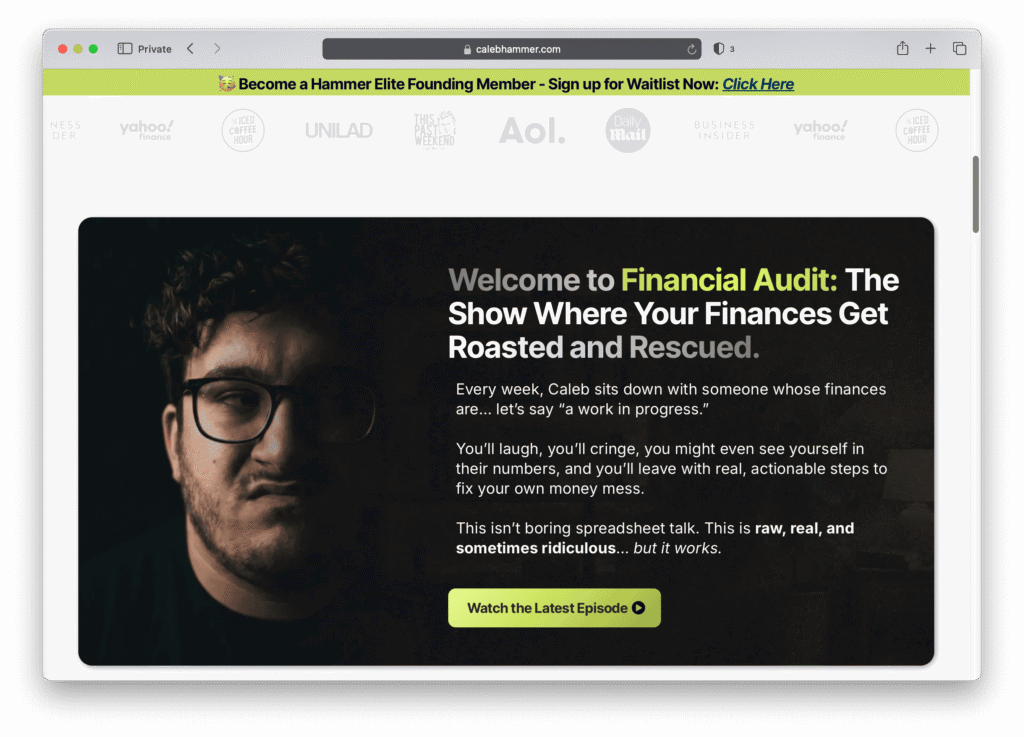
Rather than selling unrelated products, Caleb expanded into tools that directly matched the show’s mission.
Budgeting resources and, eventually, a dedicated budgeting app allowed viewers to apply what they were watching in real time. This product layer turned Financial Audit from entertainment into infrastructure—viewers didn’t just learn what to fix. They could pay for a tool that helps them do it.
Content Expansion: Podcast and Platform Reach
The launch of a podcast version of Financial Audit extended the brand’s reach without reinventing the wheel. Long-form audio made episodes accessible during commutes and workouts, while YouTube remained the primary engine for discovery and visual storytelling. Each platform played a defined role instead of competing with the others.
What Creators Can Learn From Caleb Hammer
Caleb Hammer’s success didn’t come from chasing trends or trying to appeal to everyone. It came from building systems that reward clarity, consistency, and trust. For Creators looking to turn content into a sustainable business, his path offers several high-leverage lessons.
1. Design a repeatable format before you scale
Growth compounds faster when your audience understands the rules of your content. A clear structure makes every new piece easier to produce and easier to consume.

2. Let lived experience earn trust
You don’t need perfect credentials to teach—clarity and honesty can be just as powerful. Audiences connect more deeply when they believe you understand the problem firsthand.
3. Build around outcomes, not opinions
Content that promises change performs better than content that just explains. Accountability, progress, and next steps keep viewers engaged beyond a single video.
4. Use short-form as distribution, not the product
Clips work best when they pull people toward deeper, higher-value content. Treat short-form as the funnel, not the finish line.
5. Monetize the solution your content already points to
The strongest products solve the same problem your audience is watching you break down. Alignment makes monetization feel natural instead of forced.
6. Add recurring revenue to reduce volatility
Memberships and owned products give Creators leverage. Predictable income creates room to focus on quality instead of algorithms.
7. Expect criticism as a sign of scale
If your content challenges people, pushback is inevitable. Durable brands respond with clearer framing and better systems—not reactionary changes.
The Road Ahead for Caleb Hammer
Today, Caleb Hammer’s Creator business is built around focus, not expansion for expansion’s sake. Financial Audit remains his core IP, but the surrounding ecosystem—memberships, tools, and a podcast—allows the brand to grow without diluting its purpose.
Looking forward, the opportunity isn’t about changing the format. It’s about deepening his impact: broader guest profiles, stronger follow-through systems, and products that help audiences move from awareness to action. Because the brand is rooted in behavior change, not trends, it’s well-positioned to adapt as platforms and algorithms shift.
Caleb’s success story reflects a trend we’ll see more and more across the Creator economy: education-first content that earns attention through structure, storytelling, and outcomes. As long as the mission stays clear and the systems stay tight, Financial Audit isn’t just a show—it’s a durable Creator business.
Building an audience of your own? Stan Store is the easiest way to monetize your following by selling digital products, courses, memberships, and more. We’ve helped Creators earn over $600M, and you could be next. Try it free for 14 days.
 YouTube
  Instagram
  TikTok
  Stan Store
 FAQ: Caleb Hammer
Who’s Caleb Hammer?
Caleb Hammer is an American personal finance Creator, YouTuber, and media personality from Michigan who’s now based in Austin, Texas. He’s best known for creating Financial Audit—a show that breaks down real people’s finances through tough-love accountability. His credibility comes from his own personal experiences navigating debt after high school, and his estimated net worth is in the mid seven figures.
What’s Financial Audit?
Financial Audit is Caleb Hammer’s flagship show, launched on his YouTube channel in May 2020. In each episode, Caleb invites a guest to walk through their actual finances in detail—income, debt, spending habits, and financial blind spots—in a format that feels closer to a reality show than a traditional money lesson. Every audit follows a consistent narrative arc: the problem, the confrontation, and a plan forward. The format emphasizes clarity over comfort, using real numbers and real accountability to help guests and viewers move from confusion to control.
How did Caleb Hammer grow Financial Audit so quickly?
Caleb Hammer scaled Financial Audit by building a repeatable system rather than chasing viral hits. The show’s consistent structure—introduction, financial breakdown, confrontation, and plan—trained viewers to know what to expect and encouraged binge-watching, while long-form episodes increased watch time and reinforced his authority. Short-form clips served as the discovery engine: emotional reactions, spending revelations, and blunt callouts were cut from full episodes and distributed across platforms, funneling new viewers back to the long-form content. This clip-to-long-form loop turned each episode into dozens of discovery assets, and an engaged comment-section community boosted retention and repeat visits.
How does Caleb Hammer make money?
Caleb Hammer monetizes through Creator-owned revenue streams rather than relying on ads alone, since his subject matter—debt and blunt financial talk—doesn’t fit neatly into every advertising category. His primary monetization stream is channel memberships (known as Hammer Elite), which unlock bonus content, live streams, and deeper discussions while generating predictable recurring revenue. He also earns from his dedicated budgeting app called DollarWise plus other courses and tools that let viewers apply what they learn, and a podcast version of Financial Audit that extends reach into audio. This diversified stack reduces his dependence on any single platform and protects the show’s voice.