TL;DR
Viral Instagram Reels follow repeatable structures built around strong hooks, sustained attention, and clear payoffs—not luck. Once you understand the patterns behind high-performing Reels, you can reverse-engineer them and adapt them to your niche. AI tools like Stanley speed up that process by identifying proven formats and turning them into top-performing content faster.
When you search for advice on viral Instagram Reels, you’ll see the same recommendations repeated everywhere.
Use trending audio. Add hashtags. Post Reels consistently. Keep it short.
Sure, those tactics help—but they don’t explain why some Reels explode while others barely get attention.
Viral Reels follow recognizable structures that generate specific engagement signals, sustain retention, and trigger wider distribution.
When a Reel takes off, it’s usually because:
- The hook stops the scroll immediately
- The structure holds attention
- The format feels familiar but adapted
These patterns can be studied, reverse-engineered, and replicated.
But that takes time. (More time than most Creators have).
You’ve got to analyze high-performing Reels, adapt them to your niche, then script them and film. So many Creators guess or copy trends without taking the time to understand the mechanics behind them.
AI streamlines that workflow. You can analyze patterns, adapt proven formats to your niche, and turn inspiration into scripts faster.
In this guide, we’ll break down how viral Instagram Reels actually work, the mechanics behind their growth, and a repeatable system for creating them using AI tools like Stanley.
Let’s get started.
What “Viral” Means on Instagram Reels
“Viral” is often a loose term. But on Instagram, it has a specific meaning.
A Reel goes viral when it sends strong signals that tell Instagram two things:
- People are staying.
- People are sharing.
When those signals appear early, Instagram tests the Reel with a wider audience. If performance remains strong, distribution expands again. That’s how viral Instagram Reels scale from hundreds of views to thousands, and sometimes hundreds of thousands.
The Metrics That Signal Virality
The signals that drive distribution on Instagram include:
- Watch time: How long people watch your reel.
- Completion rate: How many viewers reach the end.
- Rewatches: Replay behavior signals high value.
- Shares: One of the strongest amplification signals.
- Saves: Indicates long-term usefulness.
- Early engagement velocity: How quickly meaningful actions happen after posting.
Views are the outcome. These are the inputs. If you want Reels to scale consistently, you optimize for inputs.
How the Reels Algorithm Amplifies Content
The Instagram algorithm distributes content in expanding stages.
Test 1: Small audience sample
Your Reel is shown to a limited group, including your own followers and non-followers.
Test 2: Performance evaluation
Instagram measures behavior:
- Are viewers watching through?
- Are they replaying?
- Are they sharing?
- Are they saving?
Test 3: Expansion loop
If performance exceeds baseline, distribution widens. If signals remain strong, it widens again.
The first seconds matter because early retention determines whether your Reel advances to the next stage of distribution.
Putting this together, a Reel becomes viral when it achieves high retention and high shareability.
That’s the core mechanism. Everything else, including hashtags, audio, and posting time, supports this foundation.
Once you understand how retention and shares drive expansion, you move from hoping a Reel takes off to structuring it for scale.
The 5 Patterns Behind Viral Instagram Reels
When you analyze enough high-performing content, a clear pattern emerges:
Most viral Instagram Reels aren’t new ideas—they’re repeatable formats.
Below are five formats that consistently drive retention and shares across niches.
1. The POV Format
The POV format compresses context. It usually begins with something like:
“POV: You just launched your first product…”
“POV: You finally start taking content seriously…”
In three words, the viewer understands:
- The scenario
- The emotional state
- The target audience
There’s no cognitive delay. The faster a viewer understands the premise, the lower the drop-off rate in the opening seconds.
This pattern increases:
- Early retention
- Identification
- Shareability within a defined group
To execute it well:
- Make the POV hyper-specific. Broad scenarios reduce relatability
- Focus on one emotional trigger: embarrassment, pride, frustration, relief
- Avoid stacking multiple ideas in one Reel
The POV structure works because it removes friction. Viewers recognize themselves instantly.
2. The Authority Hook
This pattern opens with a bold statement, like:
“Most Creators waste their first 3 seconds.”
“You’re losing views because of this.”
“If your reels aren’t growing, watch this.”
The hook prompts the viewer to self-select. If they identify with the problem, they stay.
This pattern increases:
- Immediate relevance
- Audience filtering
- Perceived expertise
To use it properly:
- Be specific. “You’re doing this wrong” is vague. “Your first line is too slow” is precise
- Deliver clarity within the next few seconds
- Keep the reel focused on one issue
Authority hooks perform best when they are accurate and tightly scoped.
3. The Micro-Story Loop
Short-form storytelling is one of the most reliable retention drivers.
Your stories are built around a:
- Situation
- Challenge
- Turning point
- Outcome
Even within 15–30 seconds, this loop holds people’s attention because it introduces tension that needs resolution. That is why narrative structure works so well in short videos.
For example:
“I posted daily for 30 days…” “Nothing changed…” “Until I realized…” “This was the problem.”
The viewer stays because the brain seeks closure.
This pattern increases:
- Completion rate
- Replays
- Emotional engagement
To tell better stories:

- Don’t lead with too much context—start close to the action
- Keep the challenge clear
- End with a specific resolution instead of a vague takeaway
The goal is not just storytelling for entertainment. It’s to create enough tension that you hold their attention.
4. The Transformation Reveal
Transformation-based Reels rely on visible contrast.
Before and after. Draft versus final. Unoptimized versus refined.
This pattern performs well because it naturally drives completion. Viewers want to see the outcome.
It increases:
- Watch-through rate
- Visual engagement
- Saves for reference
To strengthen it:
- Show the “before” clearly and briefly
- Delay the reveal slightly to build anticipation
- Make the contrast obvious. Subtle shifts reduce impact
This format performs especially well in education, fitness, design, editing, and content strategy niches. The transformation captures attention, and the explanation delivers value.
5. The Open Loop Hook
Open loops naturally pique curiosity. These are hooks like:
“I wish someone told me this earlier.”
“This small change doubled my views.”
“I stopped doing this and everything improved.”
The hook leads with incomplete information, so viewers stay to close the gap.
This pattern increases:
- Watch time
- Replays
- Comments and engagement
To execute it well:
- Keep the claim grounded and specific
- Deliver the answer clearly
- Close the loop with a defined payoff
Open loops perform best when the resolution feels concrete and useful.
How to Reverse-Engineer Viral Instagram Reels (Step-by-Step)
Once you understand structural patterns, the next step is building a process around them.
Think of it like breaking down a song. You’re not just listening. You’re identifying the beat, tempo, structure, and chorus placement.
The same applies to viral Instagram Reels.
Here’s the practical workflow:
Step 1: Study Outliers
Analyze outliers within an account or Instagram page.
Ask yourself:
- Is the hook sharper?
- Is the pacing tighter?
- Is the topic more specific?
- Is there a visible transformation?
- Is it using a repeatable format?
You’re looking for deviation from your typical baseline. That’s where you’ll gain insights to fuel your Instagram strategy.
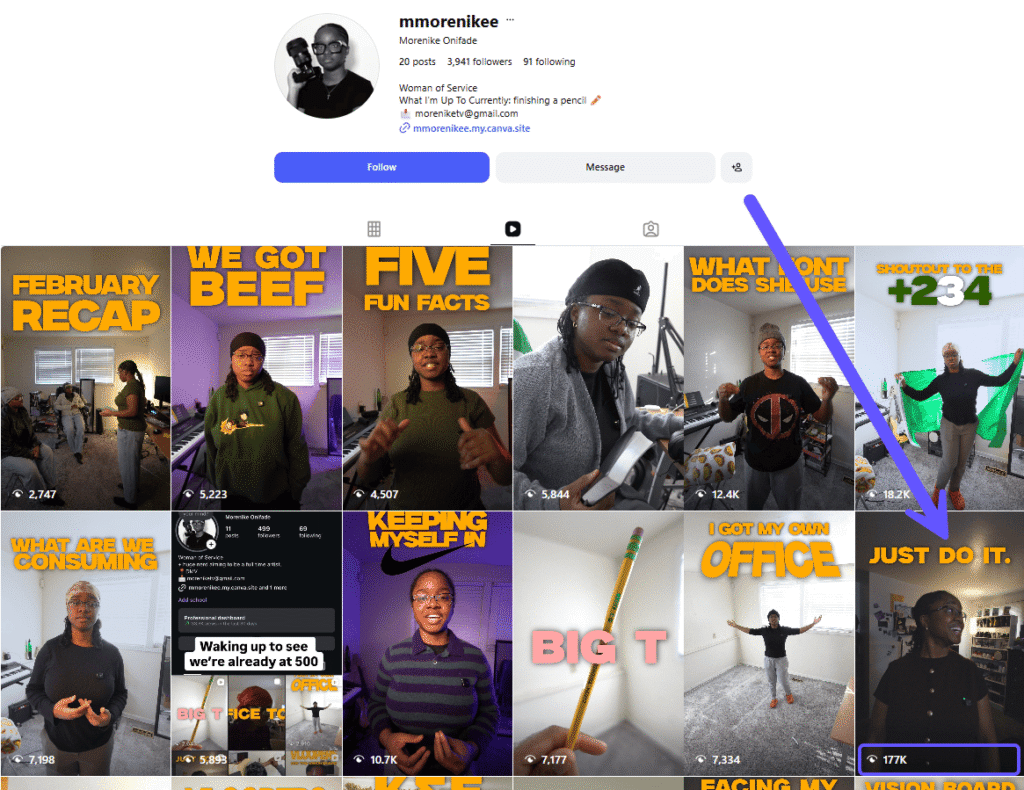
Pro tip: Select three Creators in your niche. Identify their top three performing Reels or top posts from the last 60 days. Compare them side by side. Structural patterns will emerge.
Step 2: Break the Reel Into Components
Dissect the Reel or video clip frame by frame. You can even screen-record the Reel and replay it slowly to analyze its pacing and structure.
Pause it and outline:
- 0–3 seconds: What happens immediately? Text overlays on screen? Bold claim? Expression? Motion?
- 3–10 seconds: Does it escalate? Tease? Clarify?
- Midpoint: Is there a shift, twist, or transformation?
- Final seconds: Is there a resolution, lesson, or punchline?
Most viral reels follow a compressed arc:
Hook → Build → Shift → Payoff
For example:
- Hook: “Most Creators are wasting hours editing.”
- Build: Show the over-editing process.
- Shift: “Here’s what actually matters.”
- Payoff: A clear 3-step method.
Outlining it this way removes noise and gives you structure.
Step 3: Identify the Retention Driver
Every viral Reel relies on at least one retention driver.
These are typically a:
- Curiosity gap
- Delayed reveal
- Relatability trigger
- Rapid pacing
- Visual contrast
- Pattern interruption
Your job is to identify which driver is doing the heavy lifting. For example:
If a Reel shows a messy desk transitioning into a clean workspace, the retention driver is visual transformation.
If a Reel opens with “I tested 10 hooks. Only one worked,” the retention driver is curiosity resolution.
Once you isolate the retention driver, you can apply it to different topics within your niche.
Step 4: Translate the Pattern, Not the Topic
This step is critical. If a fitness Creator posts:
“POV: You said you’d start Monday.”
The topic is fitness. The pattern is shared procrastination.
You can translate that into:
- “POV: You said you’d post consistently this month.”
- “POV: You said you’d finally start your newsletter.”
- “POV: You said you’d stop overthinking your content.”
The emotional core stays consistent, but the surface-level context shifts. This is pattern transfer.
Think of it like using the same architectural blueprint to build different houses. The layout stays the same—it’s just the details that change.
When you focus on structure instead of topic, formats become reusable across niches. That shift makes it easier to create content consistently without starting from zero every time.
Step 5: Script With Intentional Friction
Retention is engineered. During scripting, remove any sentence that doesn’t add tension or clarity.
Instead of saying, “Today I want to talk about something important for Creators…”
Start with, “If your Reels are stuck under 1,000 views, this is probably why.”
Specificity creates friction. Friction creates attention.
Then tighten your script further, making sure it has:
- Short lines
- Clear transitions
- No filler words or phrases
If you can’t summarize the core message in one sentence, the Reel needs sharpening.
Step 6: Pressure-Test the Hook
Before posting, isolate the first 3 seconds.
Ask yourself: If someone saw just this one line in their Reels feed, would they stop scrolling?
Small improvements in the opening often outperform expensive edits or visual upgrades later in the video. Reach begins with that first line.
Pro tip: Write three alternative hooks for the same Reel. Select the one that’s most specific and tension-driven.
Step 7: Optimize the Frame Around the Reel
Once your structure is strong, reinforce it externally.
- Make the cover text and cover photo echo the hook
- Keep captions value-driven and aligned with the core message
- Use relevant hashtags strategically, not excessively
- Add a subtle call to action tied to the Reel’s purpose

For example, if the Reel delivers tactical advice, prompt viewers to save it. If it introduces a perspective shift, invite discussion.
Align the call to action with the emotional tone of the Reel.
Using AI to Create Viral Instagram Reels Faster
Manually creating Reels can be incredibly time-consuming.
You have to:
- Scroll for outliers
- Break Reels down frame by frame
- Extract patterns
- Rewrite structures
- Refine hooks
- Script from scratch
That process can take hours for a single post. AI speeds up this process by helping you recognize patterns, iterate on ideas, and create faster.
Where Creators Lose Time
Most Creators lose time creating by:
1. Endlessly scrolling for inspiration
They recognize something works but can’t articulate why.
2. Starting from a blank page
Even with a solid idea, structuring it becomes a bottleneck.
3. Over-editing weak foundations
They spend time polishing visuals before fixing what actually matters—the hook and the structure. AI helps you focus on the right things first, so you’re not dressing up a Reel that was never going to hold attention in the first place.
How AI Compresses the Workflow
Consider a Reel structured like this:
- Hook: “I wasted 6 months doing this.”
- Build: Show the failed process.
- Shift: “Here’s what actually worked.”
- Payoff: A clear 3-step framework.
Without AI, you’d have to spend time:
- Rewriting it for your niche
- Tightening the hook
- Adjusting pacing
- Scripting transitions
But with AI, you can:
- Generate five alternative hooks instantly
- Translate the framework into your industry
- Adjust tone to match your voice
- Refine script length for retention
The structure stays the same. You just get there faster.
The Key Advantage: Iteration
Virality is typically the result of iteration.
AI allows you to:
- Test multiple hook angles for the same idea
- Create variations of a winning format
- Rapidly refine weak sections
The faster you iterate, the faster you learn what works. And that’s what drives growth.
Where Stanley Fits In
Generic AI tools can help you brainstorm. But the real leverage comes when the AI already knows your niche, your past content, what’s performing in your space, and how to adapt a pattern to your brand—not just copy it.
That’s what makes Stanley different.
Because Stanley’s connected to your Instagram, it already has that context. So instead of spending hours manually hunting down viral Reels to analyze, you can surface proven formats and turn them into scripts tailored to your audience—without starting from scratch every time.
That gap between inspiration and execution is where most Creators get stuck. Stanley closes it.
Inside Stanley’s Viral Reels Inspiration Engine
Understanding patterns is one thing. Consistently executing on them—without spending hours doing it—is another.
Stanley’s viral Reels workflow is built to close that gap. Instead of starting from a blank page or a general best practice, you start from your personal data and what’s already working with your audience.
The Discovery Layer
Most Creators spend hours each week scrolling their feed looking for content ideas they can put their own spin on. It’s one of the most time-consuming parts of the job—and most of the time, you’re not even sure what you’re looking for.
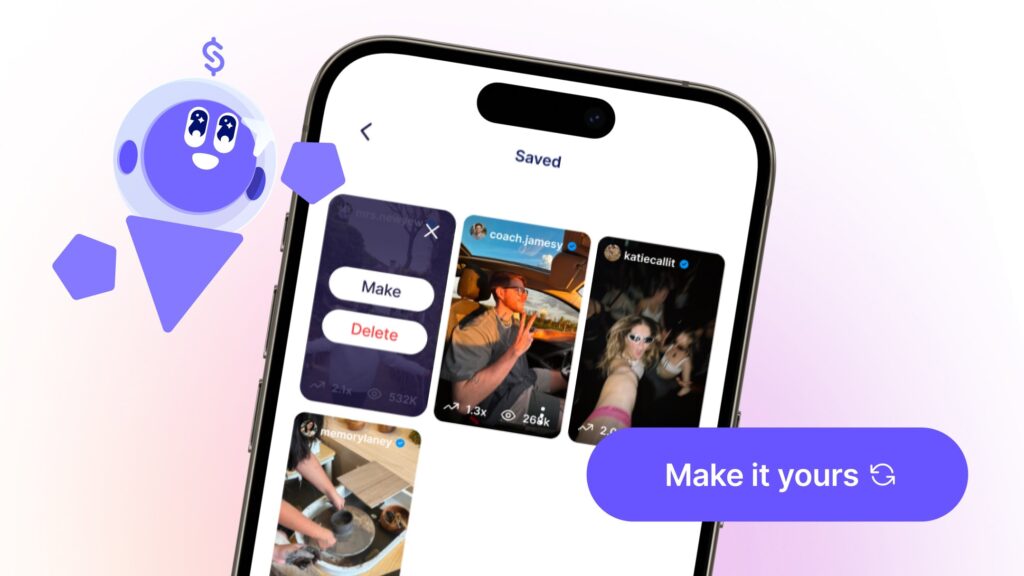
Stanley’s outlier feature removes that guesswork. Because Stanley already knows your niche and goals, you can ask it to surface top-performing videos from Creators in your space—so you’re never stuck scrolling for inspiration again. Just prompt Stanley with: “Show me today’s top performers in my niche.”
And when you come across a Reel you like while you’re scrolling on your own? Don’t save it to a folder you’ll never open. DM it directly to @StanleyForIG on Instagram instead. Stanley will store it, break down why it worked, and help you recreate it in your own voice—all from the Saved tab in your Stanley app.
So the question stops being “What’s trending?” and becomes “What’s performing in my niche—and how do I make it mine?”
The Pattern Transfer Layer
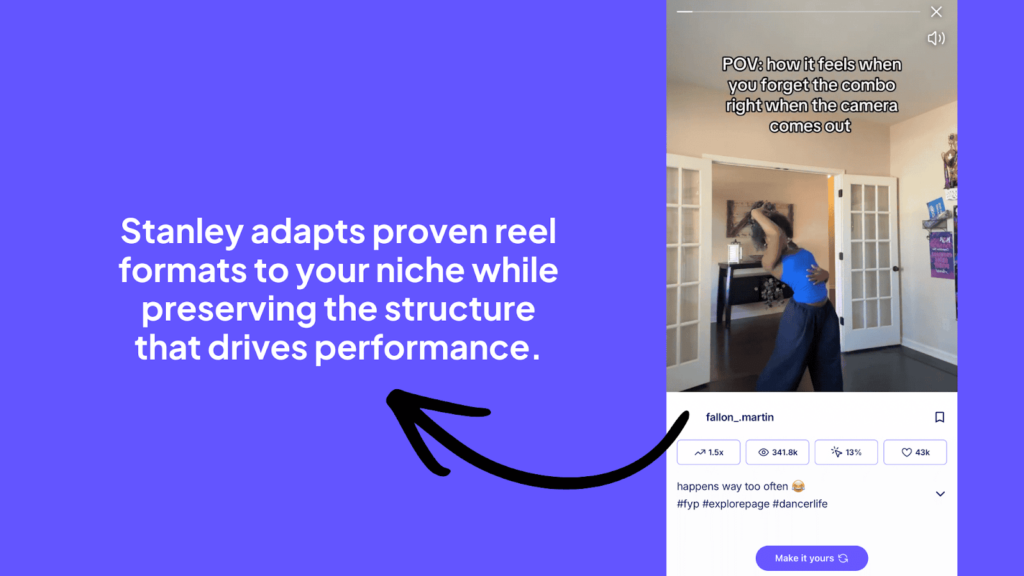
This is where inspiration becomes execution. When you tap “Make it yours,” Stanley does more than rewrite a caption. It:
- Identifies the format (POV, transformation, authority hook, micro-story)
- Extracts the structural arc
- Preserves the retention mechanism
- Adapts the concept to your niche
For example: If the original reel is a POV about quitting a 9–5 job, Stanley recognizes the emotional milestone structure.
It can adapt that arc into:
- Landing your first client
- Posting your first reel
- Reaching your first revenue milestone
The topic shifts, but the structure remains intact. That’s pattern transfer at scale.
The Execution Layer
Most AI tools stop at idea generation. But Stanley can help you execute—writing hooks, captions, and scripts that actually sound like you.
It already has context on your brand, voice, and performance, so you can get posts out of a chat loop and into your feed faster.
Why This Workflow Matters
Manual reverse-engineering works. But it takes time most Creators don’t have.
Stanley does the heavy lifting for you—surfacing high-performing Reels, breaking down why they work, adapting the structure to your niche, and generating a script in your voice. You go from scrolling for inspiration to having something ready to film.
If you’re ready to stop doing this manually, try Stanley free and see what it can do for your workflow.
How to Turn Viral Instagram Reels Into a Repeatable System
One viral Reel can shift momentum. A repeatable system shifts trajectory.
That’s why you should build a framework that makes strong performance more predictable over time. Here’s how to turn everything you’ve learned into a scalable system—and how Stanley can help you build it faster.
1. Build a Library of Top-Performers
When you find a high-performing Reel in your niche, log it. You’ll want to capture:
- The hook format
- The structural arc
- The retention driver
- The topic category
- Why it likely performed well
Stanley makes this easy. When you spot a Reel you want to study while you’re scrolling, DM it to @StanleyForIG on Instagram. Stanley will save it to your Saved tab, analyze why it worked, and help you turn it into your own content when you’re ready—no spreadsheet required.
Over time, you’ll notice a pattern. The hook styles that outperform others. The pacing structures that hold people longer. The emotional triggers that get more shares.
This becomes your database, so instead of asking, “What should I post this week?” you start asking, “Which proven pattern am I deploying next?”
2. Create Format Buckets
Group your library into format categories, like:
- Relatable POVs
- Tactical breakdowns
- Micro-story lessons
- Authority hooks
- Transformation reveals
Then, rotate them intentionally.
For example:
- Week 1: POV
- Week 2: Tactical
- Week 3: Story
- Week 4: Transformation
This prevents creative fatigue and keeps your content diverse. It also helps you identify which categories consistently drive stronger results.
3. Batch Scripts Using AI
Once you’ve picked a format for the week, don’t just script one version of it. Script three or four. Same structure, different angles.
For example, if you’re working with an authority hook format:
- Variation 1: Target beginners
- Variation 2: Target intermediate Creators
- Variation 3: Address a common mistake
This way you’re testing what resonates without reinventing your whole approach each time. Tell Stanley which format you’re working with and it’ll help you script multiple variations in your voice—so you can batch a whole week of content in one sitting.

4. Track Retention, Not Just Views
Views tell you who saw your content—retention tells you why.
After publishing, review:
- Where viewers drop off
- Which Reels generate more shares
- Which hook structures outperform others
Ask Stanley to analyze your recent posts and it’ll break down what’s actually worth doubling down on—so you’re not left guessing. Small improvements in the first three seconds can significantly affect distribution. If one hook format consistently holds attention longer, elevate it in your rotation. Iteration strengthens the system over time.
5. Stack Winning Formats Into Series
When a structure performs consistently, turn it into a recurring format.
For instance, if your “POV: Creator edition” posts drive strong engagement, expand it into a long-term series. If authority-based hooks generate discussion, build a sequence around them.
Series create familiarity. Familiarity increases watch-through. Watch-through increases distribution.
That compounding effect is how consistent viral Instagram Reels are built.
Common Mistakes to Avoid When Creating Viral Instagram Reels
Most Reels underperform because attention leaks from the structure.
When performance dips, the issue is usually mechanical: weak hooks, slow pacing, unclear payoff, or inconsistent format testing.
Improvement comes from removing friction in your process.
Here are the most common mistakes to avoid:
1. Starting With Context—Not A Hook
The first 1–3 seconds of your Reels determine whether they get reach.
Viewers scan quickly for relevance. If you don’t grab the audience’s attention immediately, its distribution will slow.
This usually happens when you lead with weak openings, like:
- “Hey guys, so today I wanted to talk about…”
- Starting mid-thought without text context
- Generic lines like “Let’s discuss something important.”
Strong hooks accomplish at least one of three things immediately:
- Identify the viewer
- Identify the problem
- Create tension
Within seconds, viewers should understand what your video is about and why they should keep watching.
Pro Tip: Mute your Reel. Watch only the first two seconds. Ask yourself, “Is it immediately clear who this is for?”
2. Copying Trends Instead of Translating Patterns
Trending music and audio can support distribution, but structure is what ultimately drives retention.
Many Creators assume using the same sound as a viral Reel increases performance. In practice, audio rarely carries results on its own.
When you replicate a trend without understanding why it worked, you copy the surface instead of the mechanism.
Let’s say a viral Reel follows this structure:
Hook → Relatable frustration → Quick visual shift → Punchline
If you reuse the audio but remove tension or delay the payoff, the structure changes and the format weakens.
To strengthen your approach:
- Identify the hook type
- Isolate the retention driver
- Pinpoint the payoff
- Adapt the structure to your niche
Then ask yourself: If the audio were removed, would this Reel still hold attention?
3. Overexplaining Instead of Progressing
Many Reels lose momentum because nothing evolves.
The Creator talks. The frame stays static. The message unfolds slowly.
High-performing Reels progress. They often feel fast-paced, even when the topic is simple.
Progress can look like:
- A new insight every few seconds
- A visual shift
- Escalating tension
- A transition from problem to solution
- A delayed reveal
If the middle of your Reel feels like a paragraph, retention declines. Viewers lose interest when progression stalls.
Short-form content compresses movement, not just information. Instead of explaining why hooks matter for 10 seconds, show:
- A weak hook
- A sharper rewrite
- The contrast in impact
Contrast creates motion. Retention improves when progression is clear.
Pro Tip: Watch your Reel at 1.5x speed. If it still feels slow, tighten it.
4. Weak or Delayed Payoffs
If your Reel builds tension but fails to close the loop on your point clearly, saves and shares decrease.
That might look like:
- Ending immediately after raising a strong question
- Offering generic advice after a sharp hook
- Skipping a clear takeaway
A strong payoff feels earned and specific.
If you lead with a hook like, “Here’s why your Reels aren’t growing.”
Your Reel should clearly outline the mistake, reason, or correction.
Before publishing, ask yourself: What single point could someone take away after watching this?
If that point lacks clarity, refine the ending.
5. Inconsistent Format Testing
If every Reel uses a different structure, performance becomes difficult to interpret.
One week it’s a POV. The next week a tutorial. Then a trend remix. Then a talking-head breakdown.
Constant format shifts create noisy data.
Instead, test in clusters. For instance, you could try creating multiple Reels with different angles but this same structure:
Authority hook → Problem → Framework → Outcome
Afterwards, you can evaluate:
- Which hook phrasing performs best
- Which topic variation drives more shares
- Where retention drops
Consistency isn’t just about creating familiarity for your audience—it’s about giving you clear insights, too.
6. Using AI Without Structural Awareness
AI can speed up content creation—but you still have to be careful about preserving your content’s quality.
A broad prompt like, “Write a Reel about productivity,” will give you a broad output.
But a structured prompt like, “Write a 25-second Reel using an authority hook, escalating tension, and ending with a 3-step framework,” will give you something you can actually use.
That’s what makes Stanley different from generic AI tools. It already knows your niche, your audience, and what’s performing in your space—so instead of starting from a blank prompt, you’re working with a tool that understands the context behind your content. You get sharper outputs, faster, without having to engineer every prompt from scratch.
The Future of Viral Instagram Reels Is Pattern + AI
Instagram continues to become more competitive—with more Creators. More content. More noise. And your Reels’ success all comes down to retention and relevance.
Today’s top Creators consistently use proven formats, learn from their data, and iterate quickly. That’s where you can use AI to your advantage.
Stop guessing at what might go viral and start creating Reels with proven top-performing formats. Use a tool like Stanley—one that already knows your niche, your audience, and what’s performing in your space—and you’ve got a system that compounds over time.
Ready to put it into practice? Start a 14-day free trial of Stanley and turn proven formats into publish-ready Reels consistently.
FAQ: Viral Instagram Reels
Viral Instagram Reels typically have strong hooks, high retention, and clear share-ability. Formats like POV, transformation reveals, micro-stories, and authority hooks perform well because they sustain attention and deliver a defined payoff.
To make Instagram Reels go viral, focus on three factors: a scroll-stopping hook, structured progression that holds retention, and a strong payoff that encourages shares or saves. Consistent testing of proven patterns increases your chances of distribution and helps you gain followers over time.
To find viral Instagram Reels, study outliers in your niche. Look for posts that significantly outperform a Creator’s average views. Analyze their hook structure, pacing, retention driver, and format repetition rather than just the topic.
Hashtags do not directly make Reels go viral. They help with discoverability and context. Virality is primarily driven by retention, engagement, shares, and watch time. Strong structure matters more than generic hashtags.
Most Reels fail due to weak hooks, slow pacing, unclear audience targeting, or lack of a strong payoff. Low early retention prevents the algorithm from expanding distribution. Improving the first 3 seconds often has the biggest impact.
Virality is relative to account size. For a small account averaging 1,000 views, 10,000 views can be considered viral. For a large account with 500,000 followers, it may not be. Context and baseline performance matter.
To increase Reel views and increase engagement, optimize hook clarity, improve retention structure, deploy repeatable formats, and test variations consistently. Using AI tools like Stanley can accelerate pattern identification and structured scripting to improve performance faster.